

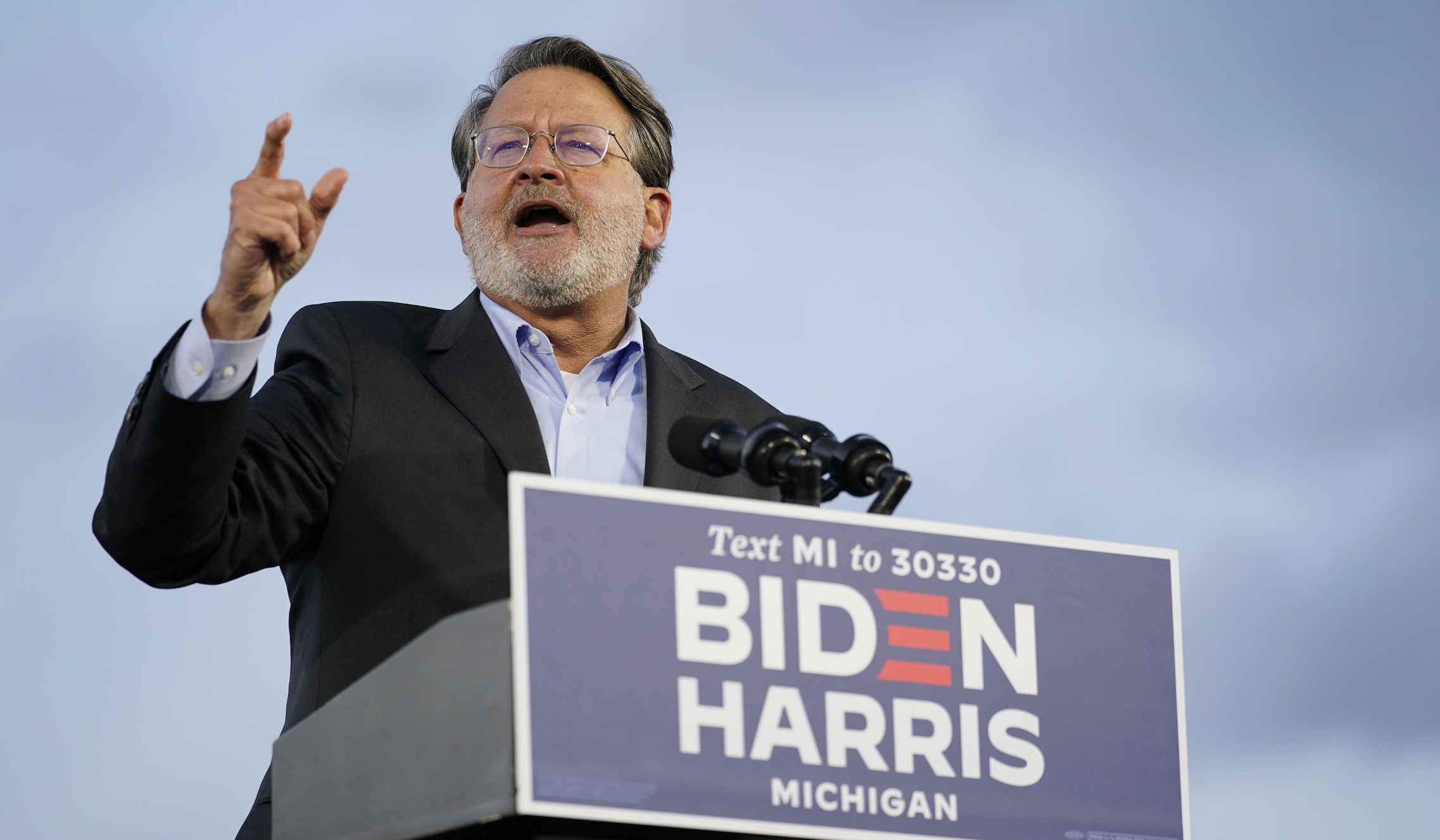
Michigan and Minnesota’s importance to Tuesday’s election between President Trump and Democratic presidential nominee Joe Biden has overshadowed their role in deciding Senate control.
Biden, the two-term vice president and 36-year Delaware senator, planned several stops in Michigan and Minnesota during his final weekend on the campaign trail to boost his support in the Upper Midwest. His visits also benefit down-ballot Democrats who could help him push a liberal agenda through Congress should he be elevated to the White House after Tuesday’s election.
Recommended Stories


Democrats need to gain three to four Senate seats for a majority. But the Michigan and Minnesota races haven’t earned the national attention of some of their counterparts across the country.
That could be because Michigan Democratic Sen. Gary Peters leads Republican Army veteran and businessman challenger John James by an average of 7.6 percentage points, according to RealClearPolitics. Two states over in Minnesota, Democratic Sen. Tina Smith is ahead of former Republican House lawmaker and incendiary radio host Jason Lewis by an average of 6.3 points.
Yet after 2016’s shock election results and a once-in-a-century coronavirus pandemic, the campaigns and pundits aren’t sure whether conventional wisdom will hold.
Matt Grossmann, the director of Michigan State University’s Institute for Public Policy and Social Research, said Michigan’s Senate race had become less competitive based on crossover voter trends.
“James was generating some support from Biden voters, but it now looks like he’ll have to rely on a surprise from Trump,” he told the Washington Examiner.
In a race so connected to the presidential contest, Grossmann thought it was interesting both candidates had tried to distance themselves from their national colleagues, “with Peters running on some local issues and James running on his background.”
Grossmann, though, said their efforts were mostly in vain since “millions of dollars of negative ads” had caricatured them as “generic Democrats and Republicans” — though Peters’s interview with Elle magazine this month in which he became the first sitting senator to share a personal experience with abortion went viral.
Jonathan Hanson, a Michigan University public policy lecturer, agreed the White House race had eclipsed Michigan’s Senate one. That’s despite the Michigan Campaign Finance Network projecting that it would be the state’s most expensive Senate contest at an estimated $100 million.
The James campaign’s ads have attempted to pigeonhole Peters as a career politician “who enjoys the perks of being a senator but votes against the interests of Michiganders,” Hanson explained.
“Peters responds that James blindly follows Donald Trump, reminding voters that James once said he ‘supports Trump 2,000%,'” Hanson said. “When pressed on the details of policy stances, James struggles to answer, and so, the Peters campaign has basically said that James is an empty suit.”
The outcome of the race, which continues to poll within the margin of error, may not be known until Friday. That’s due to the delay caused by counting an expected 2 million absentee ballots over votes cast in person. And the latter tends to be the preferred voting method of Republicans.
“In the end, it depends on how close the presidential race is. If Biden runs really strong in Michigan, Peters is likely to have wind behind his sails as well,” Hanson said. “I expect James to run a few percentage points stronger than Trump. The question is whether that’s enough to put him over the top.”
For Lawrence Jacobs, the director of the University of Minnesota’s Center for the Study of Politics and Governance, his state’s Senate race “was a sleeper until it woke up.”
Smith’s “relatively quiet campaign” is relying heavily “on riding Joe Biden’s coattails,” Jacobs told Washington Examiner.
“She’s let her opponent hang around without using his past impolitic comments about women against him — as have previous Democrats,” he said.
While Biden has consistently carved out a narrow 5- to 7-point edge on Trump since October, Jacobs cited SurveyUSA polling tracking a precipitous drop in Smith’s advantage over the last seven weeks, from 11 points to 7 points to 3 points.
“It fell as low as 1 point 10 days ago,” he said.
Eric Ostermeier, who curates the Minnesota Historical Election Archive and writes the Smart Politics blog, said, like Michigan, his state’s Senate race was tied to the presidential contest.
“It would be difficult to imagine Jason Lewis defeating Tina Smith if Donald Trump at the top of the ticket loses by 5 to 7 points. However, if the presidential race ends up being, say, a 2-point margin, then Lewis unseating Sen. Smith is on the table,” he said.
Even though Lewis hasn’t distanced himself from Trump, Ostermeier said ticket-splitting was still a distinct possibility for him and other Republican candidates down-ballot.
“If that’s the case, one could envision Lewis outperforming the president and picking up a few points vis-a-vis the top of the ticket, which could be decisive if the overall tilt of the state this cycle is less blue than conventional wisdom and many polls suggest,” he added.
Although Lewis may have earned some sympathy after being hospitalized with a potentially life-threatening hernia, Ostermeier said high turnout was anticipated to assist Democrats at the margins.
Alabama Democratic Sen. Doug Jones is likely to lose his seat to Republican former Auburn University football coach Tommy Tuberville. GOP Sens. Martha McSally of Arizona and Cory Gardner of Colorado are similarly predicted to be defeated by Democratic ex-astronaut Mark Kelly and two-term Colorado Gov. John Hickenlooper, respectively.
And Republicans are in trouble elsewhere on the map too.
Other toss-up races include those featuring Republican incumbent Sens. Susan Collins of Maine, Steve Daines of Montana, Joni Ernst of Iowa, Thom Tillis of North Carolina, and Lindsey Graham of South Carolina, as well as Kelly Loeffler and David Perdue, both of Georgia.
