

Senators in both parties could be considering a split verdict Wednesday when lawmakers vote on two articles of impeachment against President Trump.
Trump was impeached on two articles charging him with abuse of power and obstruction of Congress, but lawmakers will have the chance to uphold one charge while rejecting the other.
Recommended Stories


For both parties, a split vote may provide an opportunity to escape the political risks associated with convicting the president in full or acquitting him of both charges.
It’s not unprecedented.
Four Republicans split their vote on two of their party’s impeachment articles against President Bill Clinton in 1999.
“I think each Democrat is going to make up his or her own mind,” Senate Minority Leader Chuck Schumer, a New York Democrat, said Monday after the conclusion of closing arguments in the 12-day impeachment trial. “This is an issue of conscience to everybody.”
The second article arguing obstruction of Congress is considered the weaker of the two charges.
Sen. Marco Rubio, a Florida Republican, called it “a joke,” while lawyers for the president argued it violates the separation of powers by forcing the president to turn over information protected by executive privilege.
“I will be very surprised if there are not more than just a few Democrats that vote to acquit on that,” Rep. John Ratcliffe, a Texas Republican and a member of the Trump defense team, said after the trial concluded Monday. “I think you are going to see a number of Democrats peel off. ”
House impeachment managers, in a rush to pass the impeachment articles by Christmas, abandoned efforts to get the court to decide whether Trump had the right to block witnesses and documents.
They argued at the time that Trump’s behavior is a threat to the security of the 2020 election.
“For the sake of the Constitution, of the office of the president, this body must stand against this reckless and dangerous proposition,” Trump’s personal lawyer and member of his impeachment defense team, Jay Sekulow, argued in the Senate Monday. “It doesn’t just affect this president but every man or woman who occupies that high office.”
For some senators from swing states, their vote on the articles could affect their political survival, which makes a split vote an attractive option.
At least three Democratic senators from states that voted for Trump may be considering acquitting the president on at least one of the charges. Sens. Joe Manchin of West Virginia, Kyrsten Sinema of Arizona, and Doug Jones of Alabama are weighing acquittal on at least one of the charges.
Jones is the most vulnerable Democrat up for reelection in a state that heavily favors Trump. Manchin’s future political plans are uncertain. West Virginia voted overwhelmingly for Trump in 2016.
Manchin, on Monday, called for censuring Trump, noting there will never be the 67 needed votes to convict him. Manchin said he was undecided on how he plans to vote Wednesday.
On the Republican side, Sen. Susan Collins, a Maine Republican, is considered one of the most vulnerable lawmakers in her party who is up for reelection in November. Her race is considered a toss-up. Maine voters were nearly split on Trump in 2016. Hillary Clinton won the state with about 48% of the vote, compared to Trump’s 45%.
Collins was one of only two Republicans who voted with Democrats on Friday in a failed bid to keep the trial going by calling additional witnesses.
Collins is still weighing whether to acquit the president and is expected to announce her decision on Tuesday.
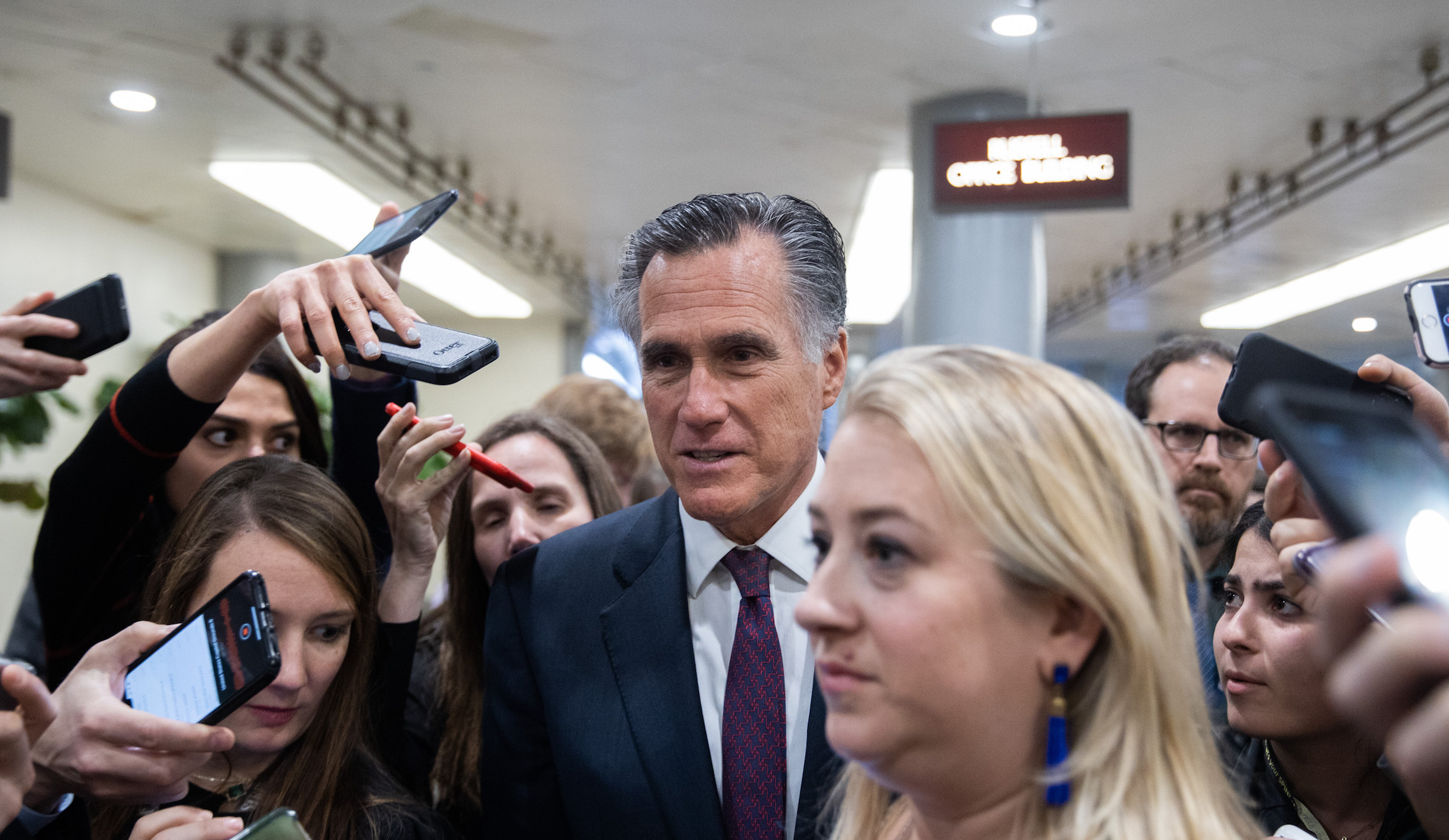
Sen. Mitt Romney, a Utah Republican, voted with Collins to call more witnesses and could be considering splitting his vote.
A representative did not return a request for comment about Romney’s deliberations.
Romney, a regular critic of the president, was interested in hearing from former national security adviser John Bolton, who is alleged to confirm in his upcoming book some of the abuse of power allegations made against the president.
In October, he accused Trump of making a “brazen and unprecedented appeal” to both China and Ukraine to investigate Joe Biden.
Romney called the effort “wrong and appalling.”
Romney was just elected to the Senate and doesn’t face voters for another five years. But Utah isn’t squarely in Trump’s camp.
The Salt Lake Tribune and Suffolk University released a poll late last month showing 57% of Utahns “now say they support him as the Senate continues the trial on abuse of power and obstruction of Congress allegations based on his dealings with Ukraine.”
The Clinton impeachment trial in 1999 produced several split votes, but only among Republicans.
Sens. Richard Shelby of Alabama, Fred Thompson of Tennessee, Slade Gorton of Washington state, and John Warner of Virginia all voted not guilty on Clinton’s perjury charge and guilty on the obstruction of justice charge against the president. Clinton was acquitted of both charges.
