

• New Hampshire primary results
• ‘Tactical voters’ went for Romney in Granite State
• Attacks on Romney now shift to South Carolina
• Economic concerns fuel voters’ decisions in N.H.
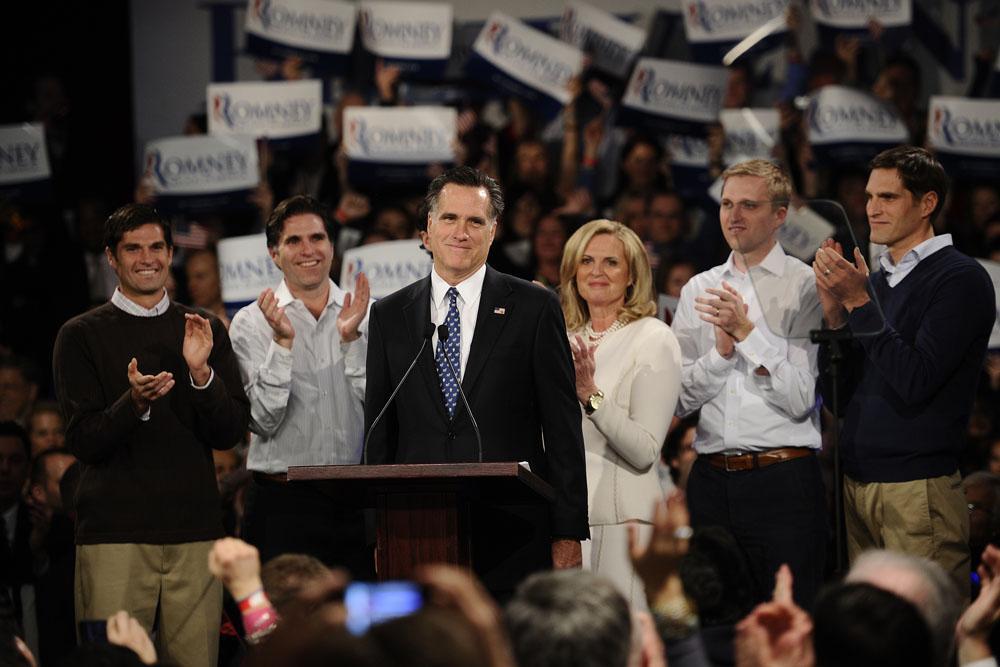
MANCHESTER, N.H. – Republican presidential contender Mitt Romney cruised to victory in the New Hampshire primary Tuesday, earning 38 percent of the vote despite fierce efforts by rivals to slow his march to the party’s nomination.
“Tonight we made history,” Romney told cheering supporters in Manchester.
With his victory in the Granite State, Romney became the first Republican candidate since 1976 to win both the Iowa caucuses and the New Hampshire primary and many are predicting that he could secure the nomination by the end of January if he does well in the upcoming primaries in South Carolina and Florida.
Romney, a former governor of neighboring Massachusetts who was heavily favored in New Hampshire, scored a double-digit victory over five GOP opponents, according to unofficial returns. With 70 percent of precincts reporting, Romney had 38 percent of the vote.
Rep. Ron Paul, the libertarian-leaning candidate with a fiercely loyal following, won the pivotal race for second place with 24 percent of the vote.
Former Utah Gov. Jon Huntsman, who focused his back-of-the-pack campaign exclusively on New Hampshire, finished third with 17 percent. “Ladies and gentlemen,” Huntsman told enthusiastic supporters, “I’d say third place is a ticket to ride.”
Former Sen. Rick Santorum of Pennsylvania, who only narrowly lost Iowa to Romney but stumbled in a state with far fewer evangelical voters, was fighting former House Speaker Newt Gingrich for fourth place. Both had 10 percent of the vote with 70 percent of precincts reporting. Texas Gov. Rick Perry did not campaign in New Hampshire and finished last with 1 percent.
South Carolina, whose primary is Jan. 21, is now a must-win state for Gingrich and Santorum as well as Perry.
The three, all of whom offered themselves as conservative alternatives to Romney, are hoping that the Palmetto State’s heavy concentration of religious and socially conservative voters will help them keep their campaigns afloat. Santorum has already spent $1 million on television ads in South Carolina after spending almost nothing in New Hampshire.
While Huntsman, a moderate, is unlikely to do well in South Carolina, he could survive until Florida, where there is a more secular and moderate electorate.
Paul hailed his second-place finish as a victory for liberty and told supporters that he will continue to chase Romney to South Carolina.
“We are nipping at their heels,” Paul told his supporters.
Romney was widely favored in New Hampshire. He served as governor of neighboring Massachusetts from 2003 to 2007 and spent millions of dollars and months of his time campaigning across the state. He’s likely to face a tougher challenge in South Carolina, where many voters still question his commitment to conservative principles.
“Tonight we celebrate,” Romney said, “tomorrow we go back to work.”
“South Carolina won’t be a slam dunk for Romney,” University of Virginia political science professor Larry Sabato said. “But if he wins that and Florida, it’s all over but the convention shouting. You never close down a campaign until the delegates are in hand, but this is a weak group of opponents. It’s hard to see how any of them catch Romney.”
