

EXCLUSIVE — U.S. Customs and Border Protection has achieved a remarkable feat under President Donald Trump, locking down tens of billions of dollars in funding for the largest-ever expansion of border security, while simultaneously bringing the number of illegal immigrant arrests at the southern border to 55-year lows for more than a year.
The Trump administration has used messaging, diplomacy, and policy to bring about those low illegal immigration numbers, and it is pursuing plans to fortify the international boundary with tens of billions of dollars worth of barrier, technology, agents, and other resources.
Recommended Stories


After a rocky few months of public relations challenges and sagging support for deportations, the Department of Homeland Security, under the new leadership of Secretary Markwayne Mullin, has pivoted to a quieter, more focused approach to fulfilling one of the president’s top agenda items.
CBP Commissioner Rodney Scott explained that a successful second term for Trump, and the nation, hangs on continuing to deliver results at the border and building up border security in a way that can continue to deliver results long after Trump leaves office.
On the southern border, Border Patrol agents have a motto: “If you’ve seen a mile of the border, you’ve seen a mile of the border,” meaning that no two miles of the 1,950-mile boundary are alike. That makes securing it that much more challenging.
In one such example, which Scott shared during a sit-down interview in his Washington office in late April, CBP will not build a border wall inside Big Bend National Park on the U.S.-Mexico border following blowback from local residents and repeated changes to the agency’s plans for that region.
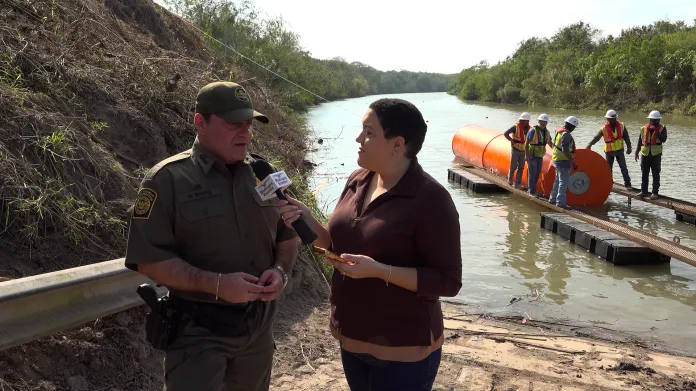
More than 75 miles of border wall and buoy barrier have been installed since January 2025, and plotting the path forward is more art than science.

Regaining control of the border
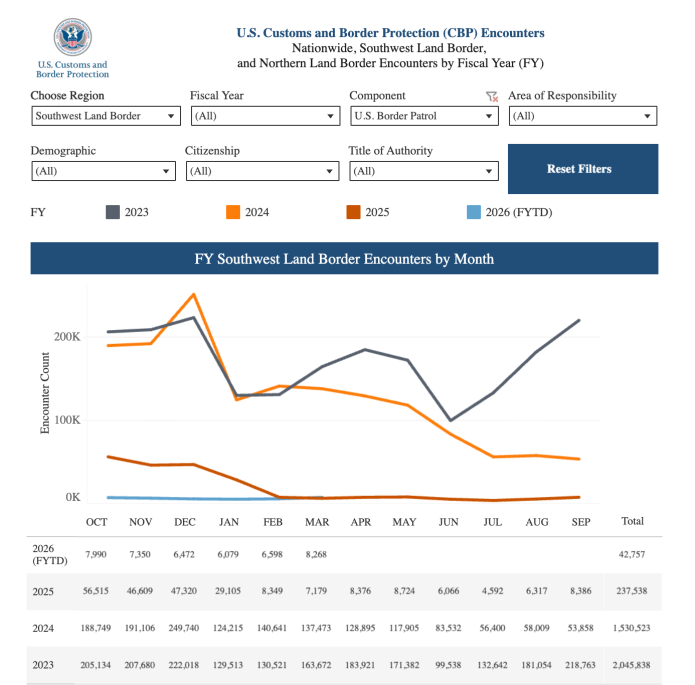
During the Biden administration, more illegal immigrants were arrested by Border Patrol attempting to enter the United States between ports of entry than during any other administration. In December 2023, just shy of 250,000 people were arrested entering illegally, CBP data show.
In former President Joe Biden’s final six months, his administration imposed select controls to disincentivize migrants from traveling to the U.S., and arrests at the southern border dropped to below 50,000 per month, which was more in line with historic monthly norms.
Trump took office in January 2025 and imposed a dozen immigration executive orders and vowed to carry out the “largest-ever” deportation operation in history, a project he had not undertaken in his first term.
“I’m not trying to be political or blow smoke or anything else,” Scott said, seated in his office blocks from the White House. “The secret sauce is a president that literally implemented policies and said, ‘This isn’t just for CBP. This is the administration’s policy. … I don’t care if you’re Health and Human Services. I don’t care if you’re IRS. Everybody is going to attack this problem together.’”
“In prior administrations, CBP, Border Patrol would get support, and we would talk strong on border security. But then none of the other agencies that could play a role in border security were really held to account,” Scott added. “I believe the president learned during his first term that the last year is really when everything started gelling and we started making a real impact.”
Between February 2025 and March 2026, monthly arrests have ranged from 4,500 to 9,000, as low as or even lower than rates seen prior to 1970.
Cartels respond to border lockdown
Scott spent two days at the end of April on the southern border with Mullin, who became DHS’s new secretary in March. Scott previously worked during Trump’s first term as national chief of the U.S. Border Patrol, which has roughly one-third of CBP employees.
Now, as CBP commissioner, he oversees an agency of 68,000 employees and the largest police force in the nation, including customs at airports, seaports, and land ports of entry. Following the Internal Revenue Service, CBP’s facilitation of trade and travel makes it the nation’s second-largest revenue generator.
Transnational criminal organizations in Mexico, or crime rings that move people and goods between countries known as cartels, have lost billions of dollars not being able to move people into the U.S. by way of the southern border.
Moving people across the border not only generates money for the cartels, but serves as a way to pull Border Patrol agents from one area to another, leaving vulnerable areas where they can run cash profits and guns southbound and push drugs into the U.S.
It’s one reason that CBP has made not just a physical barrier, but a broad array of technology, which is a huge part of its border security plan.
CBP anticipates more cross-border drug-smuggling tunnels, an increase in smuggling people and drugs via boats along the Gulf of America and Pacific coastlines, and concealing people and goods inside vehicles as they pass through land ports of entry. The agency is working to procure technology that can detect these smuggling methods.
“We are anticipating a lot of that. We’re building that into our strategy,” Scott said. “They’re not going to just go away. No one just assumes that [the] cartel is going to be like, ‘Oh, they’ve locked down the border. We’re going to go home.’ That threat still exists.”
One of the ways that CBP has been able to get more officers at ports of entry on the front lines was by ending the Biden-era CBP One app, a phone app that allowed foreigners who had migrated into northern Mexico to request an appointment with a customs officer at a port of entry and seek permission to enter the country on a temporary parole basis.
“There were 1,400 people a day, so that was easily 1,400 hours a day put back into enforcement,” Scott said. “Those were man-hours shifted back to enforcement. So right now, on average, at a port of entry, I just looked at the numbers this morning, we’re doing about 10% more vehicle inspections and baggage inspections than we were doing just last year because we have more people.”
Border security plans
An interactive map on CBP’s website that previously showed the wall would run for hundreds of miles through the national park and the surrounding region of the border was updated earlier this year to show the region would instead be secured with “detection technology.” It was later changed to show a blend of wall and technology in the region, further confusing residents.
Sheriff Thaddeus Cleveland of Terrell County, a former Border Patrol agent, told the Washington Examiner in March that community leaders in the region, including five sheriffs, pleaded with the Trump administration not to build a wall through the natural landscape.
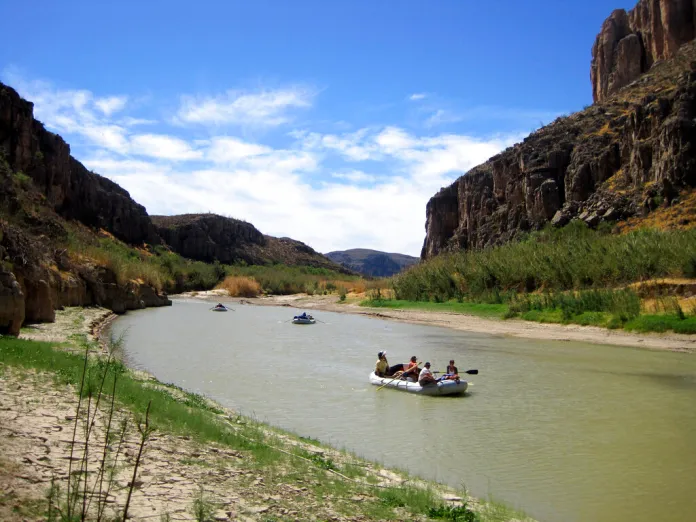
“We pulled it down [to] try to make [it] a little more clear,” Scott said. “Big Bend National Park has some just, like, unbelievably huge granite cliffs. It would be kind of silly to put like a 30-foot border wall on top of a 90-foot granite cliff. So what we’re trying to convey is that we are going to have meaningful border security in that entire area.”
For Scott, it has meant listening closely to what agents in the field say is necessary and how it will affect local communities.
In Big Bend National Park, CBP will pave roads along the border, as well as use more technology, such as drones, radars, cameras, and fiber-optic cables to monitor the area. Because it is such a remote area, anyone who crosses there cannot immediately disappear into a populated area or immediately access a highway. Border walls are often used in those types of areas, while technology is preferred in remote areas.
IMMIGRATION GROUPS THAT WANT MASS DEPORTATIONS BLAME BIG BUSINESS FOR DELAY
Beyond enhancing security at ports of entry, between the ports, and at sea and in the sky, Scott wants to achieve “stability” by freeing up some Department of War resources to leave the border and getting agents out on the frontlines by using artificial intelligence to help surveil and identify threats.
“One of the first things I did when I came as commissioner is mandate that any investments we make, I want to be able to see and measure a return on the investment in things that only a human can do, that it frees up our agents and officers to do things that only humans can do,” Scott said.
