

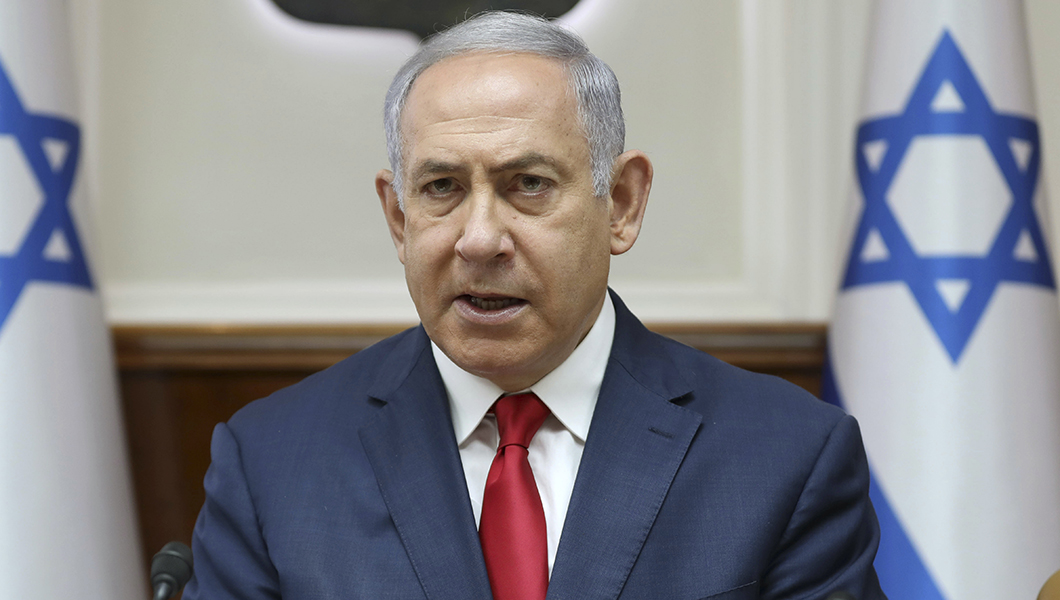
European leaders must exit the 2015 Iran nuclear deal and renew international sanctions on Tehran, Israeli Prime Minister Benjamin Netanyahu said, comparing the regime’s activities to the Nazi occupation of the Rhineland.
“Iran is brazenly violating the deal, so it’s time for Europe to do what they’ve promised to do,” Netanyahu said during a Monday address by satellite to the Christians United for Israel summit in Washington. “They promised to leave the deal and snap back sanctions if Iran did this.”
Recommended Stories


Netanyahu’s comments came hours after Iranian officials revealed they are enriching uranium at levels higher than the caps set by the 2015 accord. The illicit enrichment was a response to President Trump’s renewal of sanctions on the regime’s oil industry and nuclear program, raising the specter of Iran jump-starting its nuclear weapons program if the sanctions pressure continues.
The Israeli leader, who lobbied against the 2015 nuclear agreement throughout the negotiating process, likened the situation with Iran to the Nazi occupation of the Rhineland in 1936.
“Nobody said anything, nobody did anything, and you know the continuation, you know what followed,” he told the evangelical Christians assembled in Washington.
His speech was the latest in a diplomatic push for key Western European powers to stop trying to preserve the deal and instead join Trump’s effort to renew all international sanctions lifted when the agreement was implemented. France, Germany, and the United Kingdom have pledged to stay in the deal if Iran remains in compliance, despite U.S. sanctions.
“We are extremely concerned at Iran’s announcement that it has started uranium enrichment above the limit of 3.67%,” Maja Kocijančić, a spokeswoman for European Union top diplomat Federica Mogherini, said Monday. “We strongly urge Iran to stop and reverse all activities inconsistent with its commitments.”
The elevated enrichment of uranium follows Iran’s announcement that it would amass a larger stockpile of uranium than allowed under the deal. If uranium is enriched to sufficiently high levels, it can be used to make a nuclear weapon.
“There is the 20% option, and there are options even higher than that, but each in its own place,” Iran’s Atomic Energy Organization spokesman Behrouz Kamalvandi said Monday of uranium enrichment. “Today if our country’s needs are one thing, we won’t pursue something else just to scare the other side a little more. But they know it’s an upward trend.”
It’s the latest escalation in the two months since Trump’s administration announced the revocation of waivers that had allowed Iran to produce uranium and heavy water, two key materials for a nuclear program, provided that the regime’s excess supplies were shipped out of the country.
“This is what one of the problems was with the Iran nuclear deal: the ease in which Iran could reverse its nuclear program,” Jason Brodsky, policy coordinator at United Against Nuclear Iran, a U.S.-based nonprofit organization with ties to the Trump administration, said Sunday.
European allies, on the other hand, favored the deal because they credited the pact with defusing, or at least postponing, such a nuclear crisis. But they have also warned Iran not to expect that limited compliance with the deal will be tolerated.
“While the UK remains fully committed to the deal, Iran must immediately stop and reverse all activities inconsistent with its obligations,” a British diplomatic spokesman said Monday. “We are co-ordinating with other [nuclear agreement] participants regarding the next steps under the terms of the deal, including a joint commission.”
That process could lead to the ultimate destruction of the agreement, the signature foreign policy achievement of President Barack Obama’s tenure.
“We should stand up to Iran’s aggression now,” Netanyahu insisted. “And Europe should back the sanctions instituted by President Trump. We certainly do.”
