

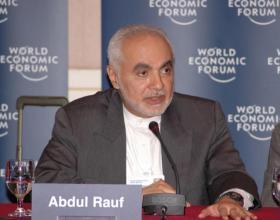
Christopher Hitchens doesn’t oppose the Ground Zero mosque, but he does want to draw attention to the endorsement by Feisal Rauf, the Ground Zero mosque imam, of Vilayet-i-faqih in Iran:
See Bill Kristol on Rauf’s defense of the Iranian regime here.
Meanwhile, via Drudge, a new video of Imam Rauf, saying: “We tend to forget, in the West, that the United States has more Muslim blood on its hands than al Qaida has on its hands of innocent non Muslims. You may remember that the US lead sanction against Iraq lead to the death of over half a million Iraqi children.”
A pithy takedown by Jim Geraghty:
Yes, U.S. taxpayers are spending $16,000 so Rauf can spread his “moderate” message.
Rauf’s full quote here, at Atlas Shrugs, which first posted the video:
Islamic law, the text of Islam, the Koran is quite explicit on describing Christians and Jews as people of the book, and throughout Islamic history even Islamic scholars in India have actually included Hindus as being people of the book because Hindus were not yet involved – were not part of the society, of Arabic society, at the time of the prophet.
The complexity arises, sir, from the fact that – from political problems and the history of the politics between the West and the Muslim world. We tend to forget, in the West, that the United States has more Muslim blood on its hands than al Qaida has on its hands of innocent non Muslims. You may remember that the US lead sanction against Iraq lead to the death of over half a million Iraqi children. This has been documented by the United Nations. And when Madeleine Albright, who has become a friend of mine over the last couple of years, when she was Secretary of State and was asked whether this was worth it, said it was worth it.
What complicates the discussion, intra-Islamically, is the fact that the West has not been cognisant and has not addressed the issues of its own contribution to much injustice in the Arab and Muslim world. It is a difficult subject to discuss with Western audiences but it is one that must be pointed out and must be raised.
How many of you have seen the documentary: Fahrenheit 911? The vast majority – at least half here. Do you remember the scene of the Iraqi woman whose house was bombed and she was just screaming, “What have they done.” Now, I don’t know, you don’t know Arabic but in Arabic it was extremely powerful. Her house was gone. Her husband, I think, was killed. What wrong did he do? I found myself weeping when I watched that scene and I imagined myself if I were a 15-year old nephew of this deceased man, what would I have felt?
Collateral damage is a nice thing to put on a paper but when the collateral damage is your own uncle or cousin, what passions do these arouse? How do you negotiate? How do you tell people whose homes have been destroyed, whose lives have been destroyed, that this does not justify your actions of terrorism. It’s hard. Yes, it is true that it does not justify the acts of bombing innocent civilians, that does not solve the problem, but after 50 years of, in many cases, oppression, of US support of authoritarian regimes that have violated human rights in the most heinous of ways, how else do people get attention?
So I’m not – I’m just providing you with the arguments that are happening intra Islamically by those who feel the emotion of pain. Half a million Iraqi – there’s a sense in the Arab and Muslim world that the European world and Western world is just – does not care about our lives or human lives. There’s a perception in much of the Arab world and the Muslim world that the issue is about race. That the Palestinian Israeli issue is less about religion than it is about race because about 25 per cent or more of the Palestinians or the Arabs are Christian. Many people in the West are unaware that Palestinians are not uniformally Muslim.
