

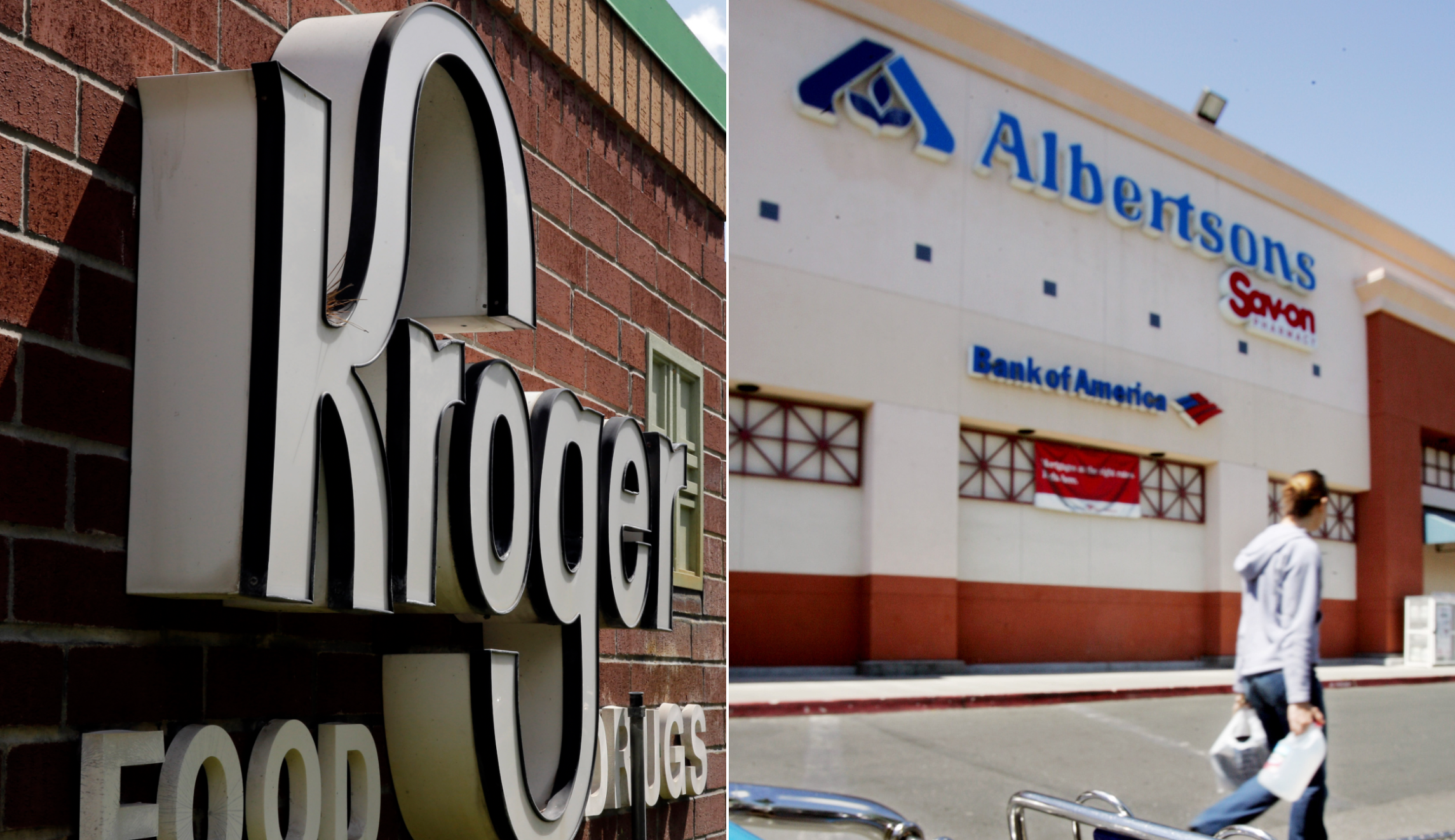
Kroger announced Friday that it is buying the Albertsons grocery chain for $24.6 billion.
Recommended Stories


The merger comes at a cost of $34.10 per share, which is a 19% premium according to a press release. As a result, the company will have 710,000 associates, 4,996 stores, 66 distribution centers, 52 manufacturing plants, 3,972 pharmacies, and 2,015 fuel centers across 48 states and the District of Columbia. Kroger was already among the largest supermarket operator in the U.S., and together with Albertsons will have a share of approximately 12% of the U.S. market share, according to 2021 statistics.
“Albertsons Cos. brings a complementary footprint and operates in several parts of the country with very few or no Kroger stores,” Kroger Chairman and CEO Rodney McMullen said of the merger. “This merger advances our commitment to build a more equitable and sustainable food system by expanding our footprint into new geographies to serve more of America with fresh and affordable food and accelerates our position as a more compelling alternative to larger and non-union competitors.”
PUBLIC INCREASINGLY USING BUY NOW, PAY LATER SERVICES FOR GROCERIES
News of the merger alerted some to rail against it online.
“At a time when food prices are soaring as a result of corporate greed, it would be an absolute disaster to allow Kroger, the 2nd largest grocery store in America, to merge with Albertsons, the 4th largest grocery store in America,” Sen. Bernie Sanders (I-VT) tweeted Thursday. “The Biden Administration must reject this deal.”
At a time when food prices are soaring as a result of corporate greed, it would be an absolute disaster to allow Kroger, the 2nd largest grocery store in America, to merge with Albertsons, the 4th largest grocery store in America. The Biden Administration must reject this deal.
— Bernie Sanders (@SenSanders) October 14, 2022
“Grocery mergers in concentrated markets are associated with price increases, according to a 2012 FTC study,” news outlet More Perfect Union tweeted, also pointing out the combined share the merged companies would have nationally.
If Kroger and Albertsons merge the new company would control 13% of the U.S. grocery market.
Grocery mergers in concentrated markets are associated with price increases, according to a 2012 FTC study. https://t.co/OUjGsbDqnE
— More Perfect Union (@MorePerfectUS) October 13, 2022
“Oh glorious, even less competition in the grocery sector, sure that’ll be wonderful for consumers,” reporter Daniel Knowles tweeted.
Oh glorious, even less competition in the grocery sector, sure that’ll be wonderful for consumers https://t.co/CqfwkpKKuI
— Daniel Knowles (@dlknowles) October 13, 2022
Editor Brian Sozzi tweeted a chart showing the top ten grocers prior to the merger, pointing out that Walmart is still the No. 1 grocer by somewhere between 3% to 4%.
Visually shows why Kroger may be buying Albertsons: Walmart dominates grocery. pic.twitter.com/K0sDj7H6Wi
— Brian Sozzi (@BrianSozzi) October 14, 2022
McMullen will remain CEO of the merged company. Up to 375 Albertsons locations will be converted into a spin-off store to be known as Spin Co., with Kroger investing $1.3 billion into the stores “to enhance the customer experience.”
CLICK HERE TO READ MORE FROM THE WASHINGTON EXAMINER
Meanwhile, the price index for grocery items has increased 13% since last September, according to the Bureau of Labor Statistics. Cereals and bakery products increased 16.2% over the year, dairy rose 15.9%, meat, poultry, fish, and eggs rose 9%, and other food rose 15.7%.
