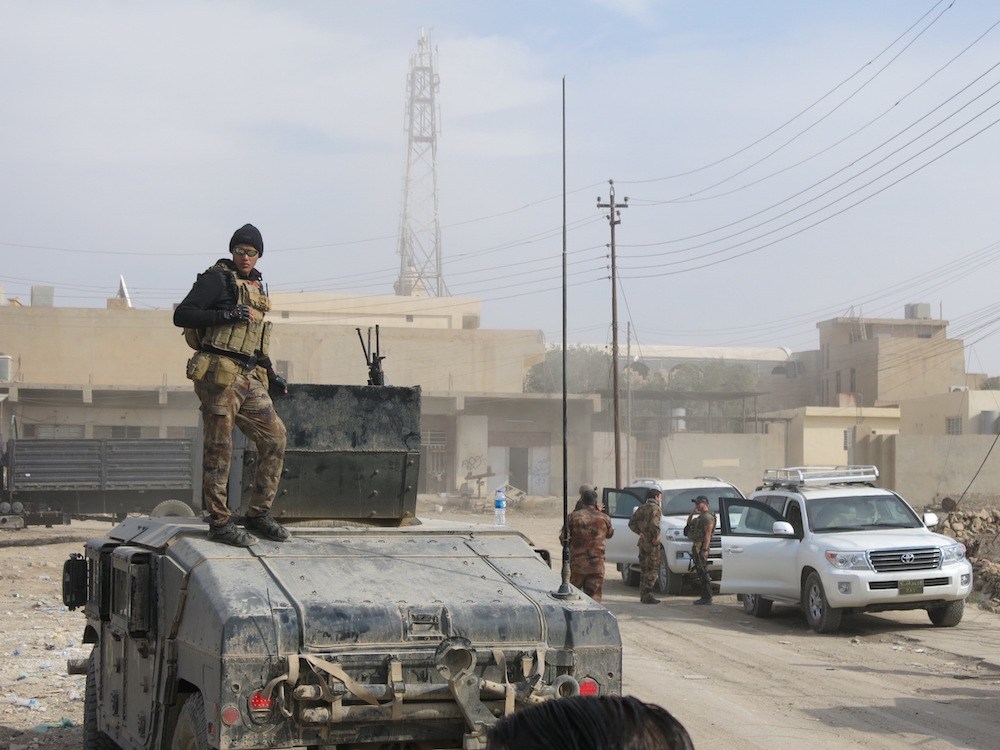
The victorious Iraqi troops who greeted us this winter in the newly liberated town of Bartalla on the edge of Mosul seemed so different from those I remembered from the mid to late 2000s that it was hard to believe they came from the same country. These guys were, to put it in American military slang terms, squared-away, high-speed, and locked-on to the nth degree. They looked, moved, and spoke not just like real soldiers but like professional Western combat troops.
Back then, in the mid-2000s, many if not most U.S.-trained Iraqi units tended to be sloppily unimpressive in dress and demeanor. Away from the parade ground (on which they could usually pull off a decent approximation of Soviet-style marching) the jundis, or ordinary soldiers, carried their Kalashnikovs any old way, sometimes dragging the muzzle through the dirt. Their brown and tan U.S.-pattern uniforms were ill-fitting. On their feet they wore sneakers or even sandals. Their helmets were wonky. Their new standard-issue body armor looked pathetically homemade. They looked unprofessional, and to a depressing degree they were.