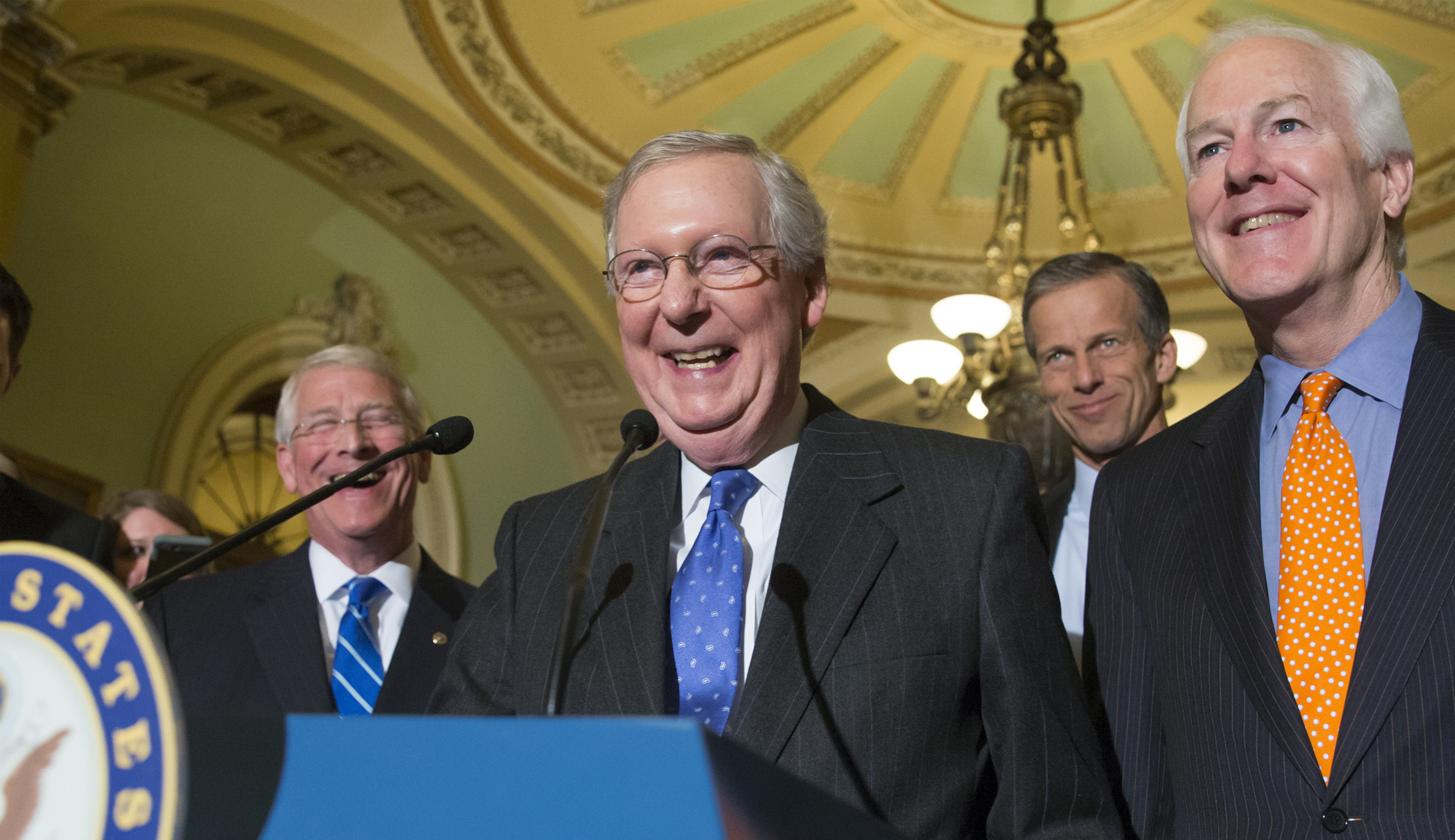
Cutting the August recess could be a win-win for Senate GOP

Published June 1, 2018 4:00pm ET


Senate leaders are weighing a plan to shorten the August recess, a move that would likely benefit Republicans who have fewer seats to defend in the upcoming election and don’t need as much time on the summer campaign trail.

“August is an important time for campaigning, largely because incumbents get a bloc of uninterrupted time to hit the campaign trail,” Jennifer Duffy, senior editor for the Cook Political Report, told the Washington Examiner. “If the Senate stays in August, it hurts Democrats more because they have more incumbents at risk.”

Senate Majority Leader Mitch McConnell, R-Ky., will announce the August schedule on Monday, a spokesperson told the Washington Examiner.

But in addition to keeping Democrats off the campaign trail, shortening the normal five-week recess would also help advance the GOP agenda on spending, and give the Senate more time to confirm President Trump’s appointees.

McConnell wants to begin considering appropriations bills in June, he said earlier this month. But Democrats have slowed the schedule for judicial and executive branch nominees and if they continue with the tactic, it could clog the June and July calendar, when spending bills are normally on the floor.

“We have time to do our work in July, but they have been slow walking, slow walking, slow walking everything,” Senate Appropriations Committee Chairman Richard Shelby, R-Ala., said of the Democrats.

Republicans and Democrats have already agreed to a top line number for fiscal 2019 but must still work out the provisions in the individual spending bills, which they plan to later bundle into a group of spending measures. Shelby, who is eager to pass all 12 spending bills on time, said he has been urging McConnell to keep the Senate in session in August to get the work done.

Canceling part of the August recess would be fine with Republicans, said Shelby, who agrees it could create a political benefit for the GOP.

Democrats are defending seven competitive seats in the upcoming election. Republicans are fighting to hold onto just three endangered seats. An August work session, Shelby said, “might not be realistic for the Democrats because they have a lot more seats,” to defend.

McConnell said he’s having “constructive” talks with Minority Leader Chuck Schumer, D-N.Y., about passing spending measures, which have in recent years stalled in the upper chamber. But Schumer said he doesn’t think canceling any of the August recess will be needed to finish the spending legislation ahead of the Sept. 30 deadline.

“I think we’re going to have plenty of time to get done what we need to be done, if everybody cooperates,” Schumer said.

Republicans point to last year, when the Senate was unable to pass a single spending bill thanks to Democratic opposition, as part of the reason to threaten an August work session.

While political analysts say August is an important time for lawmakers to campaign, University of Virginia political science professor Larry Sabato said it won’t be critical.

“Even in August, a couple of weeks subtracted from campaigning can hurt,” Sabato said. “But it’s a giant exaggeration to say this is a critical factor. Take two weeks out of October and I’d say it would really make a difference in highly competitive states. But August? That’s a real stretch. The velocity of events today means August will be long forgotten by the time people vote.”

Duffy said the plan could also backfire on the GOP by hurting their own vulnerable lawmakers. The GOP is fighting to hold onto open Senate seats in Arizona and Tennessee and to ensure the re-election of Sen. Dean Heller, of Arizona. Duffy has rated all three seats as toss-ups.

Duffy said newcomers like Sen. Cindy Hyde-Smith, R-Miss., who was appointed to replace Thad Cochran and is running for a full term, also need the extra campaign time and could be hurt by a shorter August break.

“Republicans like Heller and Hyde-Smith would also be hurt,” Duffy said.
