

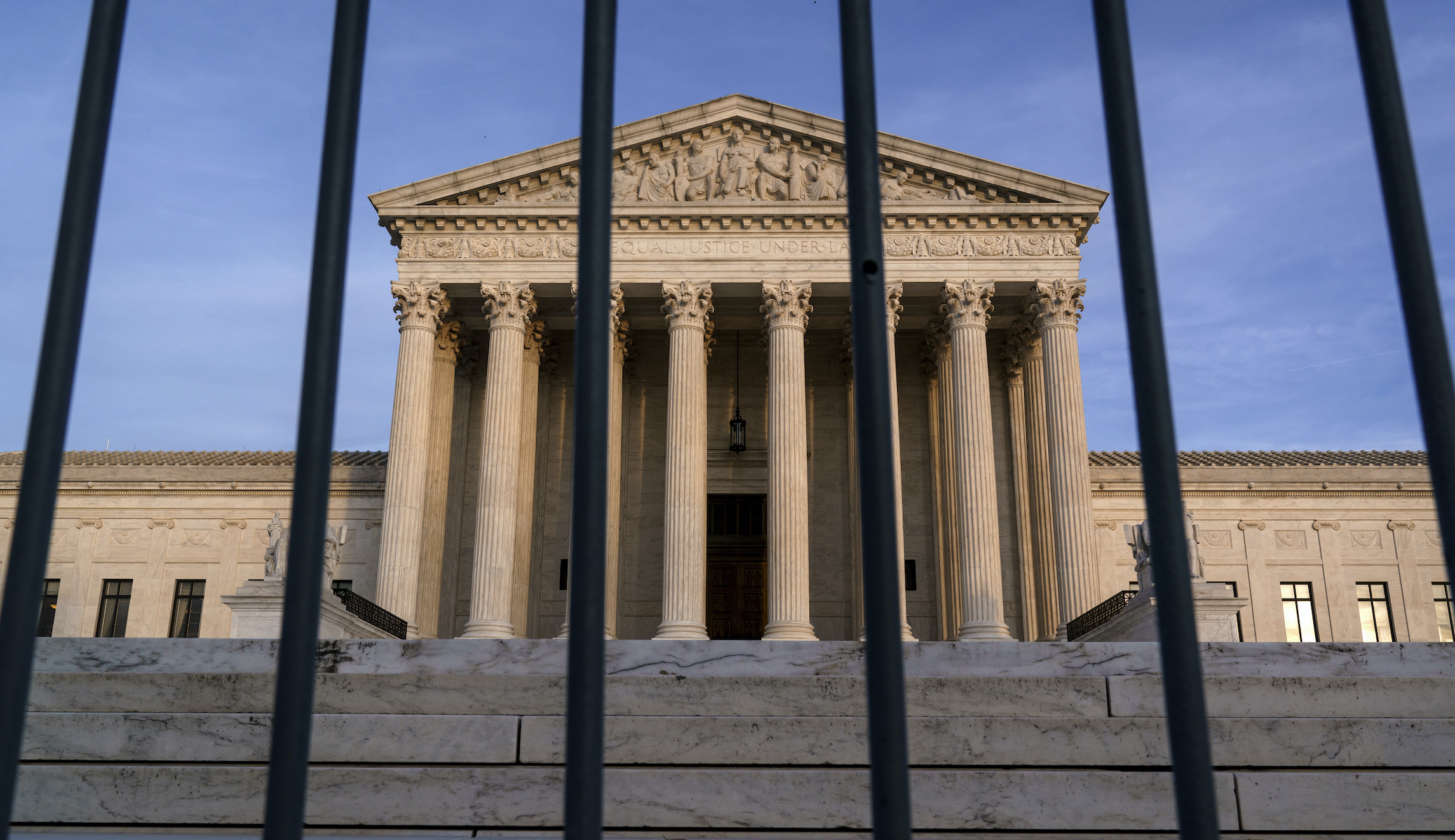
New York Democrat Mondaire Jones is poised to become one of the first openly gay black members of Congress, and he’s also been candid about his support for packing the Supreme Court with liberal justices.
“Our democracy is under assault, and the Supreme Court has dealt many of the sharpest blows. If Democrats want to do something about that, expanding the court is our only option,” he wrote during his primary campaign to succeed retiring House Appropriations Chairwoman Nita Lowey.
Recommended Stories


Jones’s Slate op-ed was penned after the Supreme Court blocked Wisconsin from extending absentee voting for its spring elections, including the Democratic presidential primary, amid the COVID-19 outbreak.
When Jones gets to Congress as a first-term member, it will be a tall order to push through court-expanding legislation and pass it into law. He’ll succeed Lowey in the district she’s represented since 1989, which includes all of Rockland County and portions of Westchester County just north of New York City.
His primary race has not been called yet due to outstanding absentee ballots, but with 42.5% of the vote, Jones holds a seemingly insurmountable lead over several Democratic primary rivals. The Democratic nomination is the key fight in the district, where the party has an overwhelming advantage, meaning Jones, a graduate of Stanford and Harvard Law School, is on his way to be a House member in January 2021.
And with the Supreme Court last week ruling against President Trump’s administration and its agenda, the judiciary will likely be relitigated ahead of November’s contests.
Supreme Court Chief Justice John Roberts last week sided with his four liberal colleagues to rule against Trump’s executive order trying to end President Barack Obama’s Deferred Action for Childhood Arrivals program. The program shields immigrants who were brought to the U.S. illegally as children from deportation.
Roberts, appointed in 2005 by President George W. Bush, also filed an opinion concurring with the liberals on the court, arguing that Louisiana couldn’t mandate that abortion clinics have admitting privileges in hospitals within a 30-mile radius. He made a similar move in the court’s decision banning sexual orientation and gender identity-based discrimination in the workplace.
“I guess Justice Roberts doesn’t want to give Democrats any excuse to pack the courts,” New America Foundation political reform fellow Lee Drutman tweeted in response.
I guess Justice Roberts doesn’t want to give Democrats any excuse to pack the courts.
— Lee Drutman (@leedrutman) June 29, 2020
Former Democratic White House hopeful Pete Buttigieg raised stacking the Supreme Court during the primary. The two-term South Bend, Indiana, mayor’s proposal involved adding another six seats, increasing the number of justices to 15.
The Supreme Court has had nine seats since 1869. The last attempt to augment it was in 1937, when Franklin Roosevelt, frustrated by rulings against his New Deal platform, suggested elevating up to six new justices for every sitting justice older than 70 years and six months. Roosevelt’s court-packing plan was eventually thwarted by members of his own party in Congress.
Now, Democrats are revisiting the matter. They’re spurred in part by Trump’s successful nominations of Neil Gorsuch in 2017 and Brett Kavanaugh in 2018 and by Senate Majority Leader Mitch McConnell’s refusal to hold confirmation hearings for Judge Merrick Garland, Obama’s pick to take over from the late Antonin Scalia.
While his potential running mates Sens. Kamala Harris of California and Elizabeth Warren of Massachusetts are open to a “conversation,” Joe Biden, the presumptive 2020 Democratic standard-bearer, won’t entertain the discussion.
“Structural reform is a fancy way to say packing the court,” he said last year. “I think packing the court is a mistake.”
Author and founding partner of the speech writing firm West Wing Writers Jeff Shesol told the Washington Examiner that the Democratic push for Supreme Court changes had lost momentum since the height of the primary contests. He attributed the shift to Biden’s position, the pandemic, COVID-19’s economic fallout, and the civil unrest incited by George Floyd’s death.
“The other important element in this is that through a series of recent decisions, the court has kind of taken the wind out of the court-packing movement,” said Shesol, author of Supreme Power: Franklin Roosevelt vs. the Supreme Court, a definitive narrative of FDR’s court-packing efforts.
“I think it’ll be difficult on the Left to generate the kind of negative energy about the court that was possible to do at the beginning of the year,” said Shesol, a senior White House speechwriter during President Bill Clinton’s second term.
For Shesol, Republicans are better than Democrats at politicizing the Supreme Court anyway. McConnell’s control of the Senate has empowered him to appoint Trump nominees to the federal judiciary, 200 of as last week, at a “relentless pace,” he explained. That’s a boon for Trump, who Shesol argued had achieved little else during his first term and couldn’t tell Fox News’s Sean Hannity what he would accomplish with a second.
“I don’t think Trump himself has a lot of interest in it. But I think that when you look at the impact made by this administration over the course of the last nearly four years, this is very high on the list, and it will continue to shape life in this country for a long time,” he said.
Democratic strategist Mike Nellis agreed that the judiciary was a crucial component of Trump’s reelection argument “as the country spirals out of control.” But the CEO and founder of Authentic Campaigns believed there were still opportunities for Democrats.
“Kavanaugh is very disliked amongst Democratic voters, and he’s used frequently in fundraising appeals I’ve seen,” Nellis said.
As rumors emerge of Supreme Court Justices Samuel Alito’s and Clarence Thomas’s impending retirements, both Biden and Harris have stressed the judiciary’s significance to the fall melee.
Biden, for instance, told an NAACP town hall that he was “very concerned” that McConnell would pressure federal judges to retire from the bench early so that he could replace them during the 116th Congress. And with Trump due to distribute updated names of Supreme Court candidates by Sept. 1, Biden told reporters this week he may do the same.
“We are putting together a list of a group of African American women who are qualified and have the experience to be on the court. I am not going to release that until we go further down the line in vetting them,” the two-term vice president said.
Meanwhile, Harris has reiterated her primary campaign mantra that “justice is on the ballot” on Nov. 3.
“I think what Biden and Harris are doing is really smart to focus on the Supreme Court,” added Nellis, who was a senior adviser to Harris this cycle. “And as we’ve seen in the last few weeks, there is a lot of energy around these fights.”
