Elizabeth Warren’s proposed crackdown on the National Rifle Association’s influence in Washington, D.C., has a loophole.
The Massachusetts senator is a longtime critic of lobbying and money in politics, turning her desire for “big, structural change” to “level the playing field” into a rallying cry as she campaigns for the 2020 Democratic presidential nomination. And Warren, 70, often uses the NRA as an example in her pitch to primary voters.
Recommended Stories
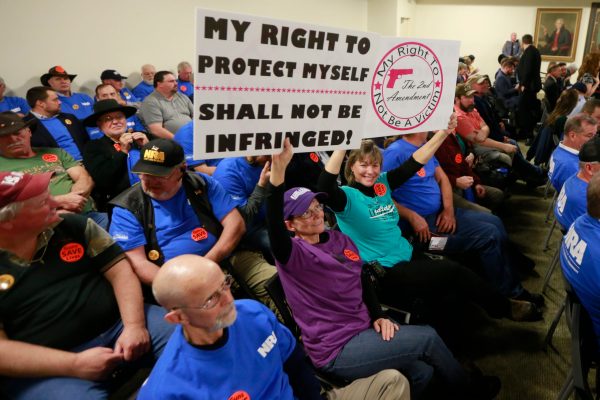
“What is so badly broken in this democracy that something that the overwhelming majority of Americans want to see done doesn’t get done?” Warren said in Las Vegas this month, citing universal background checks for gun purchases. “And the answer is there’s too much power in the hands of the gun industry and the gun lobby, and we’ve got to fight them and we’ve got to break that.”
Warren released her “gun violence prevention” plan over the summer ahead of an appearance at Everytown for Gun Safety Action Fund’s “Presidential Gun Sense Forum” in Des Moines, Iowa, convened after mass shootings in El Paso, Texas, and Dayton, Ohio.
Her proposal singled out the NRA, vowing to “break the NRA’s stranglehold on Congress by passing sweeping anti-corruption legislation and eliminating the filibuster so that our nation can no longer be held hostage by a small group of well-financed extremists who have already made it perfectly clear that they will never put the safety of the American people first.” Under her Anti-Corruption and Public Integrity Act, lobbyists would, for instance, be banned from donating to political candidates and members of Congress.
But Warren’s platform to tax excessive lobbying on Capitol Hill, published to coincide with the March for Our Lives and former Democratic Arizona Rep. Gabrielle Giffords’ gun forum in Las Vegas, doesn’t capture one very important target: the NRA.
Under the framework, she’d slug corporations and trade organizations that spend more than $500,000 on lobbying each year starting at a rate of 35% on those costs. The catch? The NRA, which spent $5.076 million lobbying the federal government in 2018, is classified as a 501(c)(4) organization by the Internal Revenue Service.
The Warren campaign didn’t immediately respond to the Washington Examiner‘s request for comment, but Claremont McKenna College’s Stan Oklobdzija explained 501(c)(4) groups are tax-exempt because they focus on “social welfare” causes.
“While one cannot deduct contributions to a (c)(4) on one’s taxes like one can with a 501(c)(3), these orgs don’t need to pay taxes on their earnings.,” Oklobdzija said.
University of Wisconsin-Madison’s Eleanor Powell added it’d be difficult for Warren to go after the NRA in this way because 501(c)(4) entities could also be “local volunteer fire departments and homeowner associations.”
“Most are actually not political. So I think the idea is that she likely wouldn’t want to group the truly local nonprofit folks in with the other groups,” Powell said.
But former Federal Elections Commission Chair Brad Smith slammed Warren’s idea more broadly. The Institute for Free Speech chairman and professor at Capital University Law School says Warren’s “anti-corruption” suggestions simultaneously muffle voices of “dissent.”
“It’s terrible policy,” Smith told the Washington Examiner. “I don’t know her thinking but it is probably just first, she believes nonprofits are legit in a way for-profits are not. And secondly, she thinks nonprofits lean left and for-profits lean right.”