
Twentieth and twentyfirst-century art do not always age well. Consider this Oldenberg. Or this Rauschenberg. Or, horrible visu, this shark suspended in formaldehyde. It rotted not even 15 years after it was tossed into its vitrine coffin-tank, and had to be entirely refashioned.
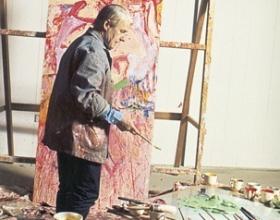
Compared with these extreme examples, paintings by the likes of Jackson Pollock and Jacob Lawrence seem like they need little special conservation. And there’s truth to that. Paint is more lasting than, say, vinyl; nonetheless, modern paints are complex creatures–and have been mixed and applied in unorthodox ways. To preserve these works correctly it’s necessary to study their paints and how the they were used. At the Getty, the Modern and Contemporary Art Research Initiative is concerning itself, in part, with the study of modern paints, and as part of their program, it has started publishing a series of lush books about the use of new art materials. Book one examines–with appendices, cross-sections of paint layers, chromatograms, and photos to delight any art nerd– the materials and methods of Willem de Kooning (1904-1997). His paintings from the ’60s and ’70s are already proving problematic, with surfaces that are sticky or soft.
Real journalism.Trusted by millions.
Unlimited access to in-depth reporting, expert analysis, and the stories that shape our country.
Already a member? Log in