

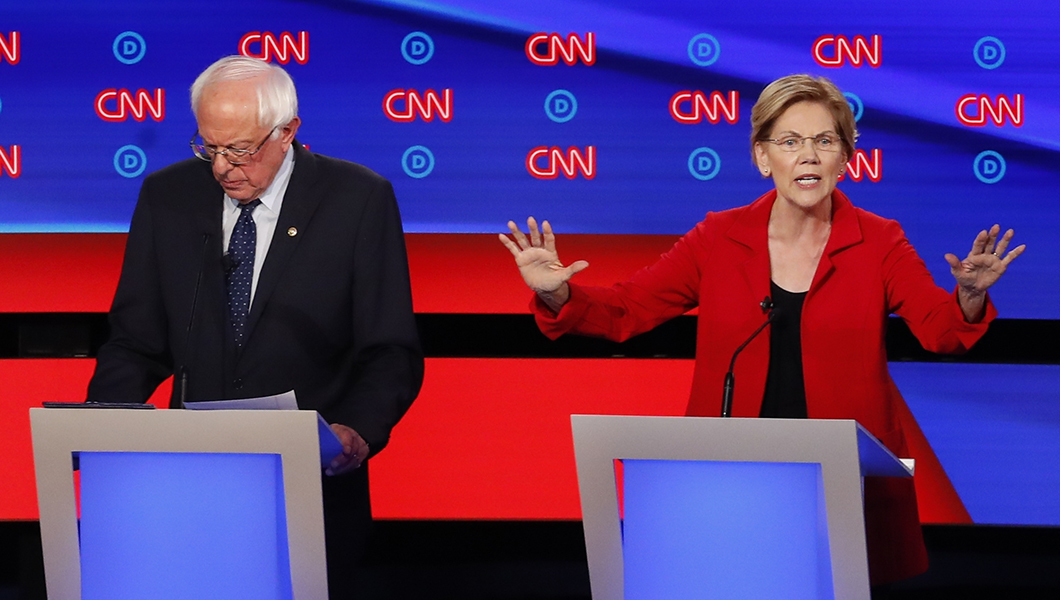
DETROIT — Centrist 2020 Democratic presidential candidates confronted liberal rivals on healthcare and immigration in the opening round of the party’s second debate set, while liberals targeted the man they want to replace: President Trump.
On Tuesday night, Montana Gov. Steve Bullock, making his debate debut, slammed “wishlist” politics in the first minutes of the event, sanctioned by the Democratic National Committee and hosted by CNN in downtown Detroit. Former Maryland Rep. John Delaney, a wealthy ex-healthcare executive, warned against opponents’ “impossible promises.” Delaney cited a Holy Trinity of Democratic presidential nominees who lost in landslide fashion, George McGovern, Walter Mondale, and Michael Dukakis, and pointed to socialist Sen. Bernie Sanders of Vermont as a cautionary tale about moving too far left.
Recommended Stories


Former Colorado Gov. John Hickenlooper advised against “massive government expansions.” Minnesota Sen. Amy Klobuchar, meanwhile, said her “bold ideas” were still “grounded in reality.”
The attacks were aimed at the likes of firebrand populists on the debate stage, Sanders and Massachusetts Sen. Elizabeth Warren, as well as younger, idealistic hopefuls South Bend, Indiana Mayor Pete Buttigieg and former Texas Rep. Beto O’Rourke.
Warren, in response, warned against half-measures.
“We’re not going to solve the urgent problems that we face with small ideas and spinelessness,” Warren said. “I don’t know why anybody runs for president of the United States talking about what we can’t do and what she shouldn’t fight for,” she added later in the evening.
Buttigieg framed the matter similarly, saying, “We will not be able to meet this moment by recycling the same arguments, policies, and politicians that have dominated Washington for as long as I have been alive.”
Divisions over healthcare access repeatedly proved a striking point of departure between the centrists and left-wingers. Sanders, when asked to respond to Delaney’s criticism over his signature Medicare for All bill before Congress, which would make private insurance illegal, thundered, “You’re wrong.” Delaney told the Vermont senator, “We don’t have to be the party of subtraction.”
Immigration was another divisive issue among the candidates, specifically moderators’ questions over proposals to decriminalize border crossings. Warren reiterated her support for decriminalizing illegal entries. Bullock, whose state shares a 545-mile border with Canada, opposed the idea. Buttigieg qualified his previous advocacy of the platform by saying unlawful crossings would still be considered illegal, just dealt with under civil not criminal law.
Other dividing lines were drawn over tax and student loan debt forgiveness plans.
“We don’t need to come up with new taxes that are arguably unconstitutional,” said Delaney, who would be affected by Warren’s “wealth tax,” which would slug households with net worths of more than $50 million at a 2% rate, rising to 3% for billionaires.
Trump, whom the left edge of the Democratic coalition is demanding be impeached immediately, played a somewhat secondary role in the debate. Warren and Klobuchar hit at the president sporadically. Their strongest bromides came over the crisis along the U.S.-Mexico border, where tens of thousands of migrants from Central America and elsewhere have tried to enter America stretching back to 2014, during the Obama administration.
“We must be a country that every day lives our values,” Warren said. Sanders cited Trump’s “racism and xenophobia.”
The debate stage also included Ohio Rep. Tim Ryan and self-help author Marianne Williamson, who received resounding applause for her reparations position. Arguably the breakout performance of the night came from its newest participant, Bullock. The second-term chief executive, who twice sailed to victory in a state Trump carried by wide margins, tempered his detailed public policy proposals with folksy humor and anecdotes.
“Look, I’m a pro-choice, pro-union, populist Democrat who won three elections in a red state — not by compromising our values, but by getting stuff done,” Bullock said. “That’s how we win back the places we lost — showing up, listening, focusing on the challenges of everyday Americans.”
The party’s internal debate spilled over from the formal stage to Michigan-based likely Democratic primary voters milling outside the historic Fox Theatre in the Motor City’s downtown area.
Terry Rarus, 72, a retiree from Macomb Township in the Thumb of Michigan, said she is leaning toward former Vice President Joe Biden, California Sen. Kamala Harris, and Buttigieg for their intelligence, but won’t commit until she knows they can “stand up” to Trump. “I think we’ve got to come together. You’ve got far out there, and you’ve got in the middle,” Rarus told the Washington Examiner. “I don’t think it’s realistic. Really. I mean they may have a plan, but I don’t know where the money’s coming from,” she said, referring to “Medicare for all” and generous student debt relief proposals.
Meanwhile, Nicole Lox, 37, who works for a grocery chain in Mt. Clemens, north of Detroit, and identifies with socialism, told the Washington Examiner the two factions of the party are “just going to have to have it out” when asked whether a liberal nominee could recapture the Great Lake State. “We just need to gel behind that person,” the Warren supporter said. “As a liberal, I will gladly vote with a more moderate Democrat and I will encourage all of my friends to do the same because the alternative, of course, four more years of Trump.”
Tuesday’s debate sets the table for Wednesday’s expected clash between front-runners Biden and Harris. They will be joined by Colorado Sen. Michael Bennet, New York City Mayor Bill de Blasio, New Jersey Sen. Cory Booker, Obama administration housing secretary Julián Castro, Hawaii Rep. Tulsi Gabbard, New York Sen. Kirsten Gillibrand, Washington Gov. Jay Inslee, and entrepreneur Andrew Yang.
