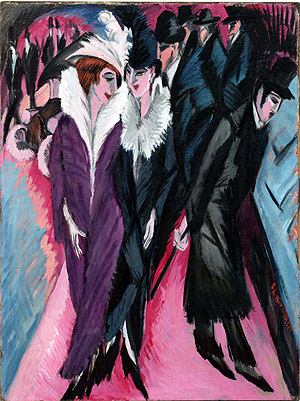
DEBORAH WYE, CHIEF CURATOR of prints and illustrations at the Museum of Modern Art, laments that German expressionist Ernst Ludwig Kirchner (1880-1938) is still “not so well known in the States as he should be.” And so she has organized a show devoted to a single chapter of his work: the Berlin street scenes of 1913-15, arguably the high-water mark of German expressionism.
“Kirchner and the Berlin Street” opens with a bang. Seven street paintings, each vertical, nearly four feet tall, and hung close together, arrest the viewer like advertisements. In Kirchner’s painted world, there are no straight lines or natural colors. Everything is lurid and crooked, divided into diagonals tracing the messy hems of coats, furtive bowler hats, red lips, and cigarette butts. As in illuminated medieval manuscripts, which Kirchner studied and praised, perspective does not govern space; and without it, there is no way to tell foreground from background. But out of this chaos, Kirchner finds a fragile compositional balance, which–so fraught with sick energy and color–could break at any moment.