

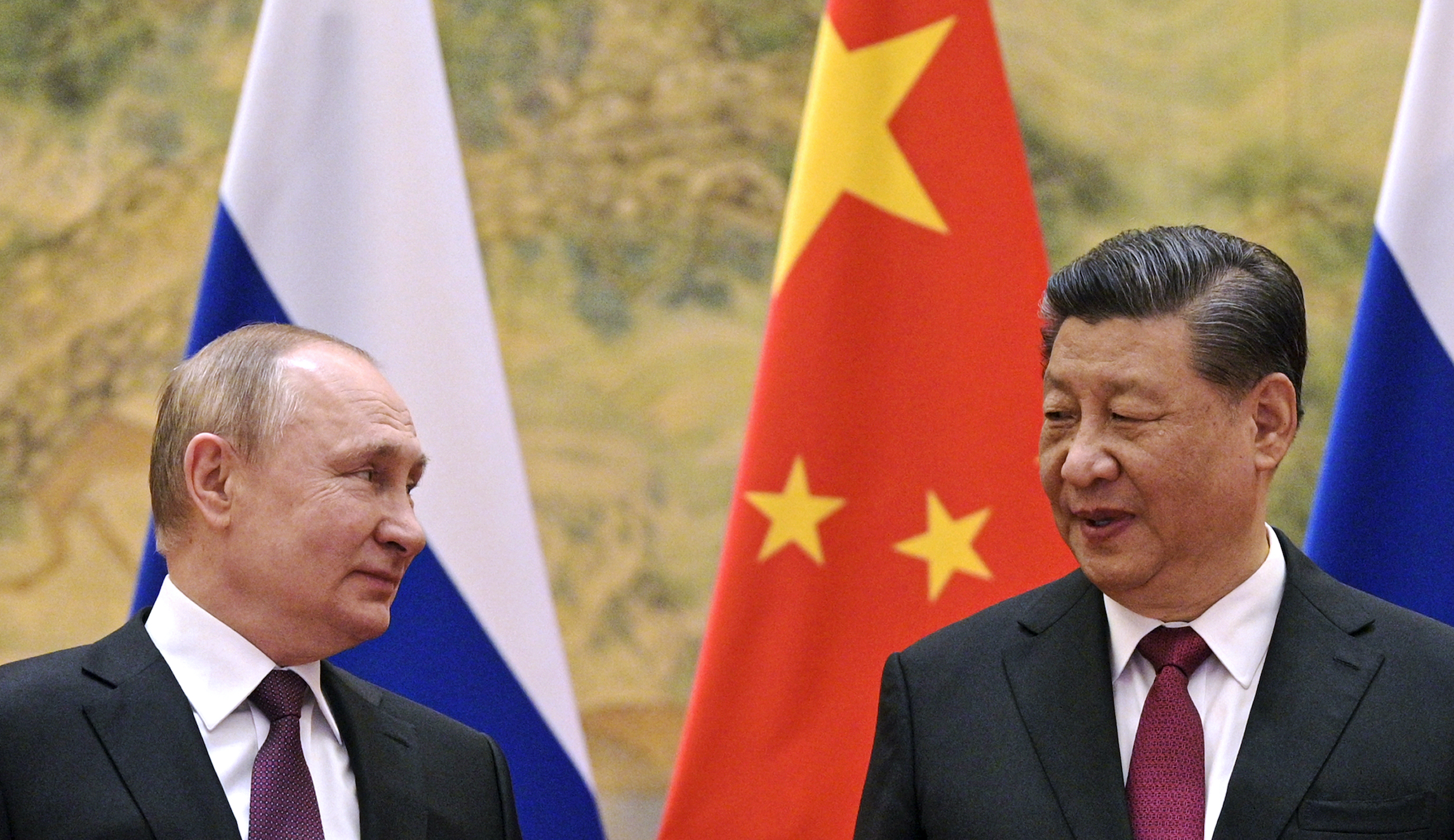
China and Russia have forged a relationship “superior” to the ties that bind NATO, according to their leaders, who called for “a new kind of relationships between world powers” in a challenge to the United States and its Western allies.
“The new inter-State relations between Russia and China are superior to political and military alliances of the Cold War era,” the two governments said in a joint statement released after a meeting between Chinese General Secretary Xi Jinping and Russian President Vladimir Putin. “The sides reaffirmed their intention to strengthen foreign policy coordination, pursue true multilateralism, strengthen cooperation on multilateral platforms, defend common interests, support the international and regional balance of power, and improve global governance.”
Recommended Stories


That boast followed a call for NATO to stop admitting any new countries into the alliance, which the pair accused of maintaining “ideologized Cold War approaches.” Xi made an overt show of support for Putin’s position in the ongoing Ukraine crisis, while the Kremlin chief offered a corollary endorsement of the Chinese Communist Party’s desire to control Taiwan — exemplifying their broad-based challenge to the ideas about international affairs that have characterized Western foreign policy debates since the end of the Cold War.
US WARNS VLADIMIR PUTIN: CHINA’S XI JINPING CAN’T PROTECT RUSSIA FROM SANCTIONS
“It’s not quite an alliance agreement, but it sure smells like one,” U.S. Army War College research professor Evan Ellis, a former member of the State Department’s policy planning staff, told the Washington Examiner. “It’s almost like a coordinated strategic concept … on a scale that is only possible through the collaboration of the globe’s two principle anti-democratic powers.”
The statement opens with a preamble that forecast the “transformation of the global governance architecture and world order.” And the joint statement implies an evolution of Russian and Chinese approaches to foreign policy, as the two leaders adopted positions that would have been untenable in previous decades.
“The strategic community in the West has been rather skeptical about the rapprochement between Russia and China,” Jamie Shea, NATO’s former deputy assistant secretary for emerging security challenges, told the Washington Examiner.
U.S. and European analysts generally have assumed that China would not provide meaningful support for Russian aggression against Central and Eastern European states given the centrality of sovereignty to Chinese foreign policy discourse, he explained. Likewise, trans-Atlantic observers have expected Putin to bristle at the prospect of being a “junior partner” in the relationship.
“Those kinds of theories are now getting a bit discredited,” Shea said. “There’s more life — there are more legs to this relationship than people thought. It helps both of them.”
Their alignment drew a prompt rebuttal from NATO Secretary General Jens Stoltenberg — a salvo that portends more open disputes between China and the trans-Atlantic alliance, which historically have regarded each other as powers on the periphery of their respective interests.
“NATO has never forced any country into our alliance. But many countries have actually, through democratic processes, decided that they want to be part of NATO,” Stoltenberg said Friday afternoon. “So this is about respecting independent sovereign choices of independent nations, not returning to an age of spheres of influence where big powers decide what small neighbors can do or not do.”
Xi and Putin declared themselves the real protectors of global peace and stability. “The sides believe that certain States, military and political alliances and coalitions seek to obtain, directly or indirectly, unilateral military advantages to the detriment of the security of others,” Xi and Putin added.
Yet Xi emphasized his support for Putin’s approach to Ukraine, even though it has been wracked by conflict since Russia annexed Crimea and sent troops into eastern Ukraine to destabilize the Donbas region in a bid to gain influence over the Ukrainian central government’s foreign policy.
“The Chinese side is sympathetic to and supports the proposals put forward by the Russian Federation to create long-term legally binding security guarantees in Europe,” the statement reads.
Putin, for his part, endorsed Beijing’s claim to sovereignty over Taiwan — the island democracy that Chinese Communist officials have never ruled but regard as a breakaway province that must eventually be brought under mainland Chinese governance.
“The Russian side reaffirms its support for the One-China principle, confirms that Taiwan is an inalienable part of China, and opposes any forms of independence of Taiwan,” the joint statement says.
Their coordination already has paid dividends in the current standoff around Ukraine, Shea observed, because Putin ordered Russian forces typically stationed in eastern Russia to reposition themselves near Ukraine — a decision prior Russian leaders would not have felt free to take given the disputes and even occasional conflict along Sino-Russian borders in the region. U.S. and European officials hope the threat of economic punishments will deter a new Russian offensive against Ukraine, but Moscow and Beijing have underscored their commitment to try to offset the effect of Western sanctions.
CLICK HERE TO READ MORE FROM THE WASHINGTON EXAMINER
“It obviously would encourage Putin to take greater risks vis-a-vis Ukraine, vis-a-vis NATO, believing that he can ride out the consequences, particularly when it comes to getting Chinese help for sanctions,” Shea said. “Henceforth, it’s going to be very difficult for NATO to consider Russia without thinking of China, and it has to think about how it handles the two countries simultaneously, which is going to be an even bigger headache than just handling Russia.”
