

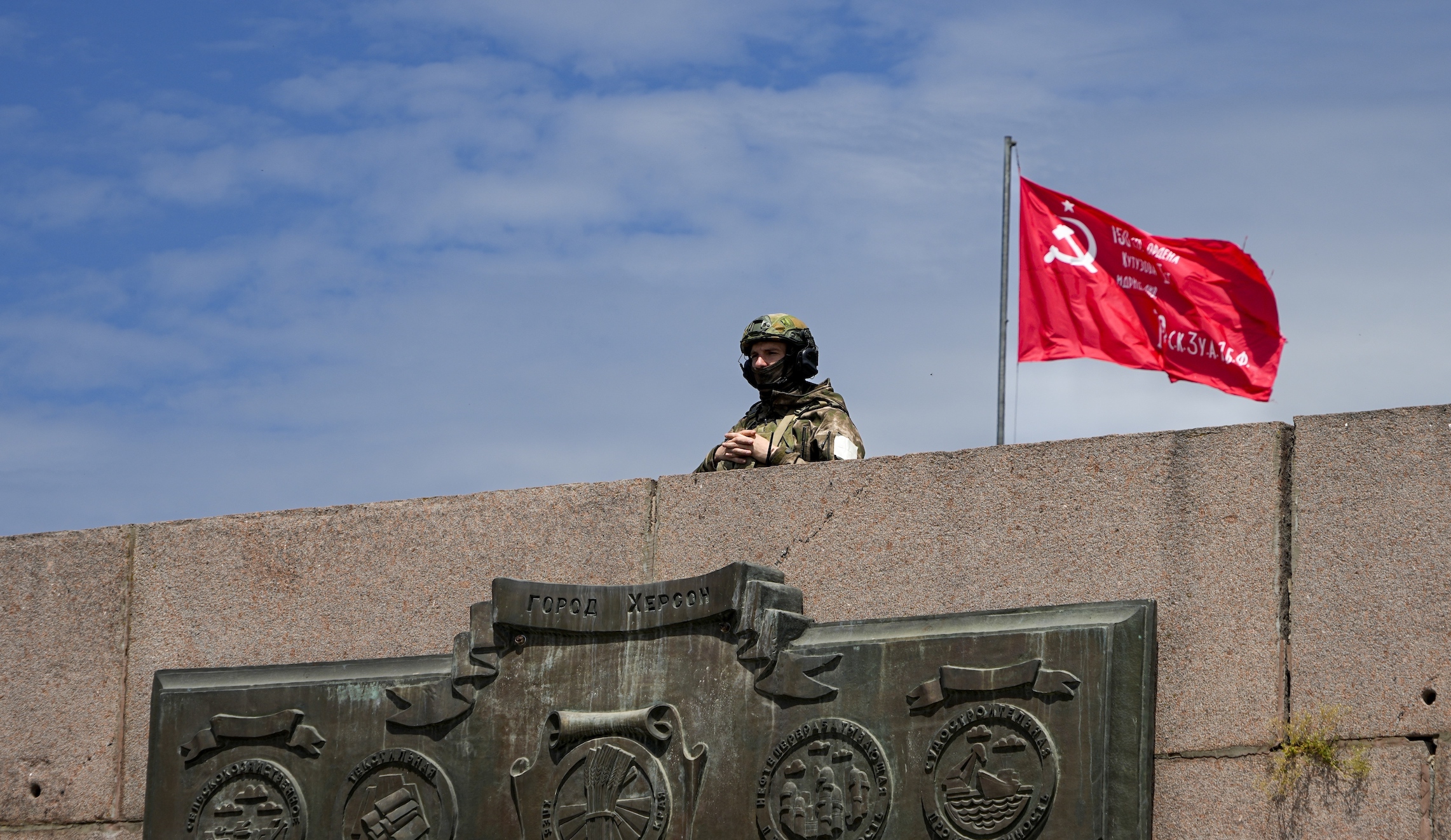
A major Russian military force could be destroyed by Ukraine following a gambit that baited Russia‘s commanders into sending their troops into a vulnerable position.
Recommended Stories



“They are trapped between Ukrainians and the river,” a senior European official told the Washington Examiner. “They are all in range of Ukrainian artillery at the moment.”
That bleak scenario for Russian forces has been described not only by trans-Atlantic observers eager for Ukraine’s victory but also by pro-Russian sources alarmed by the turn of events sprung upon the invading troops in recent weeks. The Russian lines have traced the shape of a fishhook on the map of Ukraine — from Crimea and Kherson in the south, north and east toward Donbas before curving around toward Kharkiv — but Ukrainian counterattacks have blunted that hook near Kharkiv and exposed the vulnerability of the invading troops at the opposite end of the Russian line in a precarious position, as even Russian sources acknowledge.
MERCENARY GROUP SEEKING 1,500 CONVICTED FELONS TO FIGHT IN UKRAINE, US SAYS
“An interesting technique: they achieved success in one direction — brought us to a state where we do not think about any offensive operations in this direction, only about stabilizing the frontline — and offensive surpluses are transferred to another sector,” the commander of the Vostok Battalion, Aleksandr Khodakovsky, who has led the pro-Russian force since his defection from Ukraine in 2014, wrote in a Telegram post. “A developed transport infrastructure allows them to maneuver with limited forces, creating accumulations in places where it is necessary according to the plan, and the presence of a plan and its implementation is the possession of a strategic initiative.”
That grim compliment, translated by the Estonia-based War Translated project, reflects the “brilliant” stratagem of Ukrainian General Valerii Zaluzhnyi, as a former U.S. ambassador put it. The curvature of the Russian positions gave Ukrainians the advantage of “interior lines” — that is, the defending Ukrainian forces inside the fishhook can move along a straight line from one contest to another, while the Russian troops have to take a longer route along the outside of the curve to move from one end of the war zone to the other.
“From Kharkiv to Kherson, this arc [of Russian-held territory in Ukraine] — for a long time, the Ukrainians made it pretty clear that their counteroffensive was going to be down near Kherson, and the Russians noticed, they moved their troops around … and prepared and dug in,” former Ambassador Bill Taylor, a veteran of the Vietnam War who led the U.S. Embassy in Kyiv on two occasions, told the Washington Examiner. “And then the Ukrainians apparently transferred this surplus, these additional forces [to Kharkiv] and drove [the Russians] way, way, way back. That’s brilliant generalship. The [American] Civil War generals would be in awe.”
The efficient maneuverability of the Ukrainian forces makes for a marked contrast with the clipped wings of the Russian forces, as described by the pro-Russian sources. Khodakovsky described Ukraine as “accumulating resources” around the Kurakhove and Pokrovsk, a pair of cities in the Donetsk district, part of the Donbas region that has been ravaged by the war since 2014. In parallel, the Russian troops around Kherson find themselves on the receiving end of punishing artillery barrages — a kind of bludgeoning that they relied on throughout the summer to power their own attacks on Ukraine.
“The situation … cannot be called a stalemate,” a pro-Russian analyst who writes under the pseudonym “Atomic Cherry” observed in a different Telegram post.
This analysis credited Ukrainian forces with approaching about 7.5 miles closer to Kherson since “the end of August.” Their advance has continued even though the terrain is “cut through by many irrigation canals [that present] significant water barriers” to the Ukrainian forces, as the pro-Russian observer put it, and thus afford the Russian forces “ample opportunities for defensive operations.” Yet that terrain can’t deflect the careful use of Ukrainian artillery to prevent the Russian forces from moving supplies or men across the Dnieper River.
“From the very beginning, the Ukrainian army had fire control over the crossings across the Dnieper, and over the past weeks of September they only increased it by bringing forward their own firing lines,” the Atomic Cherry author wrote, per the War Translated project’s translation. “Under the current condition, it is impossible to either strengthen them and saturate them with ammunition, fuel, and equipment, or simply begin to withdraw them to the left bank of the Dnieper. Any movements of large masses of troops in the area of crossings will be easily detected and hit by missiles and artillery.”
That dynamic has produced a punishing cat-and-mouse game: Russian forces try to find and bombard the small units of Ukrainians picking their way across the district, while Ukrainian artillery forces try to ravage the Russian forces who have amassed in a relatively small area.
“The Russians are in trouble on the western side of the Dnieper River, [near] Kherson,” said Taylor, the former U.S. ambassador. “They can neither get resupplies — ammunition, food, more soldiers — to the right bank, to the west bank, nor can they get those 25,000 troops out of that cauldron … and that cauldron might be a real vulnerability for them. If they either lose those 25,000, if they’re killed or captured, that’s an enormous morale boost for the Ukrainians and a morale hammer for the Russians.”
If Russian leaders can’t find a way out of that dilemma, they could lose a substantial formation of troops over the coming months — a critical reversal of their ambition to encircle and destroy Ukrainian forces over the spring and summer.
CLICK HERE TO READ MORE FROM THE WASHINGTON EXAMINER
“Russians have been disconnected from their rear,” the senior European official said, pointing to the logistical conundrum that could tilt the contest in favor of the slow-moving Ukrainian forces. “So [you] can have an excellent defensive position, but if you don’t have ammunition and food, then it is a beautifully defensible grave.”
