

Weeks of closely held trans-Atlantic unity broke as Washington rejected Poland’s proposal to arm Ukraine with warplanes from an American air base, fearing Russian President Vladimir Putin could view the transfer as an escalatory step.
Poland’s 300-mile border with Ukraine puts the country closer to the conflict than other trans-Atlantic allies, with its idea to deploy the jets first to the U.S. Air Force’s Ramstein Air Base in Germany, a move that seemed intended to stifle possible charges of wartime complicity by Russia.
Recommended Stories


Ukrainian President Volodymyr Zelensky has pleaded for more aircraft as his country comes under attack, a request the U.S. had seemed ready to oblige when Secretary of State Antony Blinken said days ago that Poland had the “green light” to send its planes to Ukraine.
WHITE HOUSE HAS ‘LOST CONTROL ON THE HILL’ OVER RUSSIAN OIL BAN
After the Biden administration shot down the plan, actor Sean Penn entered the fray on Wednesday, suggesting that a storm of public opprobrium could find the bottleneck in the bureaucratic chain between Washington and Warsaw to get Ukraine its jets.
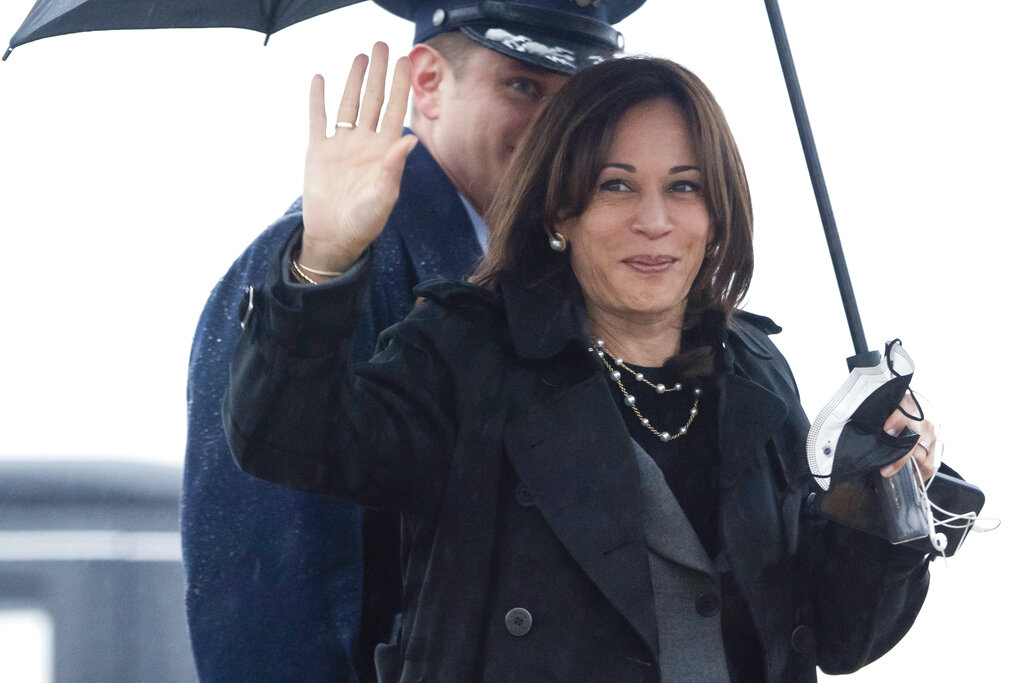
It’s into this delicate mix that Vice President Kamala Harris steps on Thursday to meet with Polish President Andrzej Duda and Prime Minister Mateusz Morawiecki, wading into a live diplomatic spat as war rages on Europe’s borders.
“This has emerged as the central example of the trans-Atlantic alliance being anything short of fully consultative and coordinated in their approach,” said Carisa Nietsche, an associate fellow at the trans-Atlantic Security Program at the Center for a New American Security.
As the highest-ranking envoy to the conflict, Harris will face intense scrutiny as she works to align the U.S. and Poland. Senior administration officials declined to say whether the vice president was bringing any deliverables requested by Poland, and it was unclear Wednesday whether there remained the possibility of forging a solution to delivering jets to Ukraine.
Still, Harris has “really been immersed in this issue,” a Biden administration official told reporters on a call, “working intensively on a daily basis on all of the issues that are related to the ongoing crisis resulting from the Russian invasion.”
The vice president’s first order of business will be to reinforce ties with NATO allies as concerns of a spillover conflict continue to escalate. President Joe Biden has promised not to send troops to Ukraine, turning to economic statecraft as his principal weapon to stop Putin.
But while crippling sanctions imposed by the U.S. and its European allies have decimated Russia’s economy, the Kremlin has shown no signs of backing down.
On Wednesday, the White House warned that Russia could be on the verge of a chemical attack in Ukraine. Russian forces have also captured the Zaporizhzhia and Chernobyl nuclear power plants.
Washington’s halting response is drawing rebuke from Ukrainian officials, as well as refugees who’ve fled their homes in droves.
Uljana Zamaslo, an English teacher, fled Lviv for Poland days into the war, where she is now searching for work. As a Ukrainian American, she wondered why the U.S. was not stepping in as Russia targets nuclear facilities inside the country.
“Putin smells Biden’s fear, even from his bunker in the Ural mountains,” Zamaslo said, adding that, “Nobody wants a nuclear war, but allowing the Russians to bomb nuclear power plants isn’t the answer.”
She said that while Poland’s people fear nuclear war as well, they face immediate concerns over elevated radiation due to the nuclear plant bombings.
“That is now, Biden is worried about later,” Zamaslo said. “That later may never come.”
When Harris met with Zelensky in Munich last month, he followed a publicly staid bilateral sit-down with the vice president with a fiery indictment of trans-Atlantic leaders on the security conference stage. Speaking to a room of Ukraine’s powerful supporters, he accused leaders of adopting an “appeasement” policy toward Russia that had allowed the crisis on Ukraine’s borders to escalate.
Within days, more than 150,000 Russian troops along Ukraine’s borders began to advance.
Historian Joel Goldstein said Harris’s return to Europe so soon after meeting with leaders in Munich suggests a growing diplomatic range.
While it is not unprecedented for vice presidents to travel to or near war zones, “it reflects her involvement in diplomacy on significant matters,” said Goldstein, a professor emeritus at Saint Louis University School of Law.
After Warsaw, Harris will travel to Bucharest, Romania, for a bilateral meeting with President Klaus Iohannis, whose country also borders Ukraine.
CLICK HERE TO READ MORE FROM THE WASHINGTON EXAMINER
A second senior administration official said Harris was stepping up to the trip bolstered by meetings with leaders in Europe as Russia’s threats began to mount in November.
“When she first went to Paris, we had already started to get the signs of potential Russian buildup,” the official said.
