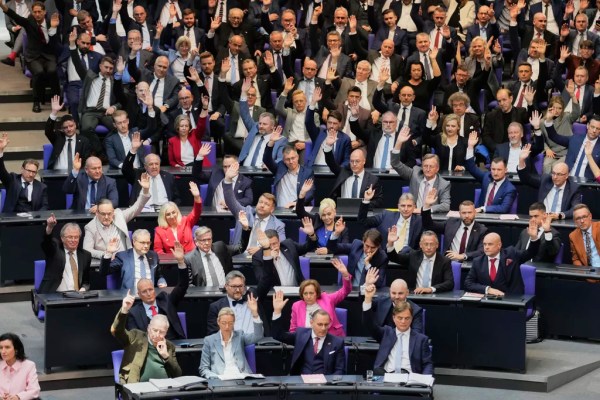
TODAY THE GERMAN parliament is scheduled to vote on whether to extend the Bundeswehr’s 3,000-strong ISAF military deployment in Afghanistan for another year. While there is no doubt that Chancellor Merkel’s Grand Coalition has enough votes to get the measure passed, the much-anticipated Bundestag debate will certainly highlight growing opposition to what is increasingly viewed by the German public as a lost-cause mission with close to zero moral legitimacy. Public opinion in Germany, like in Canada, has already turned firmly against the ISAF/OEF missions in Afghanistan, with recent surveys indicating that two-thirds of all Germans favor an immediate military withdrawal. For Chancellor Merkel and her conservative CDU/CSU allies, the Bundeswehr’s bloody, seemingly open-ended Afghan engagement is a political time bomb that could easily blow up in the run-up to the next federal elections to be held by fall of 2009. In fact, Afghanistan is arguably Merkel’s only foreign policy weak spot and, at the same time, her biggest potential domestic political liability.
So far, only the post-Communist Left party is officially calling for a pullout. However, many left-wing MPs from the governing SPD party and even a growing number of CDU/CSU MPs, under strong pressure from their local constituents, are more or less openly opposed to the Afghanistan mission. The Greens are divided, with some MPs indicating that they will vote for the ISAF extension, thus ignoring a recent, non-binding party congress resolution demanding exactly the contrary.