

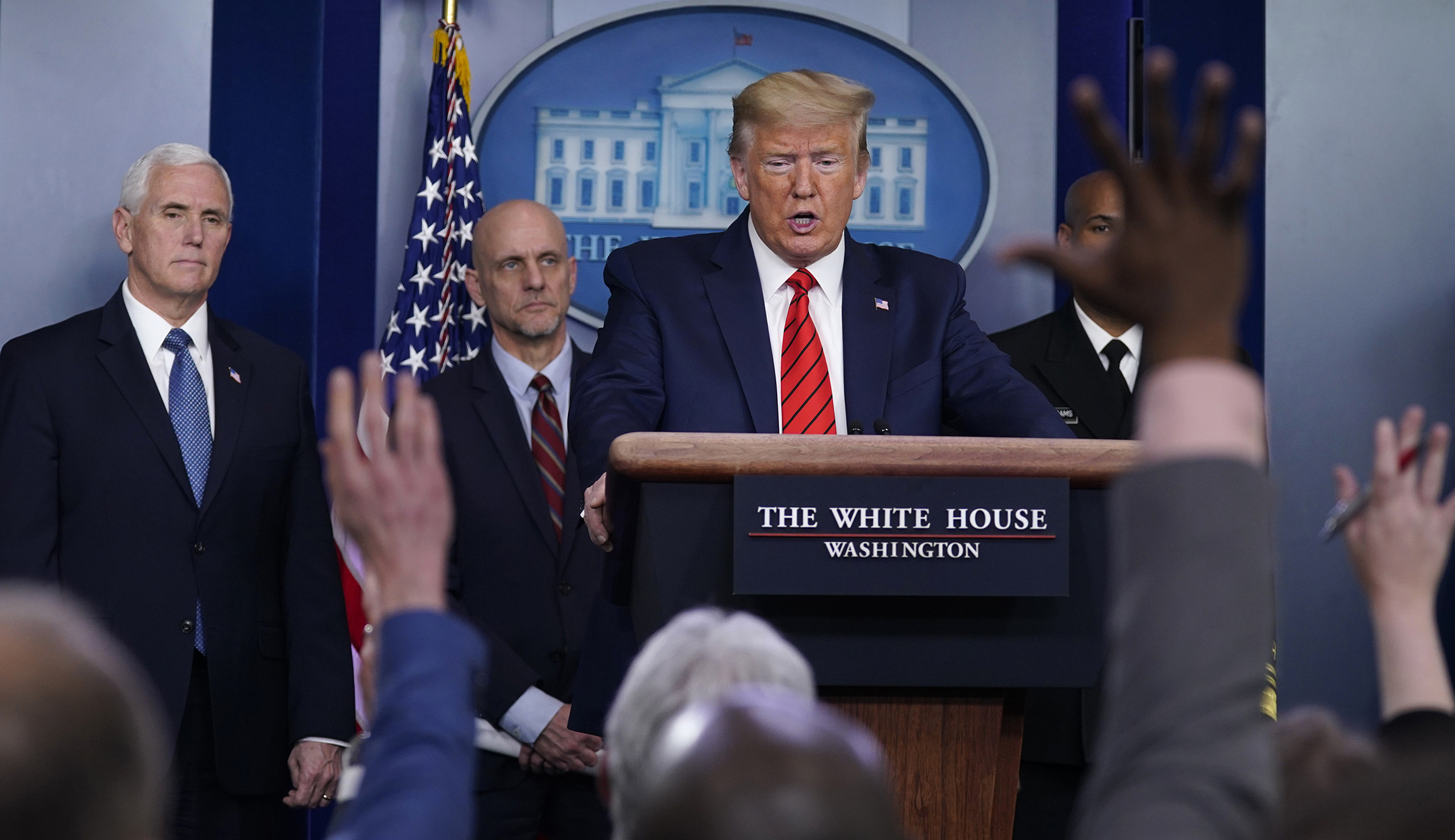
President Trump’s coronavirus press briefings have given a locked-down nation some semblance of a daily routine during the pandemic. But like everything else in Washington, they are also a source of controversy, as critics pan the events as equivalent to campaign rallies and urge the media to stop covering them.
“Trump’s new fondness for these ‘briefings’ and their increasing conversion into Trump campaign rallies, with scientists rather than local government officials as the supporting cast, should cause cable news producers to reflect on the path they are headed down,” argued The Atlantic’s James Fallows. New York University journalism professor Jay Rosen has been on a one-man crusade against Trump’s briefings, calling for “exiting from the normal system for covering presidents — which Trump himself exited long ago by using the microphone we have handed him to spread thousands of false claims, even as he undermines trust in the presidency and the press.”
Recommended Stories


“If Trump is going to keep lying like he has been every day on stuff this important, we should, all of us, stop broadcasting it,” opined MSNBC’s Rachel Maddow. “Honestly, it’s going to cost lives.” Washington Post media columnist Margaret Sullivan concurs, arguing of the briefings, “They have become a daily stage for Trump to play his greatest hits to captive audience members” who “come in search of life-or-death information.”
Some cable news networks, stung by the charge that they helped Trump’s free media advantage in 2016 by devoting wall-to-wall live coverage of his freewheeling campaign rallies for ratings purposes even as they privately doubted he was a viable candidate, have partially taken this advice by cutting out early from the broadcasts even as their reporters try to mix it up with the president at the White House. Fox News signed off from Thursday’s briefing as it was ongoing.
“The daily briefings have been extremely helpful as the nation deals with coronavirus,” said Sean Spicer, Trump’s first White House press secretary. “Having the president, the vice president, and key members of the task force is reassuring at a time when we are all looking for answers both in how we are going to mitigate the spread of it but also in terms of how we are addressing the economic impact it is having.”
Others have called for the political journalists who dominate the White House press corps to take a backseat to health and science reporters to maximize the coverage of the coronavirus rather than horse race campaign or palace intrigue stories. This includes Trump detractors such as Soledad O’Brien, who disapprove of the media taking note of the president’s more somber tone at recent briefings.
“I’ve often remarked that I enjoyed my time as State Department spokesman more than White House press secretary,” said Mike McCurry, the former top spokesman for President Bill Clinton. “The difference was a press corps at State that was composed of reporters who had degrees in international relations and the briefings there were challenging but always substantive. The White House briefings were more political ‘gotcha’ events, and the coverage was always more driven by political ups and downs.”
A Trump campaign source went further, saying many of the reporters at the briefings “function as the opposition.” White House Correspondents’ Association President Jonathan Karl has singled out CNN’s Jim Acosta for behaving like he is “part of the Resistance” in his frequent dust-ups with Trump. But McCurry puts some of the blame on the president too.
“I think the White House press corps right now seems to get that people want real, substantive information,” he said. “They seem to be rising to that challenge. The problem is that the president, having declared them ‘enemies of the people,’ cannot suddenly rely on the media to convey important public information. That is the price he pays for having poisoned the relationship.”
Trump has struck a somewhat different tone in recent days, as he has emphasized the death toll is likely to rise in the coming weeks. “Good question,” he told Acosta on Wednesday, uncharacteristic praise. But Trump has been criticized for sparring with reporters, telling NBC News’s Peter Alexander he is a terrible journalist and having tense encounters with PBS’s Yamiche Alcindor. Trump’s grasp of the facts has also come under scrutiny as both the economy and the health of the public have taken a beating under the strain of the pandemic.
This all highlights the difficult balance between holding the president accountable and focusing on the current coronavirus information instead of political controversies. Is it better to remind the public that Trump has previously compared the coronavirus to the flu, or should his current warning that the pandemic is more dangerous take precedence? “I think, for the most part, the press has upped its game,” said Ari Fleischer, White House press secretary under George W. Bush.
“I think it is smart to have experts and other Cabinet officials at these briefings,” McCurry said. “I think people want to hear more from [Dr. Anthony] Fauci than from Trump. But I also think having serious healthcare reporters there for questions makes more sense than having journalists who are more tuned in to the politics.”
“My guess is that most editors and decision-makers at news organizations are actively making those decisions,” he added. “The guiding principle, I think, is that the public has a right to know. The government has a responsibility to tell. And the media has to tell the truth, without bias or spin.”
