

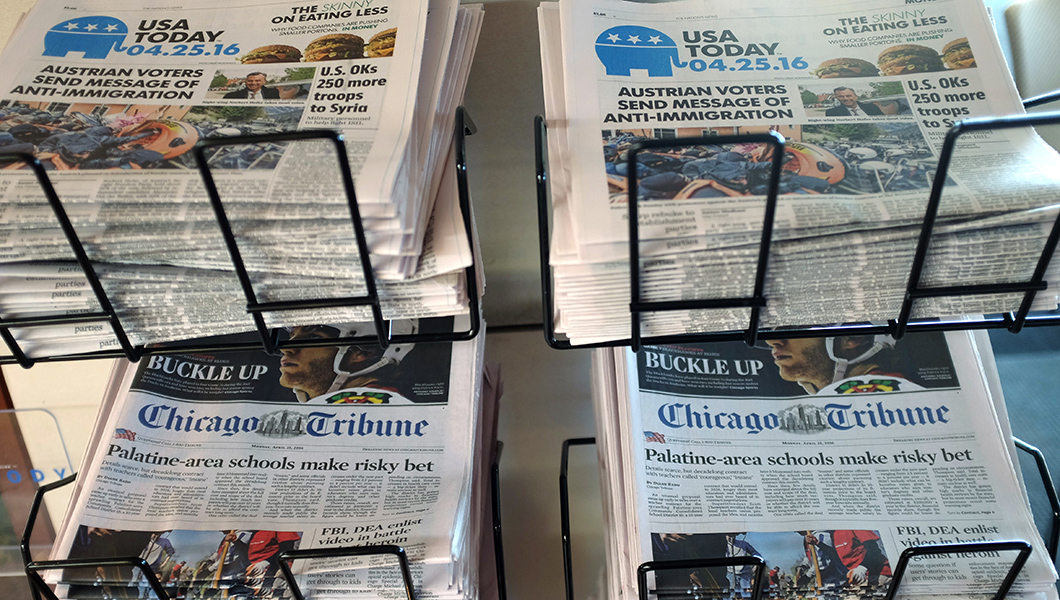
Gannett Co., the owner of USA Today, said Thursday it will scrutinize rejected suitor Digital First Media’s nominees to replace more than half the newspaper chain’s existing board for potential conflicts.
The 10 current directors unanimously snubbed a $1.36 billion offer from Digital First on Monday, arguing that it undervalues a company using established brands in areas from Detroit to Phoenix and central Florida to ramp up digital news products. The bid was worth $254 million more than the company’s previous market value.
Recommended Stories


Gannett said its board doesn’t believe the offer is a credible one and will consider whether Digital First’s six nominees “are committed to acting in the best interests of all of Gannett’s shareholders,” or are beholden to their backer. All are affiliated with Digital First or its principal shareholder, Alden Global Capital, Gannett said.
Digital First, which holds a 7.5 percent stake in Gannett and previously suggested it might wage a proxy fight to push its $12-a-share offer, said it would ask shareholders to install the six people on the McLean, Va.-based company’s board at this year’s annual meeting, whose date has yet to be announced. A sweep would give Digital First a majority on the board, enabling it to move forward with a sale.
“The sad reality for Gannett shareholders is the company has no credible plan to attain a $12 per share valuation on its own,” Digital First said earlier this week. “Gannett’s ‘pie in the sky’ hopes for its digital businesses are not believable,” it added, “and cannot be counted on” to deliver a better return than the current offer.
Gannett chairman J. Jeffry Louis acknowledged at the time that the newspaper industry faces an array of challenges but said existing management has the expertise needed to navigate them and grow. The company comprises the publishing operations separated from the broadcasting business of a once-larger company that bore the same name; the TV firm is now known as Tegna.
Gannett’s revenue has declined about 9 percent over the past five years, dipping to $3.02 billion in the 12 months through September 2018, as newspapers struggle with the loss of advertisers who can promote their products more effectively, and for less money, online. While media companies have embraced digital advertising, it typically generates far less revenue than its print counterpart.
At the same time, media companies of all stripes have found themselves grappling with growing hostility from some supporters of President Trump, who has labeled coverage with which he disagrees as “fake news” and referred to the industry broadly as an “enemy of the people.”
