
The Federal Reserve voted to hold its interest rate target steady, a decision that investors mostly anticipated, but that nonetheless had markets on edge because of the off-chance that the central bank could hike rates just before the midterm elections in light of the high rate of inflation.
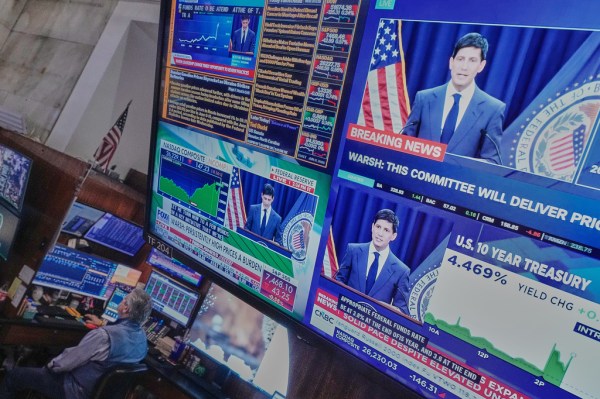
After a two-day meeting in Washington, the Fed’s monetary policy committee, led by Chairman Kevin Warsh, announced it would hold its rate target at a range of 3.75% to 4%. Notably, the decision was not unanimous, with Fed governor Lisa Cook and Federal Reserve Bank of Cleveland President Beth Hammack dissenting.
Recommended Stories
The decision to hold rates steady is in tension with the fact that inflation is well above the Fed’s 2% target, driven in part by higher energy costs stemming from the Iran war. Some measures of inflation are rising, rather than falling.
WHAT TO EXPECT FOR INFLATION, JOBS, STOCKS, AND HOUSING IN THE YEAR AHEAD
Ahead of the decision, implied odds of a rate hold were over 90%, according to CME Group’s FedWatch tool, which calculates the probability of rate changes using futures contract prices for rates in the short-term market targeted by the Fed.
Warsh spoke at a press conference after the Fed’s Wednesday rate decision. Throughout the conference, he repeatedly highlighted the fact that inflation is still well above the Federal Open Market Committee’s 2% target.
“It’s our responsibility to get inflation down,” Warsh said. “That’s the reason the FOMC’s discussion over the last couple of days focused mainly on the price stability side of our remit.”
He touched on how the war with Iran has caused oil prices to spike, sending gasoline prices spiraling, and said the Fed is working to ensure that spike doesn’t end up translating into inflation in other parts of the economy.
“Energy and related prices have moved higher again in recent weeks, and our job is to ensure that relative price changes in some sectors do not broaden out across the economy, and that inflation expectations remain as they are anchored,” Warsh said.
The decision comes at the tail end of a midterm election cycle that has been marked by the two parties fighting over affordability, inflation, and the cost of living. A rate increase would have come as a surprise to the markets and likely to President Donald Trump, who has been pushing for lower interest rates.
Trump has given Warsh more leeway with the rate calculus than his predecessor, Jerome Powell, and has instead blamed other members of the monetary policy committee for failing to cut rates. Trump has previously said that Warsh is “fantastic” and “wants to do the right thing,” but is dealing with a “political” Fed board.
At the last Fed meeting, where the central bank voted unanimously to raise rates, Warsh declined to comment to the Washington Examiner on any conversations he had with the president about rates, but emphasized Fed independence.
“Part of the independence of the Federal Reserve is that we stay in our lane,” the chairman said. “Independence is a two-way street. We let people that do trade policy and fiscal policy stay in their lane, too. That’s how we can stand up here and call them [the] way we see them.”
Inflation stood at a 3.4% for the year ending in August, according to the gauge favored by the Fed.
The high inflation has caused economic sentiment to sour among consumers. Inflation has been higher than wage gains over the past year.
On the other hand, the labor market appears to be resilient.
Although payroll growth has slowed in recent months, the unemployment rate remains low by historical standards. And new claims for unemployment insurance benefits have been historically low, suggesting layoffs are rare.
During the meeting, Warsh emphasized that the focus for the Fed is now largely on the inflation side of its dual mandate, given the low unemployment rate.
“The jobless rate is lower than a year ago, and payroll growth is noticeably above last year’s pace,” he told reporters. “The four-week moving average of unemployment insurance claims continues to run at the lowest level in generations. So, on the employment side of the Fed’s dual mandate, conditions are quite positive.”
Warsh has indicated repeatedly that he is focused on bringing inflation to heel, and some have even interpreted his tone as “hawkish.” In Fed lingo, “hawks” are central bankers who prefer tighter monetary policy, while “doves” are those who advocate looser money.
During hearings on Capitol Hill, Warsh has emphasized the priority of getting inflation under control.
At the central bank’s last meeting in September, the board updated its economic projections for the coming years. Fed officials said they see inflation, as measured by the personal consumption expenditures index, running at 3.7% by the end of the year.
HERE IS HOW MUCH PRICES FOR GROCERIES, GAS, UTILITIES, AND SHELTER ARE UP UNDER TRUMP
The officials projected that the unemployment rate would be at 4.1% by the end of this year.
In terms of GDP, they predict 2.3% GDP growth this year, a slight increase from June, when board participants were projecting 2.2% growth in 2026.