
Investor expectations that rising inflation will force the Federal Reserve to raise interest rates this year are creating a political quandary for Republicans ahead of the midterm elections, as well as new chairman Kevin Warsh.
Bond markets show that traders see it as a 50-50 proposition that the central bank will raise its interest rate target before the end of the year.
Recommended Stories
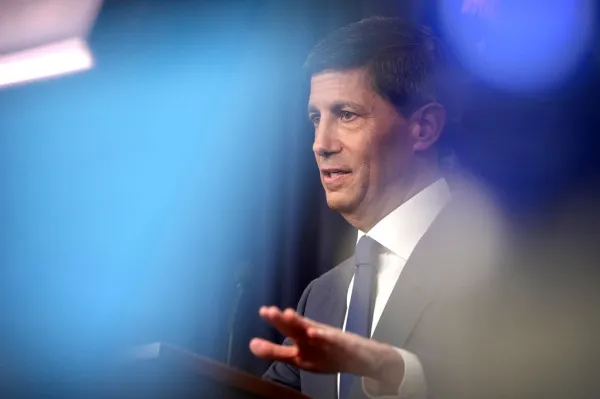
Overseeing a rate hike would be a major headache for Warsh, whom President Donald Trump appointed after castigating his predecessor, Jerome Powell, for failing to cut rates.
A rate hike would also be a new problem for Republicans, especially if it came before the November elections. It would increase awareness of high-interest mortgages and car loans, adding to the miseries households are already experiencing, such as high inflation, expensive housing, and, most recently, soaring gas prices.
TRUMP GOING TO LET WARSH ‘DO WHAT HE WANTS TO DO’ AT FED WITH INTEREST RATES
“Things voters don’t like to see going up include interest rates and gas prices, so this is very bad news for Republicans,” Peter Loge, director of the George Washington University School of Media and Public Affairs, told the Washington Examiner.
Up until recently, a rate hike was not seen as likely. But recent high inflation readings have changed perceptions.
As of Wednesday, the implied odds of a rate increase before the end of the year were nearly 50%, according to CME Group’s FedWatch tool, which calculates the probability of rate changes using futures contract prices for rates in the short-term market targeted by the Fed. The odds of a rate cut were minimal.
Warsh has suggested over much of the past year that he would lower interest rates as chairman, a stance that undoubtedly helped win him Trump’s favor.
But cutting rates will not be viable if inflation is rising and investors expect the Fed to raise rates. Nor can Warsh act alone. The Fed sets monetary policy via a committee, of which Warsh is just one member. By convention, the committee acts with a high degree of consensus.
One factor alleviating the pressure on Warsh is that, in recent days, Trump has unexpectedly given him latitude to conduct monetary policy without criticism.
Trump, who had been pushing Powell hard to lower interest rates for months, shifted his tone in a phone interview with the Washington Examiner.
“I’m going to let him do what he wants to do,” Trump said in response to a question about Warsh and market expectations for a rate hike. “He’s a very talented guy, he’s going to be fine, he’s going to do a good job.”
During Warsh’s swearing-in ceremony, Trump further vowed to let Warsh handle the Fed free of White House influence.
“I really mean this, I want Kevin to be totally independent,” Trump said. “Don’t look at me, don’t look at anybody, just do your own thing and do a great job, OK.”
But a rate increase would not be good news for consumers or for Republicans vying to keep control of the House and the Senate.
“I mean, there’s a reason presidents always want lower interest rates, interest rates are something that Americans feel every month,” Alex Conant, a GOP strategist and a partner at Firehouse Strategies, told the Washington Examiner.
And voters are already grappling with higher inflation, which has shot up in recent months because of higher energy costs stemming from the war with Iran.
The most closely watched consumer price index shows that inflation spiked by 0.5 percentage points to 3.8% for the year ending in April. The April inflation reading was the highest since May 2023. In March alone, prices rose 0.9%.
Additionally, the producer price index showed wholesale inflation shot up to a blistering 6%, the biggest increase since 2022. It increased an astonishing 1.4% in April alone.
“That’s a ‘holy cow’ reading,” Ryan Young, senior economist at the Competitive Enterprise Institute, told the Washington Examiner. “And as that works its way through supply chains up from the wholesaler level, and then on to retail and consumers, that’s a sign that the next few CPI readings are likely to continue being high.”
Why rate hikes are likely in store
The Fed has a mandate to keep inflation in check. It typically responds to rising inflation by raising its interest rate target, on the theory that doing so will lead businesses and households to borrow and spend less, which will thereby lead to less money chasing goods and services and thus lower inflationary pressures.
With inflation rising, unemployment relatively low, and the White House seemingly backing off its push for rate cuts, the odds of a rate hike have increased.
Democrats are already running on affordability, arguing that Trump and Republicans haven’t done enough to fix the cost-of-living crisis. A rate hike, or the increasing odds that one will happen by the end of the year, would give Democrats more ammunition heading into November.
“If interest rates go up, they’ll point to rising mortgage and borrowing costs,” Conant said, adding that if the Fed merely holds rates steady, Democrats will still focus on things like the price of groceries.
“This is the message that the Democrats plan to run on, and it historically is a very effective one,” he added.
One way to avoid the scenario is for the conflict in Iran to die down and for the Strait of Hormuz to reopen. That could put downward pressure on energy prices, thus headlining inflation and making a rate increase far less likely.
There are still months before the polls close, and Conant said it will come down to how voters feel about the economy when the midterm elections roll around.
WHAT’S NEXT FOR THE BIPARTISAN HOUSING LEGISLATION
“Ultimately, if people feel better about the economy this fall, Republicans are going to be fine,” he said, “but if voters still overwhelmingly feel that the economy is not good, that’s going to be trouble for incumbents.”
Aside from inflation, the economy is strong in key respects. For instance, unemployment is low. At 4.3% in April, the unemployment rate is below where it was for much of the 1990s and 2000s.
