

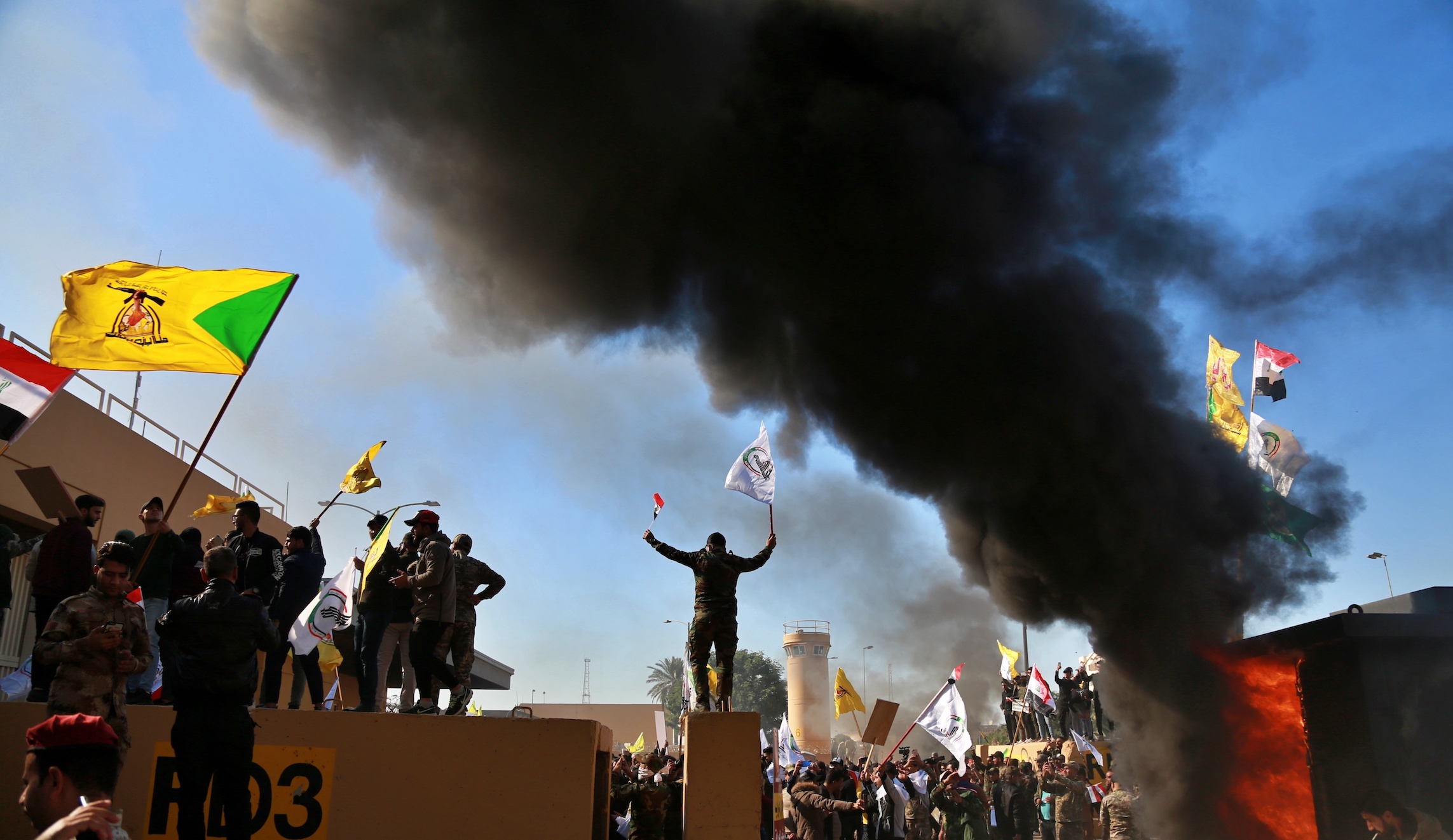
Ambassador Matthew Tueller is headed to the embassy in Baghdad following an attack on the facility by Iranian-controlled militias, cutting short a trip amid claims that he abandoned the post.
“Reports that he has been evacuated are false,” a State Department spokesman told the Washington Examiner. “He is returning to the embassy.” Tueller, who took over as the top American diplomat in Iraq in June, was “on previously scheduled personal travel for over a week” prior to the attack Tuesday, the spokesman said.
Recommended Stories


The assault was orchestrated by militia leaders loyal to Iran, according to U.S. assessments that underscore Tehran’s influence in Iraq.
“It’s important for him to come back because it would be a show of force that America is not going to flinch in the face of this pressure,” Behnam Ben Taleblu, a senior analyst at the Foundation for Defense of Democracies, told the Washington Examiner.
The incident involved hundreds of protesters led by Iranian-controlled militias who aimed to retaliate against American airstrikes targeting Kataib Hezbollah. President Trump authorized those U.S. airstrikes after Kataib Hezbollah killed one American civilian and injured several U.S. soldiers in a rocket barrage targeting a military base. The tit-for-tat sequence provided a dangerous demonstration of a problem that Tueller identified as his chief concern for Iraq during his Senate nomination hearing earlier this year.
“Where the United States seeks to help Iraq build professional security forces loyal to the state, Iran seeks to cultivate irregular forces operating outside the full control of the government,” Tueller testified in March. “In short, Iran wants to keep Iraq weak and dependent. If confirmed, I will work to make Iraq strong and sovereign.”
Still, officials in Baghdad rebuked the Trump administration for conducting the airstrikes, calling the operation “a flagrant violation of the sovereignty of Iraq” and affirming that Kataib Hezbollah and similar militias “are an Iraqi national force.” The Iraqi central government has struggled to control the militias, however, which have close links to Iran’s Islamic Revolutionary Guards Corps.
“Naturally, the brave people and heroic Hashd al-Sha’bi forces of Iraq reserve the right to retaliate and give [proportionate] response to the recent big crime of Americans according to international laws and conventions,” Iran’s IRGC said Monday, in a statement that seems to have foreshadowed the attack on the embassy.
The Pentagon is sending “around 100” U.S. Marines to reinforce the security at the embassy, but the State Department is frustrated by Iraq’s failure to protect American facilities from Iranian threats.
“We have made clear the United States will protect and defend its people, who are there to support a sovereign and independent Iraq,” the State Department spokesman said. “We are closely monitoring the situation in Iraq and call on the Government of Iraq to protect our diplomatic facilities per their obligations.”
