


Asked what she doesn’t like about presumptive Republican presidentialal nominee Donald Trump, Lily Eskelsen Garcia, president of the 3 million-member National Education Association, laughs and replies, “Where do I start?”
Randi Weingarten, her counterpart at the 1.6 million-member American Federation of Teachers, agrees. “He is dangerous. He does not have the temperament to be president.”
Recommended Stories


This much is clear: Two of Trump’s harshest critics represent the nation’s largest teachers unions. Both groups endorsed Democratic candidate Hillary Clinton early in the race, well before most other unions made their announcements.
They have repeatedly denounced Trump’s immigration proposals and his rhetoric in general as “hateful” and “incendiary.” The unions — who are coordinating, their presidents confirm — will likely donate millions to union-run super PACs to take him down.
What they don’t do much is attack Trump specifically on education policy. In part, that’s because Trump himself doesn’t talk about it much. He is clearly more interested in subjects like immigration, trade and fighting terrorism.
“He is hard to pin down on actual [education] policy,” Garcia conceded in an interview with the Washington Examiner, adding, “That is classic Trump.”
Weingarten confesses she doesn’t know what Trump’s education policy really is, and she doesn’t think he knows either.
“I have no idea if he even knows what he is talking about,” she said.
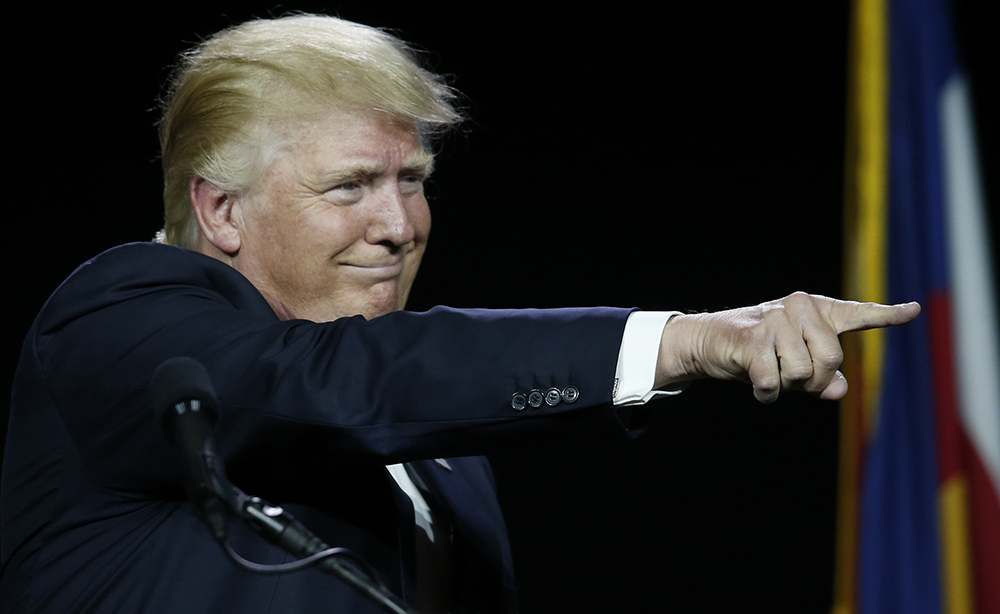
Donald Trump doesn’t talk about education policy much. He is clearly more interested in subjects like immigration, trade and fighting terrorism. (AP Photo)
There is however, an additional reason they oppose Trump: When he does discuss education, he says teachers unions are the main problem and school choice, either through vouchers or charter schools, is the way to fix that. To the extent that Trump has an education agenda, that is it.
Such policies are a dagger aimed right at the heart of teachers unions. Trump even makes clear that he’d like to see more public schools closed down in favor of the alternatives like charter schools, which is further than most education reform advocates go.
“He has pretty much said that his agenda would be: privatize, privatize, privatize,” Garcia said.
In Trump’s 2000 book, The America We Deserve, he argued that parents need the option to send their kids to places other than public schools. He argued that labor groups were the ones blocking this.
“The Brotherhood of Blackboard Workers wants to keep the door closed to competition. That way they can run things as they choose, without review. And we’ve got to bring on the competition — open the schoolhouse doors and let parents choose the best school for their children. Education reformers call this school choice, charter schools, vouchers, even opportunity scholarships. I call it competition — the American way,” Trump wrote.
In his 2015 book, Crippled America: How To Make America Great Again, Trump doubled down on that: “Competition is why I’m very much in favor of school choice. Let schools compete for kids. I guarantee that if you forced schools to get better or close because parents didn’t want to enroll their kids there, they would get better. Those schools that weren’t good enough to attract students would close, and that’s a good thing.”
Weingarten scoffs, saying that plenty of studies dispute that school choice works. “The marketplace is really, really harmful to kids,” she said.
One of the top contenders to be Trump’s vice president is New Jersey Gov. Chris Christie, who has repeatedly, and bitterly, clashed with the teachers unions in his state.
So, assuming Trump wins and is serious about education reform, he could be a major threat to teacher union power. He is also a potential threat to the labor movement more generally.
He is a supporter of Right To Work laws, which say that workers cannot be required to join or otherwise financially support a union as a condition of employment. States with the laws generally have weaker unions because they cannot compel dues from workers who aren’t interested in joining. That’s a good thing as far as Trump is concerned.
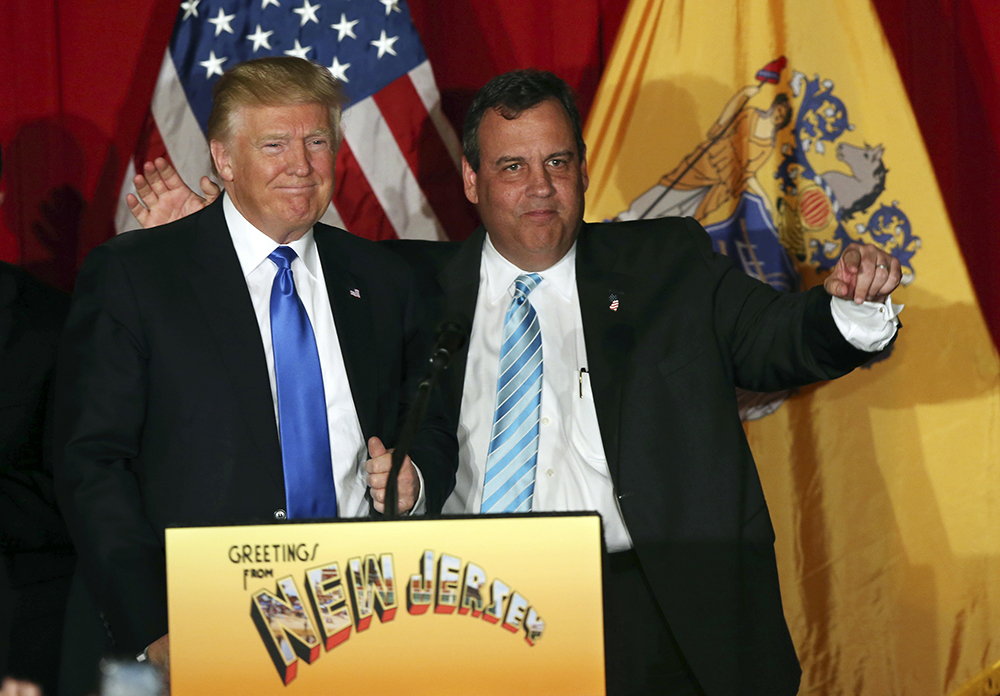
One of the top contenders to be Trump’s vice president is New Jersey Gov. Chris Christie, who has repeatedly, and bitterly, clashed with the teachers unions in his state. (AP Photo)
“It is better for the people. You are not paying the big fees to the unions. The unions get big fees. A lot of people don’t realize they have to pay a lot of fees. I am talking about the workers. They have to pay big fees to the union. I like it because it gives great flexibility to the people. It gives great flexibility to the companies,” Trump told the South Carolina Radio Network in a February interview.
The NEA’s Garcia said that Right To Work was “absolutely” a major concern of theirs regarding Trump and helping to drive their effort against him. “Right to Work laws are about weakening unions,” she said.
Garcia and Weingarten both declined to say how much their unions would be putting into the 2016 election. “That is still being determined,” Garcia said.
In the 2012 election cycle, the two groups poured an estimated $26 million into the election, according to the Center for Responsive Politics.
Donald Trump, union man
There are many ironies to the teachers unions’ fight against Trump. One is that he is arguably the most pro-union Republican candidate since Richard Nixon, though most in the labor movement would call that a low bar to clear.
Still, Trump has dealt with construction and trade unions throughout his career as a developer and hotel owner. He boasted to Newsweek in an interview last year that he had “great relationships with unions.”
In The America We Deserve, he wrote, “Is Trump a union man? Let me tell you this: Unions still have a place in American society. In fact, with the globalization craze in full heat, unions are about the only force reminding us to remember the American family.”
Trump agrees with much of labor’s economic agenda. He is a major opponent of free trade policies, echoing the unions’ arguments that the deals undercut American businesses and cost jobs by enabling off-shoring. This year he told CNN’s Wolf Blitzer he was open to a deal on raising the minimum wage, something he had previously opposed.
Trump is even a card-carrying union man himself, having joined the Screen Actors Guild as a result of his numerous appearances in television and in movies.
That has posed something of a dilemma for labor leaders, a few of whom, like Communications Workers of America President Chris Shelton, have conceded that Trump is supported by a sizable contingent of their rank-and-file. CWA eventually endorsed Clinton’s chief rival for the Democratic nomination, Bernie Sanders.
In June, Trump explicitly reached out to Sanders’ supporters. He argued that the senator’s fans should join him to fix “our disastrous trade deals.”
In response to that effort, the AFL-CIO, the nation’s largest labor federation, conceded Trump’s appeal even while warning its members against supporting him. “Donald Trump recognized some of the challenges working people have known for decades, but the truth is he doesn’t have a clue how to fix our problems. He would only make them worse,” said AFL-CIO spokesman Josh Goldstein.
To the extent that Trump has union support, it is largely among the more traditional, blue-collar construction and trade ones that struggle against foreign competition. Teachers unions, on the other hand, primarily represent public sector workers who are shielded from those particular economic pressures.
Once a small part of the labor movement, public sector unions now represent about half of the estimated 14 million people total in organized labor. Teachers unions represent a major chunk of that 7 million.
For them, Clinton is the candidate they have been waiting for. She has endorsed almost every position the NEA and AFT have. The Democratic candidate has, for example, criticized education reformers’ efforts to hold teachers accountable through regular testing. Unions argue that this is unfair to the teachers.
“We should be ruthless in looking at tests and eliminating them if they do not actually help us move our children forward,” Clinton told the International Business Times last year.
While Clinton endorsed the charter school movement in her 1996 book, It Takes a Village, she has since echoed labor leaders’ criticisms of it, too. At a November campaign stop, she said, “They don’t take the hardest-to-teach kids, or, if they do, they don’t keep them.”

Once a small part of the labor movement, public sector unions now represent about half of the estimated 14 million people total in organized labor. Teachers unions represent a major chunk of that 7 million. (AP Photo)
She is also adamantly opposed to anything that would impair union organizing. As a New York senator, she co-sponsored the Employee Free Choice Act. The legislation would have radically boosted labor workplace organizing by eliminating the employer’s right to request a federally monitored secret ballot election to confirm that the workers wanted a union in the first place.
“As president, I will fight to defend workers’ right to organize and unions’ right to bargain collectively, and I will ensure that teachers always have a voice and a seat at the table in making decisions that impact their work,” Clinton said in accepting the NEA endorsement in November.
AFT’s Weingarten is even a personal friend of Clinton’s. She was among the people Clinton shared her secret personal email address with while secretary of state.
Taking on Common Core
The big unknown regarding Trump is how serious he is about education reform. Click on the “positions” section of his campaign website and you will find that the subject is not listed.
He does have some first-hand experience with education, and it has become a major headache for him. In 2005, he founded the Trump Education Initiative, which promised to teach students the billionaire developers’ investment strategies.
It was originally named Trump University, but that was dropped at the New York Education Department’s insistence because it lacked accreditation. Three pending lawsuits allege the school was a scam. Trump has called the allegations “baseless.”
Tellingly, the one issue related to education that animates the Republican candidate the most is apparently Common Core, the controversial effort to create national school education and testing standards. In March, his campaign produced a minute-long video on the subject.
Staring directly into the camera, Trump said, “I am a tremendous believer in education, but education has to be at a local level. We cannot have the bureaucrats in Washington telling you how to manage your child’s education.
“We have to get rid of Common Core. We have to bring education back to the local level.” He has made similar comments throughout the campaign.
The video gives the clear impression that Trump thinks, or perhaps wants the audience to think, that Common Core is a federal project and therefore the next president could reverse it or at least prod Congress to do so.
The problem with that idea is that Common Core is not federally run. It is a state-level project primarily organized by the National Association of Governors and the Council of Chief State School Officers. To date, 46 states have adopted a version of it.

“We have to get rid of Common Core. We have to bring education back to the local level,” said Donald Trump. (AP Photo)
That doesn’t mean the federal government did not have any role in the states’ actions. In some cases, Common Core adoption was assisted through grants to states from the Education Department under President Obama’s Race to the Top initiative. In other cases, the department granted states waivers from the Bush-era program No Child Left Behind if they adopted Common Core or a similar program.
Those grants have all been given out though, and NCLB’s authorization runs out in August. In short, to the extent that federal government was involved in Common Core, it isn’t anymore. There is no federal law requiring Common Core’s adoption that could be repealed. Nor is there an executive order to rescind or an Education Department policy to change.
In fact, the Every Student Succeeds Act, the education-funding bill signed by Obama in March to replace NCLB, states that “the [education] secretary shall not attempt to influence, incentivize or coerce state … adoption of the Common Core State Standards.” The provision was included to address concerns by the program’s critics.
The Trump campaign did not respond to questions regarding how he would roll back Common Core, or his education policy in general.
An Education Department source, who requested anonymity, said the only thing they could even think of that the next president could do to prevent states from implementing Common Core would be to try to rescind any grant money to the states that hasn’t been spent yet. Even then, it is not clear how much would be unspent by that point or if the department even has the authority to take back grant funds once they have been awarded.
In short, if Trump really wanted to get rid of Common Core, he should be running for governor, not president, and even then he could only affect it in the state he ran in.
Ironically, re-thinking Common Core is one of the areas where there is some potential common ground between Trump, Clinton and the teachers unions. While both AFT and NEA have endorsed it, Common Core has been a major source of internal turmoil for them because some of their rank-and-file members are heavily opposed to it. Even the union leaders have expressed major concerns.
“I have no problems with Common Core. I have a lot of problems with how [states] have implemented it. In some places, it became another system of high-stakes testing for teachers,” Garcia said.
Clinton is similarly ambivalent about Common Core. When she was asked about it in April by Newsday, Clinton said she supported it in theory, but indicated that she thought the actual program had gone wrong.
“I’ve also been involved in the past, not recently, in promoting such an approach and I know Common Core started out as a, actually nonpartisan, not bipartisan, a nonpartisan effort that was endorsed very much across the political spectrum … What went wrong? I think the roll-out was disastrous,” she said.
