
In purple Georgia, where independent voters make up nearly 30% of the electorate, Republicans are hoping to pull nonpartisan voters who support Sen. Jon Ossoff (D-GA) into their fold to vote for Republican Rick Jackson in the state’s gubernatorial race.
The Peach State has a history of split-ticket voters, with 6.1% of voters splitting their tickets in the 2022 elections of Sen. Raphael Warnock (D-GA) and Gov. Brian Kemp (R-GA), according to a University of Georgia study. Democrats have increasingly turned purple what several years ago was a deep-red state, creating a landscape in which successful state Republicans, like Kemp, have targeted independent voters.
Recommended Stories
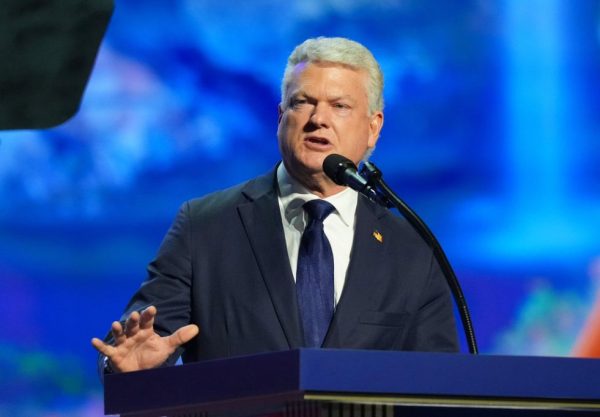

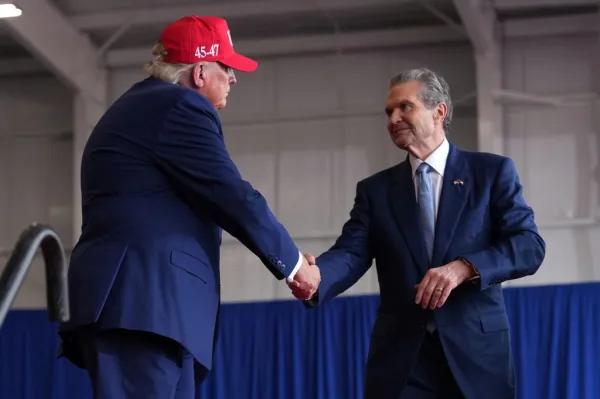
As term-limited Kemp leaves office with a 70% approval rating, Republicans are hoping Jackson can ride Kemp’s popularity to the governor’s mansion by picking up split-ticket voters along the way, despite Ossoff’s wide margin in the Senate race. On the other side, Democrats are hoping factors like Ossoff’s down-ballot campaigning and President Donald Trump’s unpopularity can help them flip the governor’s mansion blue.
Why do pundits expect split-ticket voters between Jackson and Ossoff?
Ossoff has held a commanding grip on his reelection bid throughout the 2026 election season, facing no primary challengers, building up a massive war chest, and leading his general election opponent, Rep. Mike Collins (R-GA), by an average of 8.2 percentage points in polling.
While Georgia’s Senate race has been labeled a “Likely Democrat” race by Cook Political Report, the governor’s race has remained a toss-up, with Jackson leading Bottoms by a slim 1.2 average percentage point margin, according to RealClearPolling.
University of Georgia political science professor Trey Hood, co-author of the university’s study on 2022 split-ticket voting, spoke with the Washington Examiner on the factors that have made pundits believe Jackson could scoop up some split-ticket voters supporting Ossoff. He called the Collins and Jackson campaign strategies “very different.”
“Mike Collins is just running a sort of get-out-the-MAGA-base strategy. That just really doesn’t usually work in Georgia anymore,” Hood said. “We have enough moderate, independent voters, especially in the Atlanta suburbs. You have to make an appeal to that group. Jackson is definitely trying to appeal to that group.”
CANDIDATES IN PURPLE STATES TOUT CROSS-PARTY ENDORSEMENTS IN APPEAL TO MARGINAL VOTERS
Hood emphasized how close the governor’s race looks, according to the polling, adding that these split-ticket voters are often independent, moderate voters, with partisans likely sticking to their party lines. He called it “really a necessity” for candidates to appeal to this independent group to have a successful campaign in the Peach State.
Both Jackson and Ossoff have also made a point of touting cross-party endorsements throughout their general elections, in an apparent appeal to these marginal voters.
He noted how quickly Jackson adopted a strategy to appeal to independent voters after he won his primary against Lt. Gov. Burt Jones (R-GA), who was endorsed by both Kemp and Trump. Kemp and Trump supported Jackson once he won the primary.
“A lot of these split-ticket voters are probably put off by Trump. But as soon as the primary was over, Jackson pivoted and started trying to appeal to the middle again,” Hood said.
When Jackson first launched his bid, he framed his campaign in a Trumpian, MAGA-style light, telling his supporters, “If you want a governor who’s like President Trump, who will stand up to the radical left, the media, the bureaucracy, and anyone else that tries to take advantage of Georgians, then I’m your man.” But Jackson has also tied himself closely to Kemp, clipping praise from the popular governor in an ad during his primary runoff against Jones and framing himself as the heir to Kemp’s GOP leadership style in the last several months of the race.
“Governor Kemp has always been in Georgians’ corner,” Jackson wrote on X days before Election Day. “He knows what this job requires, I’ll build on his legacy, and I’m proud to have his support.”
Jackson is also running in a year where incumbent state Republicans have outperformed their Republican counterparts in federal elections. In states like New Hampshire and Texas, incumbent Republican governors like Govs. Kelly Ayotte (R-NH) and Greg Abbott (R-TX) are seeing more polling success than their Senate race counterparts – former Sen. John E. Sununu and Attorney General Ken Paxton.
GOV. AYOTTE READIES FOR LIKELY VICTORY AS NEW HAMPSHIRE SENATE RACE MARGINS STAY TIGHT
“Of course [Kemp] is not running, but if someone is thinking to themselves, ‘I really like what’s been going on at the state level. My taxes have gotten lowered, et cetera, et cetera.’ They might be more willing to put a Republican back in the governor’s office and then vote for a Democrat for Senate, for instance,” Hood told the Washington Examiner.
Democrats project confidence for Bottoms
As Jackson has tried to paint himself as an heir to Kemp’s policies, Bottoms has aimed to tie the Republican to Trump amid the president’s low approval ratings, pointing to his billionaire status.
“Rick Jackson wants to use the governor’s office to enrich himself – just like Donald Trump,” Bottoms wrote on X, linking to a video ad comparing Jackson’s wealth to Trump’s while pointing to cost of living issues for everyday Georgians.
Bottoms has clipped Jackson saying he’ll “be like Trump” and dubbed him “Slick Rick Jackson,” while pointing to the millions of his personal dollars he is spending on his own campaign. Jackson, the billionaire founder of Jackson Healthcare, has invested $200 million of his personal funds into his race.
Tharon Johnson, Democratic strategist and adviser to the Bottoms campaign, projected confidence about the topic of split-ticket voters in a podcast interview with the Atlanta Journal-Constitution’s Politically Georgia podcast in September. He told the outlet he believes that “Rick Jackson is no Brian Kemp” and that Georgia voters are “going to look at each race and they’re going to pick the best person.”
Johnson also emphasized the value of unity on the Democratic ticket, opining that he thinks “Mike Collins should be offended” that Republicans are eyeing split-ticket voters.
On the Democratic ballot, Ossoff has been campaigning hard for downballot Democrats, with the party hoping that a rising tide will lift all boats. Ossoff, who is one of the Senate’s most prolific fundraisers, has made many joint appearances with Bottoms as the two have campaigned together across the state — a dynamic that Jackson and Collins have not really replicated, aside from recent joint appearances at Trump rallies in October.
Bottoms and Ossoff have also brought in heavy-hitting Democratic names to campaign with them in the Peach State, holding a large rally with former President Barack Obama on Wednesday and campaigning with former Vice President Kamala Harris.
Bottoms has also secured investments from the Democratic Governors’ Association as she aims to gain ground on the funding deficit between her campaign and Jackson’s largely self-funded campaign, hitting the campaign trail with DGA chairman Gov. Andy Beshear (D-KY).
Where do things stand ahead of Election Day?
As Hood put it, the toss-up race between Bottoms and Jackson “looks like it could be a squeaker” just days out from Election Day.
With Georgians breaking state records for early voter turnout, surpassing two million votes one week out from Election Day, margins in the governor race polls remain razor thin.
As of Oct. 28, Bottoms led Jackson in the Kalshi prediction market odds on the race, which have flipped between the two candidates throughout the race.
OBAMA JABS TRUMP OVER WHITE HOUSE ‘ARTS AND CRAFTS’ AT CAMPAIGN RALLY IN GEORGIA
“If the polling’s all correct, it looks to be a very, very close race, the governor’s race,” Hood said.
“If it’s very close, it doesn’t take a lot of votes to matter,” he added, pointing to the impact that marginal, split-ticket voters could have.