

In the months since Ayatollah Mojtaba Khamenei became the supreme leader following the assassination of his father, he has been characterized by the U.S. government as an ineffectual leader, and possibly even dead.
But in the last several days, that rhetoric has pivoted — concurrent with a surprise statement on Thursday from the ayatollah, declaring victory over “imperialism, led by the U.S.” and its “military base called Israel.”
Recommended Stories


“The malicious enemy has been defeated in its confrontation with the Armed Forces,” Khamenei wrote in the statement, which was published and read out by Iranian state media. “Since it has received a decisive blow both in military combat and in [Iran’s] public squares and streets, it’s experiencing a profound, significant humiliation.
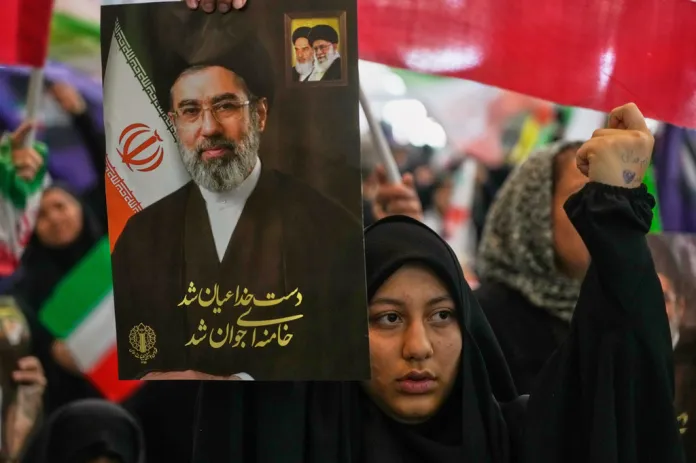
“The enemy has focused its schemes in hybrid warfare on two points: the resilience of the Iranian people and trying to create errors in the assessments of the country’s officials,” the ayatollah said. “The instrument it’s using for both is sowing the seeds of doubt, despair, fear, mistrust, and discord.”
The supreme leader called for Iranians to show “steadfastness” and “clear-sightedness” to thwart enemies’ “sinister scheme” by “refraining from echoing the enemy’s narrative.”
The Thursday declaration of victory from Tehran carried a bellicose tone. But just days prior, President Donald Trump offered a rather friendly assessment of the supreme leader, saying the Iranian people “have a lot of respect for him.”
“I’d like to meet him,” Trump told the New York Post in a Tuesday interview. “I’d love to meet everybody. I would like to meet him and we probably will meet at some point, depending on how it all works out.”
The ayatollah has not appeared in public since he was injured in a bombing of the Council of Experts at the beginning of the war. Khamenei has not delivered any addresses in person, on video, or via audio recording. His speeches, including the Thursday declaration of victory, are disseminated by Iranian state media organs.
In the same interview, Trump confirmed that the ayatollah is “involved, absolutely” in the affairs of the regime — countering previous rhetoric from the U.S. government that framed Khamenei as iced out of power by the establishment.
Back in March, Trump hand-waved Khamenei as a “lightweight” who “isn’t going to last.” Asked directly if the ayatollah was even alive, the president said he was “probably alive in some form.” Defense Secretary Pete Hegseth said the “so-called not-so supreme leader” was “scared,” “injured,” and “on the run” because he “lacks legitimacy” within the Iranian government. Other statements from the White House reported that intelligence officials suspected the ayatollah of being a closeted homosexual.
Secretary of State Marco Rubio, speaking at a House Foreign Affairs Committee hearing on Tuesday, affirmed there are “indications out there that [Khamenei] is increasingly engaging at some level.”
TRUMP BLASTS REPUBLICANS WHO VOTED AGAINST HIM IN WAR POWERS RESOLUTION: ‘UNPATRIOTIC’
“We haven’t seen him publicly,” Rubio said, explaining the supreme leader has been in contact with the U.S. through an extensive network of intermediaries. “And I would imagine given what’s happened to multiple leaders in that system, being very public is probably not something that’s recommended for them internally.”
Trump said in a Truth Social post on Wednesday that reports of Iran and the United States pausing communications are “false and erroneous.”
“The conversations between us have been going on continuously, including four days ago, three days ago, two days ago, one day ago, and today,” the president said.
