CHARLOTTE, North Carolina — One minute, a large, bearded private security guard named Charlie had his hand on my back telling me I couldn’t interview a delegate at a bar, and just a few hours later, six Black Lives Matter protesters had encircled me, asking me if I was “a fed” and telling me I was not allowed to report on their protest.
In my first half-day at the coronavirus-modified Republican National Convention, I encountered near uniform opposition toward the practice of reporting, not from Republican delegates but from GOP officials, their private security, and from left-wing protesters.
Recommended Stories
Conventions are typically an odd blend of wide-open access mixed with tense restrictions. Blocks are closed off, security is high, checkpoints are many, and credentials are required. At the same time, thousands of members of Congress, Cabinet officials, state legislators, and party chairpersons are typically walking around a convention hall, or downtown, with their names helpfully on a tag hanging around their necks.
This year, things are different. Because there is about one-fifth the normal number of delegates, they are all housed at a single hotel, and the public and press have no access to that hotel at all. When a colleague and I tried to enter the Westin on Saturday for a scheduled meeting with a delegate, we were turned away for lack of credentials. When we inquired about credentials, convention staffer Tatum Gibson told us there was no way we could get any, in part because we hadn’t undergone the multistep coronavirus screening.
There was some sense to this health restriction. The delegates are spending hours indoors together, in the hotel and at the convention center. The party wants a controlled environment where everyone inside has a very low likelihood of carrying coronavirus. Plus, we’ve all been denied access inside the bigwig convention hotels before.
But the GOP went further in its access restrictions. When I returned later Saturday afternoon to interview and talk with delegates or staffers in the courtyard in front of the Westin, Gibson said, “I hate to be the person who says you can’t stand here, but you can’t. The Westin property is off-limits to the public.”
I pointed out that I had introduced myself to Charlotte police in this very courtyard and that they were fine with my presence. There was no security perimeter, and she was literally the only person asserting that I wasn’t allowed to stand outside this hotel, which of course was a restriction with no health justification and no real security justification. Eventually, I walked down to Charlotte’s south side for what would prove to be one of the oddest experiences in my career of bar reporting.
The RNC had planned many evening events for its delegates, including a trip to the Billy Graham museum. One event Saturday evening was an outing to a bar called Hoppin’ Taproom. I love beer. I love hoppy IPAs. I love taprooms.
I did not love Hoppin’ Taproom.
Let’s just say it was more hoppin’ than I expected. I have often reported from bars where I am the youngest person. I may have reported from bars where I am the oldest person. I have certainly never before stepped foot into a saloon where I was twice the average age, but I’m pretty sure that was the case at Hoppin’ Taproom.
The girls were dressed as if they were going to a cotillion but didn’t want to risk being too warm. The guys were dressed as if they had just woken up and had stepped outside to bring in the trash cans. The taps were self-service. Throw in coronavirus anxiety in a semi-crowded bar, and it was not my optimal bar experience.
I had dressed to fit in at a Republican convention and not at a college-aged bar, and so the manager, Travis, instantly spotted me in my white button-down as a reporter. Even before they closed off the top floor for the RNC delegates, Travis was eyeing me suspiciously. I camped out at a downstairs high-top with the hope of catching a delegate coming or going or just opting for the downstairs wall of self-service taps. When one delegate came down for a pint, I approached him and started to introduce myself. That’s when the private security forces jumped in.
Charlie, a large man with a very large beard, stopped me, putting his hand on my back and saying “no press.”
I explained to Charlie that I was a reporter in a public area of a bar and that he lacked authority to tell me I couldn’t ask questions. We went back and forth long enough that the delegate had retreated upstairs with his self-served beer. In truth, very few delegates ever showed up at Hoppin’ Taproom — maybe six in total. The prospect of getting an interview or two was not valuable enough to justify continuing to hang out there.
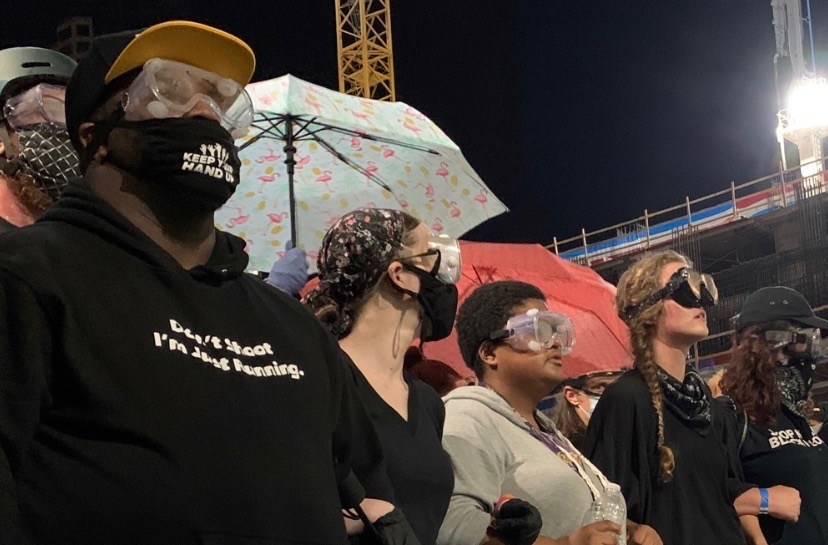
So I started the mile-plus walk back to my hotel. Walking up College Street, I came upon a protest marching up Martin Luther King Jr. Boulevard. They were chanting, “Black Lives Matter,” and, “Fuck Trump.”
I saw one protester being treated apparently for pepper spray in his eyes. When I started to film the scene, one protester stuck his hand in front of my camera. I identified myself as a reporter. Soon, three or four protesters stood in front of me, saying, “He has no comment,” and “Can you leave?”
Then, one woman, who identified herself as the victim’s lawyer, yelled, “Who are you?!”
Long after I left the apparent pepper-spray victim, this question was shouted at me repeatedly. Thankfully, I had the answer! “I’m Tim Carney with the Washington Examiner,” I said time after time, flashing my congressional press pass.
“So are you a fed?” was one reply.
“No, I’m a reporter,” I answered.
“You don’t have to be so condescending.”
“Wait, what?”
“I asked a question. You didn’t have to be condescending in your answer.”
As I stood there pondering how I could have answered, “Are you a Fed?” in a less condescending way than, “No,” (I am, in fact, not a fed) I suddenly found myself encircled by six protesters. Also, throughout all of this, famed Uptown Charlotte criminal-turned-street evangelist Sam Bethea, shouted “the blood of Jesus,” over and over again.
“You’re making a lot of people here very uncomfortable,” one protester told me, as the circle tightened around me.
For taking pictures or videos of protests over the decades — that is, doing journalism — I have been attacked (a man in an Occupy D.C. drum circle tried to hit me with his bike helmet) and threatened with violence by much larger men at Lafayette Square. This is the first time I was ever surrounded by protesters.
Thankfully, I had a magic weapon. I just turned to each protester in turn, and as they shouted, “Who are you?!” I held out my note pad and pen and said, “I’m Tim Carney with the Washington Examiner, could I interview you about this protest?”
At that, each protester turned away in disgust and left me — all this against the soundtrack of Bethea’s, “the blood of Jesus! The blood of Jesus!”
After that, I was free to go and follow the protesters and the police. I tweeted some videos in the below thread.
I saw no violence Saturday night. I saw a smattering of juvenile or intensely angry behavior, but it was a peaceful protest with no property damage while I was there.
What bugged me was the invocation of phrase, “You are making people feel uncomfortable,” as a way to try to make me stop doing something that is legal and normal: reporting on a public protest on a public street.
The irony was the similarity between the RNC, which said I couldn’t stand on a courtyard or interview a guy at a bar, and the protesters, who were similarly antagonistic to journalism.
The good news was that on Sunday morning, the delegates walking from the Westin to the convention center were almost all willing to talk on the record. I ran into Charlie the security guard too. He was off duty and saw me interviewing delegates. He joked, “Still bothering people?”
Yes, I replied. “It’s my job.”
Charlotte pic.twitter.com/nZ7k0prpJi
— Tim Carney (@TPCarney) August 23, 2020