The Virginia Supreme Court struck down the Democratic Party’s partisan gerrymander of the state’s congressional map Friday, holding that because Virginia’s lengthy voting process had begun well before the General Assembly approved the new map, the constitutionally required intervening election between amendment proposals had not occurred.
The ruling is a huge win for Virginia Republicans and the rule of law, and a huge loss for Democrats generally — and Gov. Abigail Spanberger and former President Barack Obama in particular.
Recommended Stories
As the Virginia Supreme Court details in its opinion, the Virginia Constitution deliberately created a “laborious” constitutional amendment process to ensure that the constitution could not “be changed lightly.”
Specifically, the constitution requires the General Assembly to pass proposed amendments twice, with a full election of the House of Delegates taking place between the two votes, before the amendment can be placed on the ballot for voter approval.
In this case, the General Assembly first approved the new congressional map on Oct. 31, 2025, just four days before voting for the House of Delegates ended on Nov. 4. The problem for Democrats is that, thanks to one of the most expansive early voting systems in the nation, voting for the House of Delegates had begun six weeks earlier, on Sept. 19. The Virginia Supreme Court noted that more than 1.3 million voters had already cast ballots before the General Assembly approved the new map, amounting to approximately 40% of the final vote total.
By failing to vote on the new map before 40% of voters had already voted, Democrats denied those voters their constitutional right to two opportunities to hold their elected representatives accountable for hastily changing the congressional maps in a purely partisan manner. As the court noted earlier in its opinion, voters from both parties had overwhelmingly approved nonpartisan maps just six years earlier, in 2020.
Virginia Democrats attempted to argue before the court that the “intervening” election requirement was satisfied because “Election Day” fell after the new partisan maps had been approved. But the court was having none of it. “This view appears to be wholly unprecedented in Virginia’s history,” the court wrote, noting that “in the half century since adoption of Virginia’s 1971 constitution, the General Assembly has approved 63 amendments for placement on the ballot and voters have ratified 54 of them.”
“Of these 63 prior proposals,” the court said, “the Commonwealth has identified none in which the General Assembly passed a proposed amendment after voting in the general election had already begun.”
Some have wondered why the Virginia Supreme Court allowed the referendum to proceed if the procedural issues it identified today existed when Virginia Republicans sued to stop the ballot measure earlier this year. The court specifically addressed that point, noting that it was Virginia Democrats who insisted the voting go forward before the court ruled.
“It is fair to ask whether we could have or should have reviewed the constitutionality of the proposed amendment prior to it being presented to the voters,” the court explained. “But it is not a question the Commonwealth should ask. Throughout this litigation, the Commonwealth has insisted that we cannot lawfully decide this case prior to the referendum.”
“Having successfully insisted (over the objection of the Claimants) that we postpone judicial review of the constitutional amendment until after the election process, it might be tempting for the Commonwealth to think that the final vote implicitly stacks the deck in its favor — perhaps enough so that the exercise of any judicial review could be viewed as an ultra vires effort to overturn the will of the people,” the court continued. “If this supposition were true … then judicial review of allegedly unconstitutional procedures used to adopt a constitutional amendment would not exist in the Commonwealth of Virginia.”
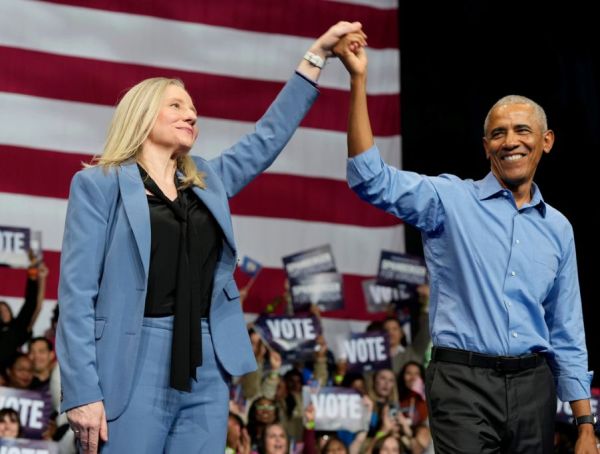
Democrats poured more than $70 million into their gerrymandering campaign, and ads featuring former President Barack Obama ran constantly on television for weeks before the vote. The court’s rejection of the partisan maps is a huge blow to Obama’s credibility.
But no one had a worse week than Virginia Senate President pro tempore Louise Lucas. Lucas had been a driving force behind the amendment, defending the partisan gerrymander on social media with the statement, “You all started it and we f**king finished it.” Lucas did not censor the profanity in her post.
VIRGINIA SUPREME COURT BLOCKS REDISTRICTING REFERENDUM
Lucas’s office was raided by the FBI earlier this week in connection with corruption and bribery allegations related to marijuana dispensary businesses. Importantly, the investigation was opened by the Biden administration, not President Donald Trump.
With gas prices high due to Trump’s Iran war and economic uncertainty surrounding his tariff policies, Democrats may still win control of the House this November. But by cutting corners and rushing through a nakedly partisan map, Virginia Democrats have alienated rural voters for decades to come and encouraged Republican majorities in other states to redraw their own maps, making it harder for Democrats to maintain control of the House going forward.