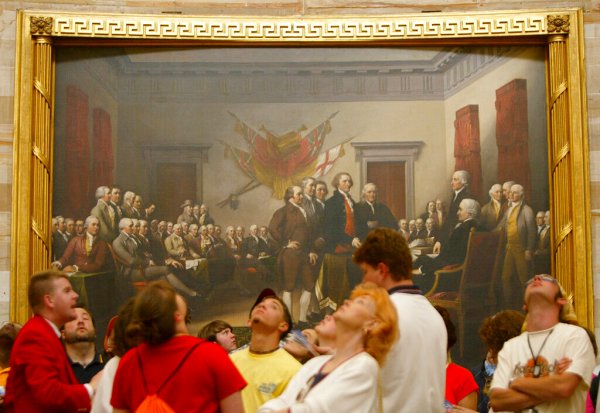
Every American schoolchild is taught that the Declaration of Independence was published on July 4, 1776, and that it proclaims that “all men are created equal” and that we are endowed by our “Creator” with the “unalienable” rights of “life, liberty, and the pursuit of happiness.” Although the declaration further decrees that these “truths” are “self-evident,” historians have been disagreeing for generations about what the declaration actually means.
The most famous book about America’s founding document is almost certainly Carl Becker’s 1922 classic The Declaration of Independence: A Study on the History of Political Ideas. Becker argued that the declaration memorialized the political ideas of John Locke, an English philosopher and physician who is widely regarded as one of the most influential Enlightenment thinkers. Becker wrote: “The Declaration, in its form, in its phraseology, follows closely certain sentences in Locke’s second treatise on government.” Locke’s ideas continue to this day to have a profound influence on the theory and practice of limited government and the protection of individual freedom.