

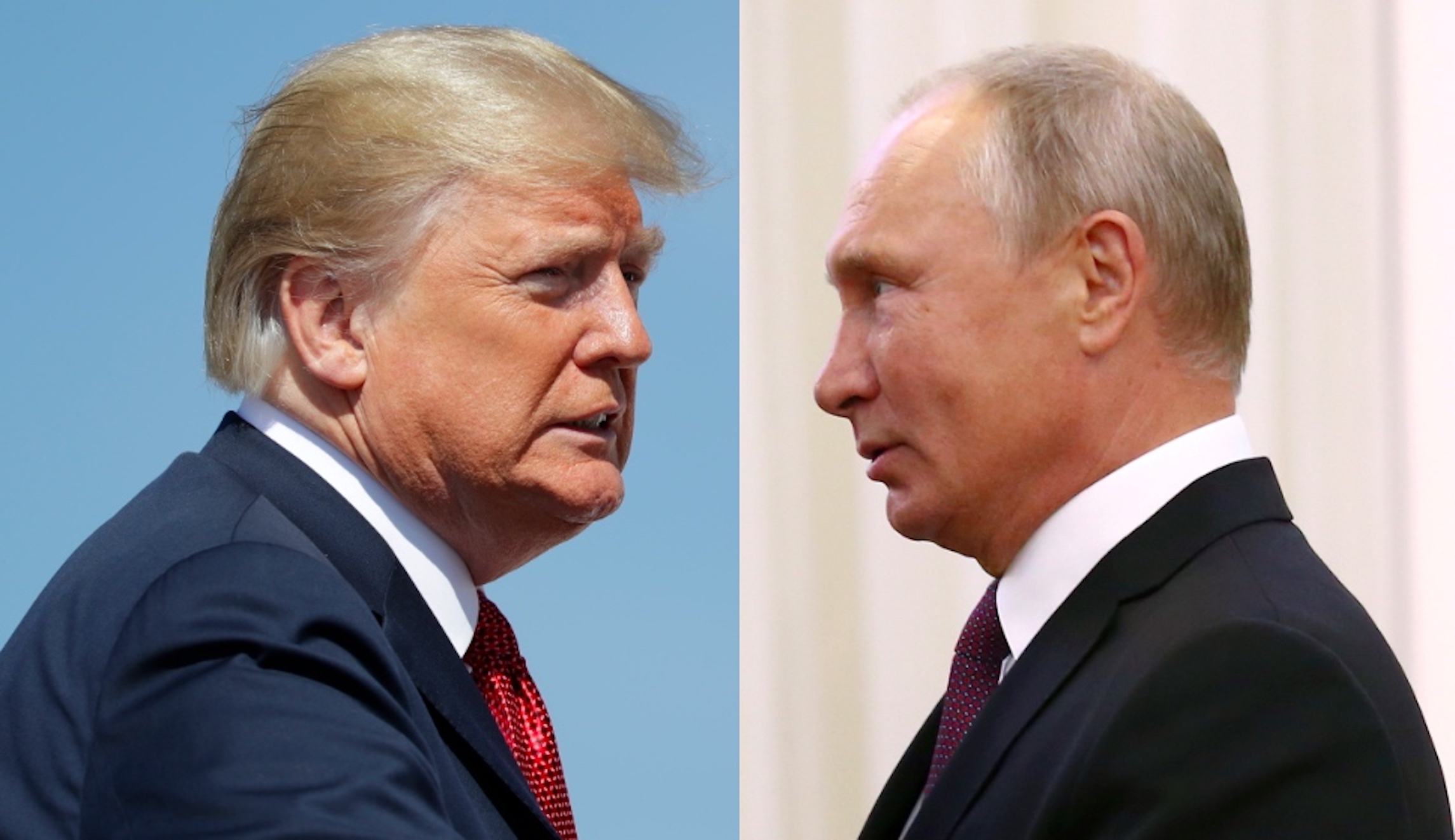
President Trump should quickly and effectively hold the Russian state accountable for its poisoning of Alexei Navalny.
A political dissident, Navalny has long been a thorn in the side of Vladimir Putin and his corrupt circle of oligarchs and security officials. Navalny’s mix of humor and incisive investigative journalism has been particularly offensive to the Kremlin, highlighting its grotesque theft of state resources and absolute abuse of public trust. Over the past few years, Navalny has repeatedly been imprisoned and attacked for his activities. But that treatment pales in comparison to what has happened to the 44-year-old over the past two weeks.
Recommended Stories


Navalny fell ill during a flight between the Siberian city of Tomsk and Moscow on Aug. 20 and was hospitalized after an emergency landing in Omsk. The dissident’s team quickly suggested that he had been poisoned before leaving the Tomsk airport and that his symptoms indicated a neurotoxin of some kind. Adding to their suspicions, FSB domestic security service officers arrived quickly at Omsk hospital, and the previously talkative doctors went quiet. For more than 24 hours, the doctors then refused to allow Navalny to be relocated to a Berlin hospital. They also insisted that no evidence of neurotoxins had been detected in Navalny’s bloodstream. After immense international pressure, Moscow finally allowed Navalny to be flown to Germany. The dissident has been treated there since.
But on Wednesday, the German government announced that its doctors have found Navalny was poisoned by the exceptionally lethal Novichok-class nerve agent. This is the same class of agents that Russia’s GRU intelligence service employed in its 2018 attempted assassination of Sergei Skripal, a defector living in Britain. What’s especially revealing is that Novichok-class agents are very tightly controlled by the Kremlin. They are available only to Moscow’s big three intelligence services; the GRU, FSB, and SVR. Due to Novichok’s lethality and political sensitivity, they are not employed without Putin’s approval. We, therefore, share the Western intelligence conclusion that Navalny is the victim of an attempted murder conducted on Putin’s authority.
Given these facts, it was disappointing to hear Trump downplay the certain involvement of the Russian government. “So I don’t know exactly what happened,” Trump said at a press conference. “I think it’s — it’s tragic. It’s terrible. It shouldn’t happen. We haven’t had any proof yet, but I will take a look.” He added, ” It is interesting that everybody is always mentioning Russia. And I don’t mind you mentioning Russia, but I think probably China, at this point, is a nation that you should be talking about much more so than Russia…” But criticizing China does not preclude holding Russia accountable for its malign actions.
This poisoning is not simply a Russian domestic concern. The use of Novichok-class agents is strictly banned by international law and by Russia’s 1993 accession to the Organization for the Prohibition of Chemical Weapons. There is good reason to enforce these rules. Novichok is highly dangerous, persistent in a contained environment for long periods. We point out the case of Dawn Sturgess. In late June, Sturgess, a random member of the British public, stumbled across the weapon delivery device that the GRU’s killers had discarded after attacking Skripal. Unconcerned with mitigating the danger to members of the public, the team simply discarded a perfume bottle filled with liquid form Novichok. We are reliably informed that the bottle contained enough Novichok to kill hundreds of people. Thinking she had stumbled on some discarded perfume, Sturgess sprayed herself and died an agonizing death soon after. She was not a targeted victim of the Russian state, such as Skripal or Navalny. She was just an innocent Briton in the wrong place at the wrong time. Putin cared not one iota. Rather than show sympathy, Russia has spent the past two years insulting her family with wild conspiracy theories.
This is the direct line between Skripal to British suburbia to Syrian cities to Navalny. Russia has proved itself a direct threat to the security of our citizens. That is Putin’s prerogative, of course. But the U.S. government has a prerogative responsibility to deter Putin’s disruptive behavior. Undeterred, Putin may well choose American soil for his next Novichok adventure.
Trump has legitimate complaints about the way his Russia policy is presented by the media and over the inadequate measure of support many European allies provide for NATO. Still, Navalny’s poisoning requires robust leadership from the leader of the free world. Most indispensably, that means the United States.
If Trump is determined to meet Putin in New York later this month, let him do so. But unless the president wishes to show fealty to the Russian leader, he must attend any meeting on a foundation of resolve. Putin will read carefully how Trump now responds to his latest bloody test.
The president should immediately dispatch Secretary of State Mike Pompeo for consultations in Europe. Pompeo should then push German Chancellor Angela Merkel, French President Emmanuel Macron, and British Prime Minister Boris Johnson to adopt a tough response to what Russia has done. A response measured by few words and significant actions. Pompeo should call on Europe to sanction Russia’s Nord Stream II energy pipeline. A top priority of Putin’s foreign policy strategy, the demise of that pipeline would educate Putin to the reality of Western democratic resolve.
The alternative is to give Putin yet another signal that his aggression carries little risk and few consequences. No American president should tolerate that outcome.
