

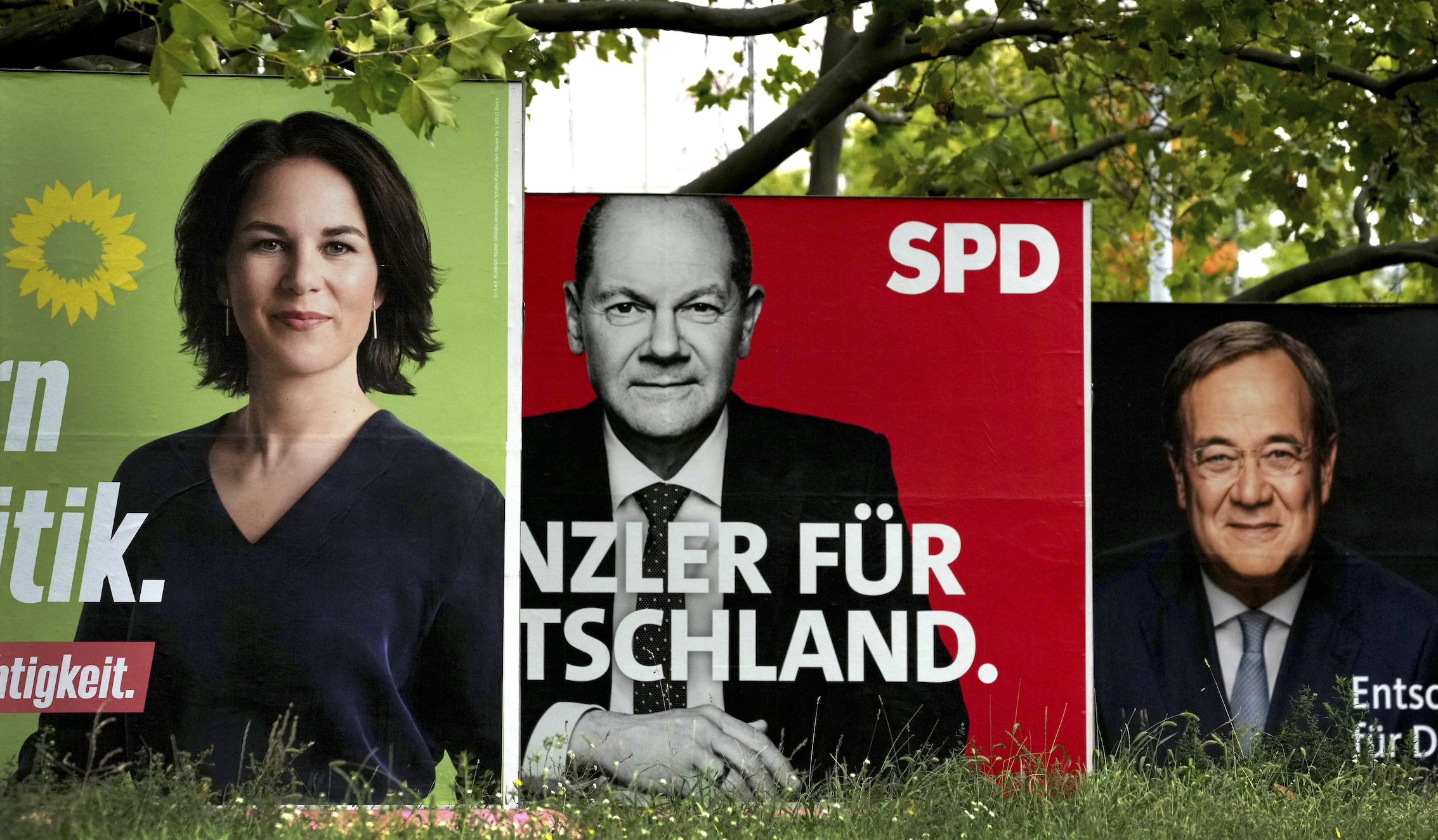
Following parliamentary elections on Sunday, Germany has entered an indeterminate period of coalition negotiations. The question of which parties form a government has significant stakes for U.S. interests.
Olaf Scholz’s center-left Social Democratic Party (SPD) won 206 seats in the Bundestag to the 196 seats of Armin Laschet’s center-right Christian Democratic Union-Christian Social Union in Bavaria coalition. The next government needs at least 368 votes to command a majority, so either party will need coalition partners. This likely means one of three options; either an SPD coalition with the Greens and the classical liberal Free Democratic Party, a CDU-CSU coalition with the Greens and the FDP, or a continuation of the current CDU-CSU supercoalition. Fortunately, the extreme Left Party’s poor showing means that an SPD-Left-Green coalition, a nightmare for U.S. interests, is out of the question.
Recommended Stories


With the Greens winning a record 118 seats, they and the 92-seat-winning, pro-capitalist FDP will be coalition kingmakers.
Like the CDU-CSU, the FDP is in favor of increased German defense spending toward the 2%-of-GDP NATO minimum target. That’s one positive for the U.S., which has been far too tolerant of German freeloading. But the FDP also seeks a deferential policy toward Russia and is unlikely to challenge China. The CDU-CSU coalition is even weaker on China but supports reaching the 2% NATO target. While the SPD is slightly more concerned about Chinese human rights abuses, that’s its only real positive. As finance minister, Scholz pared back even the mildest efforts to move toward the NATO target. His party has also adopted a pathetic defense procurement stance, opposing the purchase of armed drones. Put simply, he’s unlikely to bring strength to the chancellor’s office.
More promising is Green leader Annalena Baerbock.
Baerbock has attacked incumbent Chancellor Angela Merkel’s China and Russia policies. Pushing Vladimir Putin’s Nord Stream 2 energy pipeline and then a ludicrously weak mechanism to prevent his energy blackmail, Merkel has acted like a Kremlin agent (I’m not exaggerating). Baerbock understands how damaging this has been to NATO’s security and Eastern European sovereignty. Indeed, Putin has just declared a new energy war on Eastern Europe.
Merkel has also been a partner of Communist China, relegating concerns over Beijing’s genocide, territorial imperialism, and intellectual property theft in return for trade. Merkel’s designated successor, Laschet, is set to continue in kind.
Where does this leave us?
While the Greens don’t support the 2% NATO target, they would increase cooperation with Anglosphere efforts to counter China and Russia. On that basis, U.S. interests would be best served if Baerbock took her party into government via the foreign ministry. Considering the CDU’s support of higher defense spending, America’s best interest would then be a coalition of the CDU-CSU, Greens, and FDP.
