

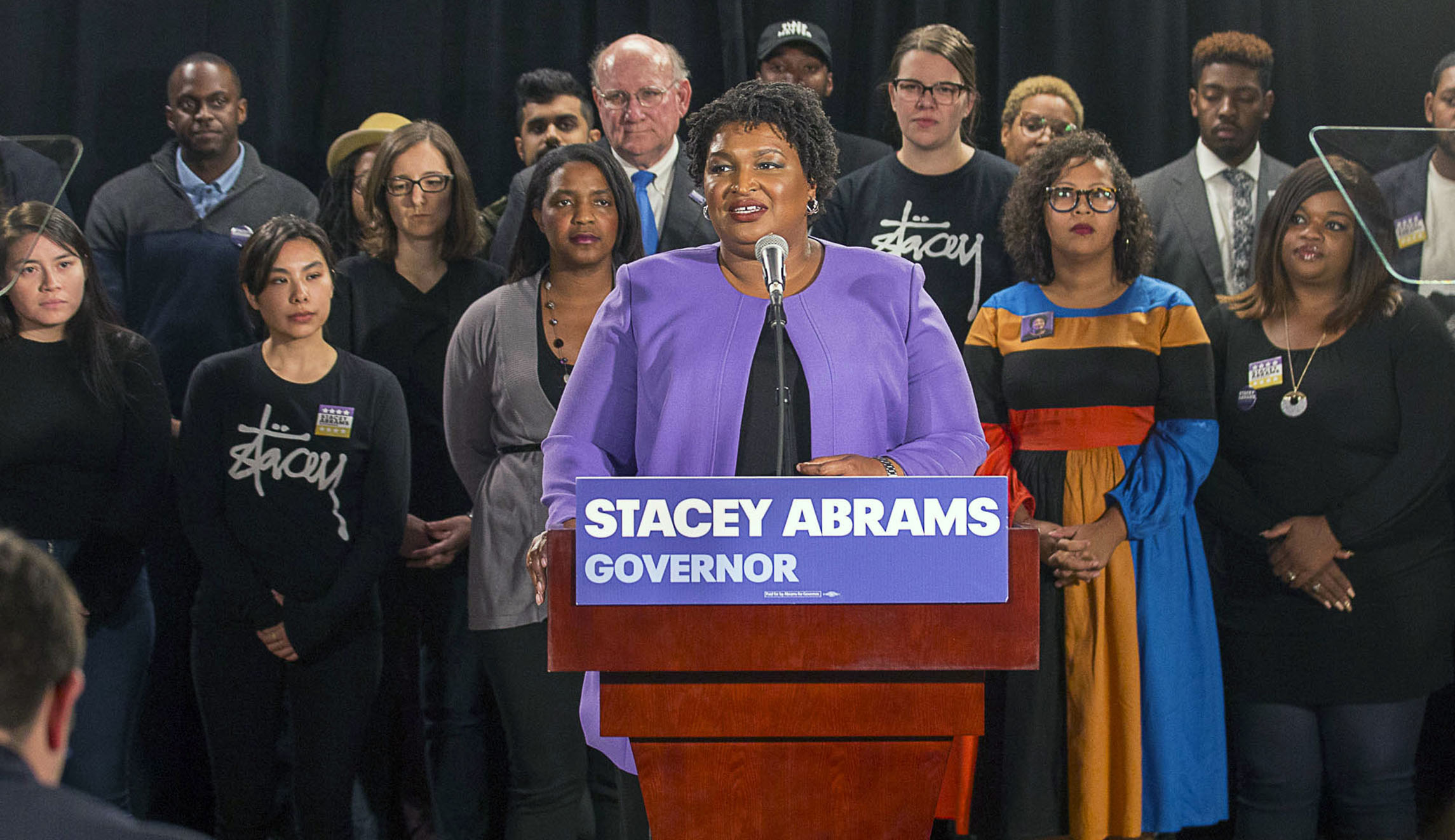
Failed gubernatorial candidate Stacey Abrams is committed to delegitimizing the 2018 Georgia governor’s race.
She alleges, without evidence and against all the facts, that she was robbed last year by GOP voter suppression tactics. She will tell this to anyone willing to listen. Give her enough time, and she’ll even regale listeners with anecdotes about how she plotted her revenge following the Nov. 6 elections last year.
Recommended Stories


“I upend the tradition of politics where you’re supposed to be genteel, say everything is fine. I didn’t do that,” Abrams said during an address this week at Vanderbilt University in Nashville, Tenn. “I could fight just to fight, but the minute it becomes about me, it becomes a vanity project.”
She added, “That can’t be the reason you do things. And I spent that 10-day period plotting. Revenge can be very cathartic.”
The rising Democratic star, who was at Vanderbilt to speak to students about her efforts to improve Georgia’s elections, bragged that she still has not conceded the 2018 election, boasting like it’s a badge of honor that she is actively seeking to delegitimize a legitimate American election.
“I don’t concede that I lost,” she said. “I acknowledge that I’m not the governor of Georgia. That’s made plain every day I don’t walk into the Governor’s Mansion.”
This is behavior beneath the dignity of any public official, much less one who lost to Georgia’s then-Secretary of State Brian Kemp by more than 50,000 votes.
“I’m still sad, still angry, but I’m less bitter than I was. That has to be channeled into action, and that’s what I’m trying to do,” Abrams also said this week.
“I do not like Brian Kemp. I do not want him to fail. Yet,” she added. “As governor, during his four years of service, I do not want him to fail, because that means he’s failing the people of Georgia. My success cannot come at their expense.”
Well, at least she’ll concede that much.
Kemp won last year with 50.2 percent of the vote, compared to Abrams’ 48.8 percent. She didn’t go quietly. She ended her campaign only when it became clear she had exhausted every possible option to overturn the results of the election. And even when she ended her campaign, she refused to concede she lost. She maintains to this day that Kemp won only because he suppressed the vote.
Abrams and her allies in the press claim, without evidence, that Kemp was responsible for Democratic county governments choosing to consolidate their polling places. (In many cases, the former Georgia secretary of state is actually on the record opposing their consolidation.) She falsely blamed him for creating longer lines and other likely unforeseen delays for voters. They also say, without evidence, that Kemp was personally responsible for Election Day mishaps, including a shortage of extension cords for voting machines at a polling station in Gwinnett County. (The extension cords were eventually found.)
And as for the vote being suppressed in Georgia, an estimated 3.9 million were cast during last year’s midterm cycle. That’s the same number of votes cast in the state during the 2012 presidential election, and not too far short of the 4.1 million votes cast in 2016. In contrast, only 2.5 million votes were cast in Georgia during 2014 midterm elections.
Whoever is in charge of suppressing votes in the state is doing a terrible job.
Despite all efforts by Abrams, who delivered the Democratic Party’s response this year to the president’s State of the Union address, and the national press to convince the public the 2018 race was rigged, the local media gave the election a clean bill of health, at least as to people’s ability to vote and the lack of any systematic irregularities.
But that’s not stopping Abrams from telling anyone who will listen that she’s the victim of GOP voter suppression efforts. Never let the facts get in the way of a good story, I guess.
