

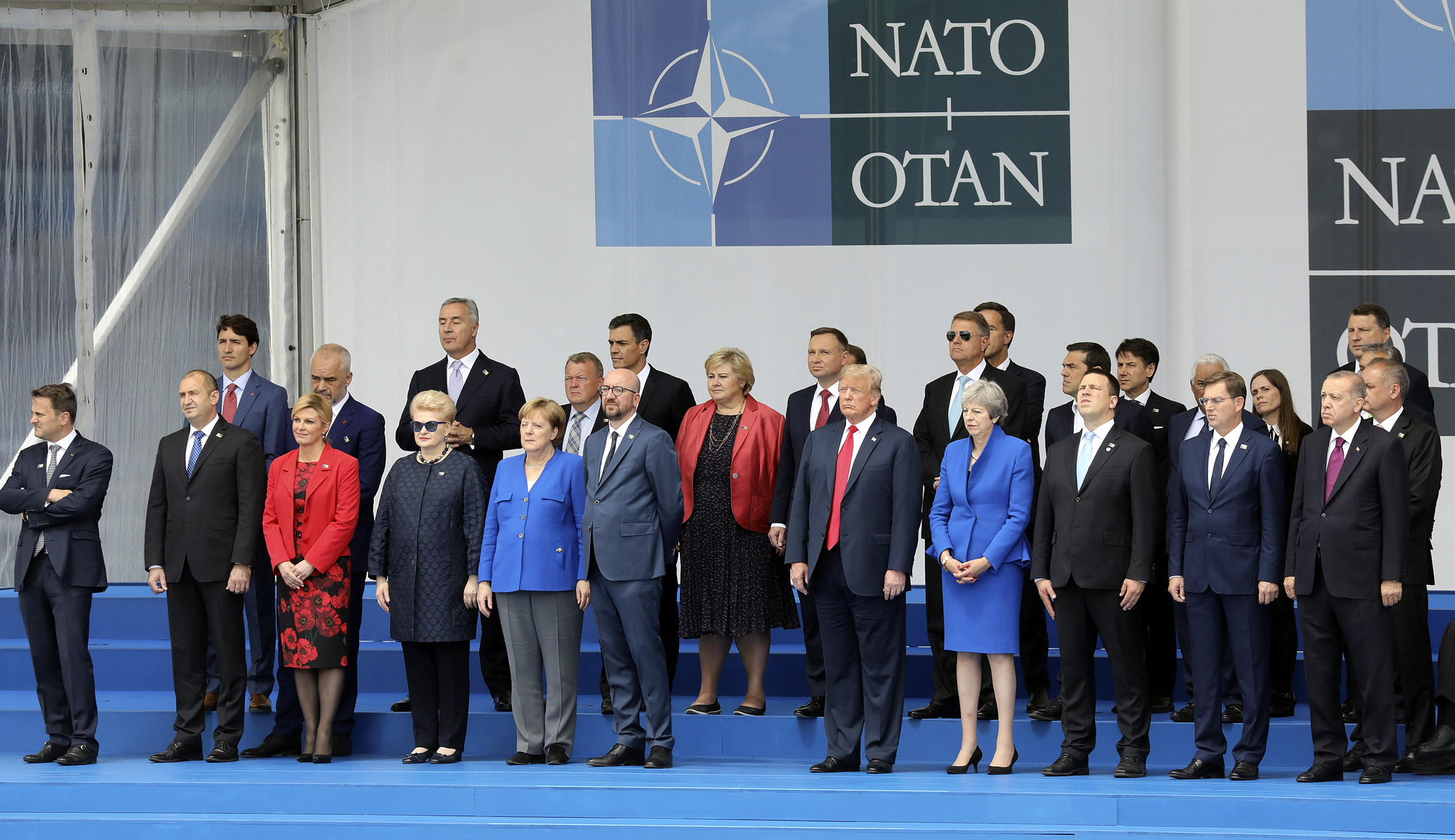
The annual NATO summit that occurred this week came and went without any major disruptions. European jitters over what President Trump would say or do — committed Atlanticists even suggested Trump may go as far as taking the United States out of NATO entirely — turned out to be grossly exaggerated. And while the leaders around the table were rattled when Trump justifiably hectored many of them on burden-sharing, the summit still concluded with the usual bland communique about solidarity.
The question that has yet to be answered is whether Canada and the nations of Europe received Trump’s tough message. An even better question is whether European governments have an intention of acting upon Trump’s message by taking their own defense and security commitments seriously.
Recommended Stories


Advocates of NATO in Washington, Brussels, London, and Berlin don’t want to delve into the existential issues of the alliance. They would prefer to believe that, as long as trans-Atlantic unity is maintained and “the adults” can protect the 69-year-old collective from a chaotic, mercurial American president, NATO will continue to function and thrive as it always has. This was certainty the assumption this week in Brussels; even Trump, who once labeled NATO as obsolete, referred to the organization as “really a fine-tuned machine.” To raise doubt on NATO’s vitality is, as the Germans say, verboten.
Those who worship NATO as a permanent feature of the world’s security architecture would argue shaking the other 28 members out of their complacency is exactly what Trump should not do — particularly when he is days away from flying to Helsinki to talk shop with Russian President Vladimir Putin. Yet business as usual is not an option for the alliance at this crucial time in its history. As uncomfortable as it is for the foreign policy intelligentsia to contemplate, NATO is not all sunshine and roses. Stressing unity, strength, resolve, and all of the other buzzwords is a distraction from the conversations that need to happen.
How big, for example, does NATO have to be? The open-door policy, where a country as strategically insignificant as Macedonia and as economically trivial as Montenegro can be inducted into the club, has done little if anything to benefit the capacity of NATO as a military organization. And yet expansion continues to be a calling card for NATO. For what purpose, nobody can quit explain.
What is NATO’s relevance in the 21st century? While the alliance doubtlessly contributed to Western Europe’s defense from 1945 until the fall of the Berlin Wall in 1989, the dissolution of the Soviet Union removed the foundation for NATO’s very existence. NATO is now too many things for too many people. For the Baltics, NATO serves as a deterrent to Russia; for the U.S. and Britain, it’s a training partner for the Iraqi security forces and a force multiplier against a never-ending Taliban insurgency in Afghanistan. Talks about NATO’s central purpose in a very different, post-Cold War world are papered over with glossy communiques.
While the defense spending issue is only the tip of the iceberg, it is a sharp tip. There is a reason why Trump is so compelled to raise alliance burden sharing in every conversation he has with a European or Canadian official, and it’s not because he hates Europeans and Canadians on an intrinsic level. He brings it up incessantly because the current financial disparity is unsustainable from an alliance perspective, unfair to the people he represents, and unwise from the standpoint of collective security. European officials are at least making the attempt to increase their military budgets (granted, at a slow pace) but actually acting on the decision to meet NATO spending guidelines by 2024 will take an enormous quantity of political will European politicians have yet to demonstrate with any consistency.
With the summit now over, the worst possible thing NATO could do is return to the status quo. Trump may have an unpredictable and erratic negotiating style, but his annoyances with the alliance are as predictable as the weather in Southern California. European leaders and ministers ignore Trump’s gripes at their own peril.
Daniel DePetris (@DanDePetris) is a contributor to the Washington Examiner’s Beltway Confidential blog. He is a fellow at Defense Priorities.
