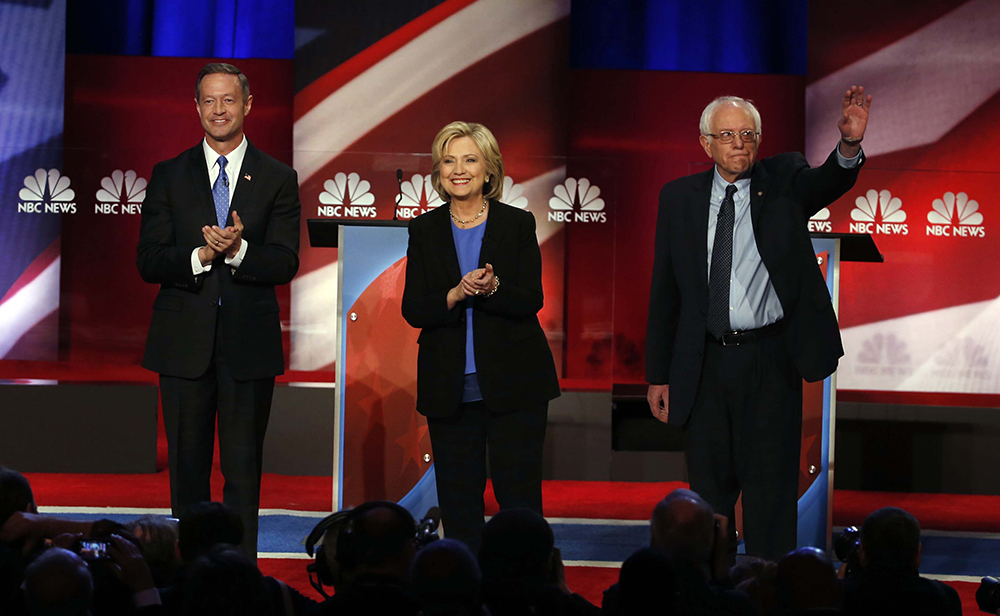
Here are a few brief thoughts on Sunday’s Democratic presidential primary debate.
Priorities
Recommended Stories
What came up in the first hour and 15 minutes of the Democratic debate? Gun control, healthcare and even heroin. No mention of the Islamic State, terrorism or homeland security. Those issues came up almost immediately in Thursday’s Republican presidential primary debate.
Concern over terrorism spiked after the Paris attacks in November, and has since dropped only slightly. It will clearly be a major campaign issue in the 2016 elections. Combined, 17 percent of Americans think either terrorism, the Islamic State, national security or foreign policy are the most important issues facing the country, according to Gallup polling. Only four percent say healthcare, one percent say drugs, and seven percent say gun control.
Taxes
Few would be surprised that self-described Democratic Socialist Bernie Sanders wants to raise taxes to support massive expansions in government programs. But it was a little surprising to see Sanders admit he would raise taxes on middle-class voters. Pretty much everyone can expect to pay more in some kind of tax under a Sanders administration.
That’s going to make it tough for Sanders to win a general election, should he upset Clinton and win the Democratic nomination. Only three percent of Americans think they pay too little in federal income taxes, according to Gallup. A small majority of Americans say their taxes are too high.
Scheduling
If the Democrats don’t want anyone to watch their debates, it’s working. The Democratic debates have routinely been watched by fewer viewers than the GOP ones. The first three Democratic debates averaged 10.6 million viewers each, while the first six GOP debates averaged 17.3 million each. Combined, the GOP debates have drawn almost three times as many viewers as the first three Democratic ones. For what it’s worth, more than 350,000 people streamed Sunday’s debate live on YouTube. Partially this is because the Democratic primary is not as hotly contested, but the strange scheduling doesn’t help.
Even if the intent of so few debates at such strange times was to quell infighting and make the process smoother for a certain candidate, there will be consequences. Fewer viewers means the Democratic agenda is getting put in front of fewer potential voters.
The next two Democratic debates are a Thursday in February and a Wednesday in March.
Jason Russell is a commentary writer for the Washington Examiner.
