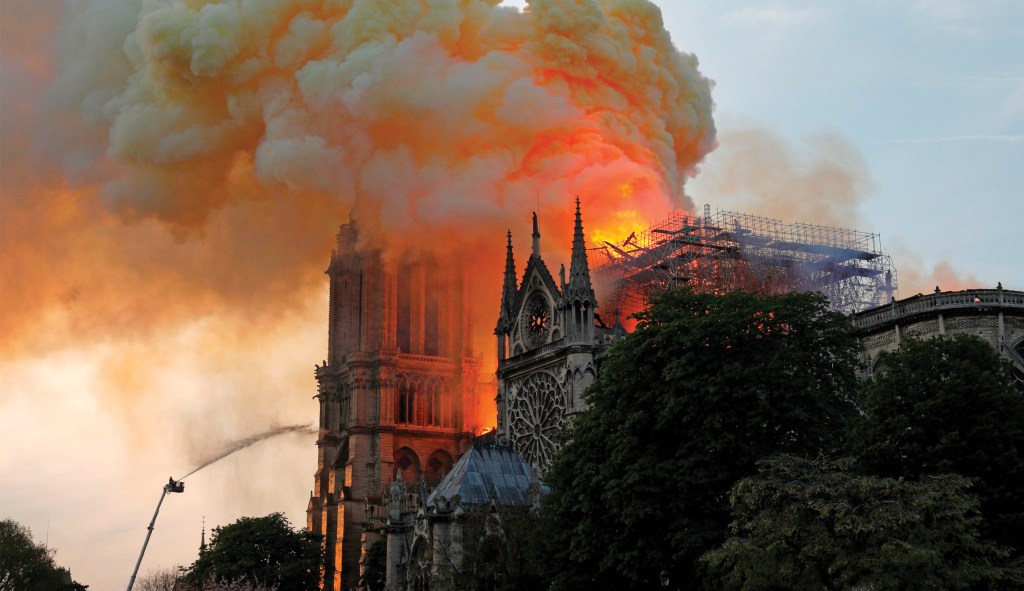
During Holy Week, Notre Dame burned. The Catholic cathedral, which has survived nearly a thousand years of wars and revolutions and persecutions and is visited by millions every year, seemed on the verge of utter destruction. Onlookers in Paris sang hymns and prayed. Much of its massive roof burned away, and its giant, lead-and-wood spire collapsed to the ground. But when the flames were finally extinguished after several desperate hours, the cathedral itself, with its famous bell towers and Gothic architecture, still stood.
Notre Dame de Paris, or Our Lady of Paris, was built as a devotional site for Mary, the mother of Jesus. A testament to human ingenuity and the motivational power of faith, it is perhaps the preeminent example of French Gothic architecture and is among the most recognizable Christian sites in the world. The cathedral’s use of ribbed vaulting, a webbed framework of interlocking stone arches, allowed the builders to build higher than was previously possible. So high, in fact, that firefighters struggled to reach its roof with water hoses. And the cathedral’s revolutionary flying buttresses, which provided outer support for the church walls, were designed by the builders to guide a worshipper’s eyes ever upward toward the heavens.