
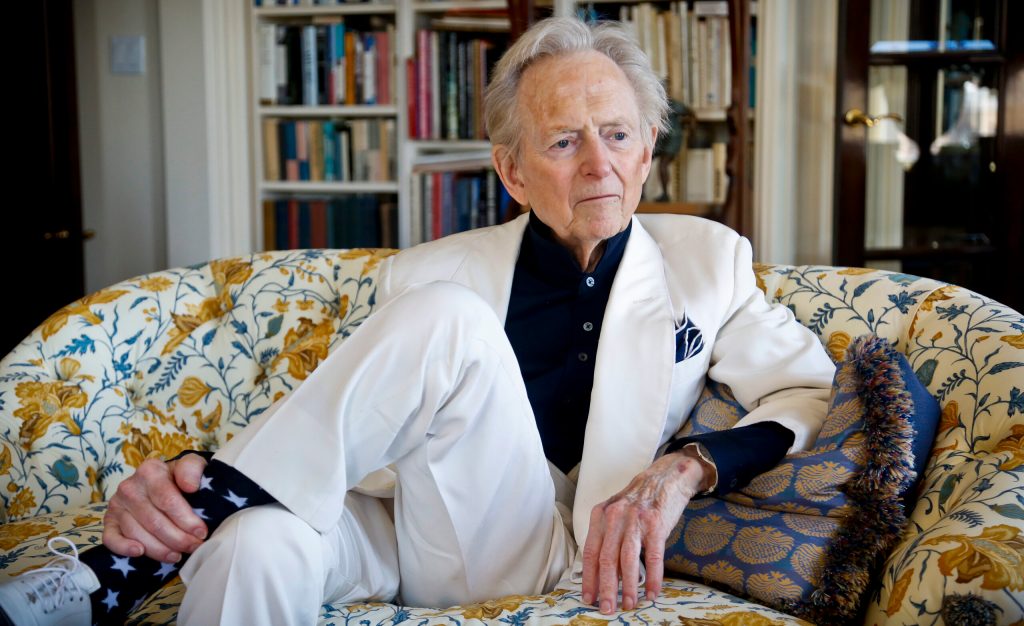
Tom Wolfe wasn’t wearing his trademark white suit when he took me to lunch at the Southampton Bathing Corporation. This would have been a disappointment if it were not that his chosen attire for a run to the beach was just as flamboyant. If I were half as good a journalist as Wolfe, I would rattle off the details of the ensemble, down to the name of the bespoke tailor who had stitched the button holes on the cream-coloured vest he wore in place of a jacket. I remember the vest, dusty-yellow slacks, a cravat around his neck, and lace-up nubucks on his feet. He reached for a straw hat as we left the house he rented as his summer residence, and headed for the Club. I don’t recall if it was a proper Panama.
The Southampton Bathing Corporation is the sort of club that Wolfe the novelist might have had to invent if it did not exist. Spread without much thought between the dunes and the beach road, Gin Lane, it is — or was, for perhaps it has been spiffed up now — shabby, in need of paint, Old Money Wasp, Harvard-Yale, White Shoe, Old Wall Street, Upper East Side, and devoid of any aesthetic value or sex appeal. In other words, it was the perfect expression of a certain social status, a status to which Wolfe, at the height of his success, could aspire.
Recommended Stories
“For years,” he said, as we selected a table in the refectory, “they would not admit the Jews.” He chuckled, rather wickedly. I chuckled too.
The food was ghastly. Of course it was: lamb stew, battered fish barely warmed, mushy vegetables, flaccid salad, canned fruit. I am sorry to report that we drank iced tea. The conversation was largely professional, for Wolfe was agreeing to write a piece or two for the Daily Telegraph of London, which I represented as New York correspondent, and Wolfe, if nothing else, was always the consummate professional journalist. But there was an odd sense that we were playing a part in a Tom Wolfe satire, without knowing quite who was to be the target of his wit: The Old Time Duffers, of whom a few were munching contentedly through their prep school lunches, the flashy new members in their Ralph Lauren Polo blazers, some of whom may well have been Jewish, the English foreign correspondent, presumed to feel at home here, or Wolfe himself?
The first work of Tom Wolfe I read was an already worn and creased paperback copy of The Electric Kool-Aid Acid Test, Bantam Books, $1.75, passed on by an American friend at my British university. We shared an interest in American literature, and drugs. It must have been around Christmas, 1970, for we were down for the holidays, and I was working a few shifts in a factory nearby in order to finance a trip to Paris, where my parents lived. I managed to bang my head on an assembly line, and, possibly because we did not eat much and it was cold, passed out. The foreman sent me off to the local emergency room, where they decided I should stay for a day or so of “observation.” I settled into a wonderfully warm and cozy bed, reached into my satchel, and opened this strange book about LSD.
It may have been the perfect introduction to Wolfe. The culture and characters he wrote of had a certain familiarity and an equally exotic allure — The Beats!! The Grateful Dead!! The Hell’s Angels!! San Francisco!! — while the language was astonishing. I felt woozy from the bang on the head, sidelined in the strange world of the hospital ward, and ready and available for the long, strange trip so brilliantly evoked by this American journalist I had never heard of.
That day and night I just went along for the ride. It was only later, thinking about the book as a book, that the thought occurred that the absurd, over-the-top style actually amounted to superb descriptive writing. You could smell those Hell’s Angels and hear the nonstop stoned banter of Neal Cassady as he steered the bus careening down the Rockies after the brakes failed, jabbering away without missing a beat, and staying on the road despite all!
Wolfe’s power obviously came from his talent as a descriptive writer. But this book — “’The Best Book on The Hippies!’ — The New York Times” — was billed as nonfiction. Did Wolfe really see and record all this? Or did he invent the details?
It took only a little research, and a parcel from the City Lights Bookshop of San Francisco, for a final year student in England to discover the New Journalism. Wolfe was not alone. There were even one or two English writers credited with the label. It was dazzling stuff. It gave me, along no doubt with many others, an idea of what to do for a living.
Wolfe did not invent the details. Sadly, other stars of “nonfiction” have been caught making it up, goaded by their own ambitions and perhaps the high bar set by Wolfe himself. How do you top that? Wolfe’s trademark rococo style and gonzo punctuation works as descriptive writing only because he worked and worked at gathering the details. He “reported.” He filled notebook after notebook.
And he had the eye for the detail to scribble into the notebook. By the time Wolfe became a bestselling novelist with The Bonfire of the Vanities, in the 80s, he had a reputation as a “conservative” writer, even as a controversial and a “leading” conservative writer.
That never made much sense to me. He lambasted abstract painting and damned modernist novelists in favor of the great works of social realism, which he tried to follow. He liked Old World stuff, anchored in the Southern gentility from which he came. His exhibitionist wardrobe was in some ways a disguise — he was the undisguised outsider with a notebook wherever he went — but he also simply felt at home as a Southern Gent. As he got old, he got cranky, too.
But the great works of nonfiction were no more “conservative” than “progressive.” He simply saw things with a razor eye, and with an eye for cultural context. Think of Radical Chic, perhaps his most celebrated satire, and certainly the one most beloved by his conservative fans. It is brilliant! But surely anyone with honed powers of observation would have reacted much the same way to the gaudy spectacle of the celebrated composer and conductor Leonard Bernstein with Manhattan’s glitterati sucking up to the violence-prone radicals of the Black Power movement. It was an article which all but got Wolfe banned from the celebrity salons, and it put a phrase into the language — radical chic — but it resonated so powerfully simply because it was true.
Wolfe liked to talk about the basics of the craft, the research, the recording, the “reporting.” He was visibly tickled at the Southampton Bathing Corporation when the subject came up and I pulled a notebook from my pocket. He is, when it comes to it, most widely known for the catch-phrases of his headlines and book titles: Radical Chic, The Right Stuff, and so on. But none of the flash and glitz would mean anything without that extraordinary power of observation and recording.
How many actually recall the meaning of The Right Stuff? Because the story created a contemporary folk hero in the Air Force test pilot Chuck Yeager and celebrated the truly extraordinary men and women of the Mercury moon landing program, the phrase has been adopted as shorthand for what it means to be a true American. John Wayne, perhaps, or Ronald Reagan, men with the right stuff.
Wolfe actually picked up the phrase from the test pilots. It denotes, specifically, the ability to make the right decision in a nanosecond in a life or death situation. The most vivid example offered involved the testing of a jet with two pilots on board. The plane was going to crash. Each pilot had to decide whether or not to eject. One did; if he had not, his legs would have been crushed as the jet crash-landed. One did not; if he had, he would have been decapitated because his canopy had jammed. The Right Stuff.
To have picked that up, understood what it implied, and turned a snatch of pilot-speak into an emblematic cultural concept is reporting at its very best.
The Daily Telegraph in New York enjoyed a long, loose connection to Tom Wolfe, via my predecessor at the bureau. Ian Ball was something of a legend among journalists in his own right, a smooth writer and an equally smooth operator who managed the career feat of being dispatched to New York in the early 1950s, and remaining in this most desired seat until retirement in 1991. He was well-established by the time Wolfe arrived on the scene in the early 1960s, and they became friends.
Wolfe would pop into the bureau from time to time, to say, “Hello.” But it was one of those little twists of New York life that Wolfe and Ball could not mix if family were involved. In 1986, Ball, who had been widowed, married Leonard Bernstein’s brother’s divorced wife. It was a very happy marriage. But the Bernstein clan has never forgiven Wolfe for the mockery of his prose in Radical Chic, and even the name remains unmentionable at their table.
That is powerful testimony indeed.
Charles Laurence is a freelance journalist in New York, a former bureau chief for The Daily Telegraph, and is author of The Social Agent: A True Intrigue of Sex, Spies and Heartbreak Behind the Iron Curtain.
