

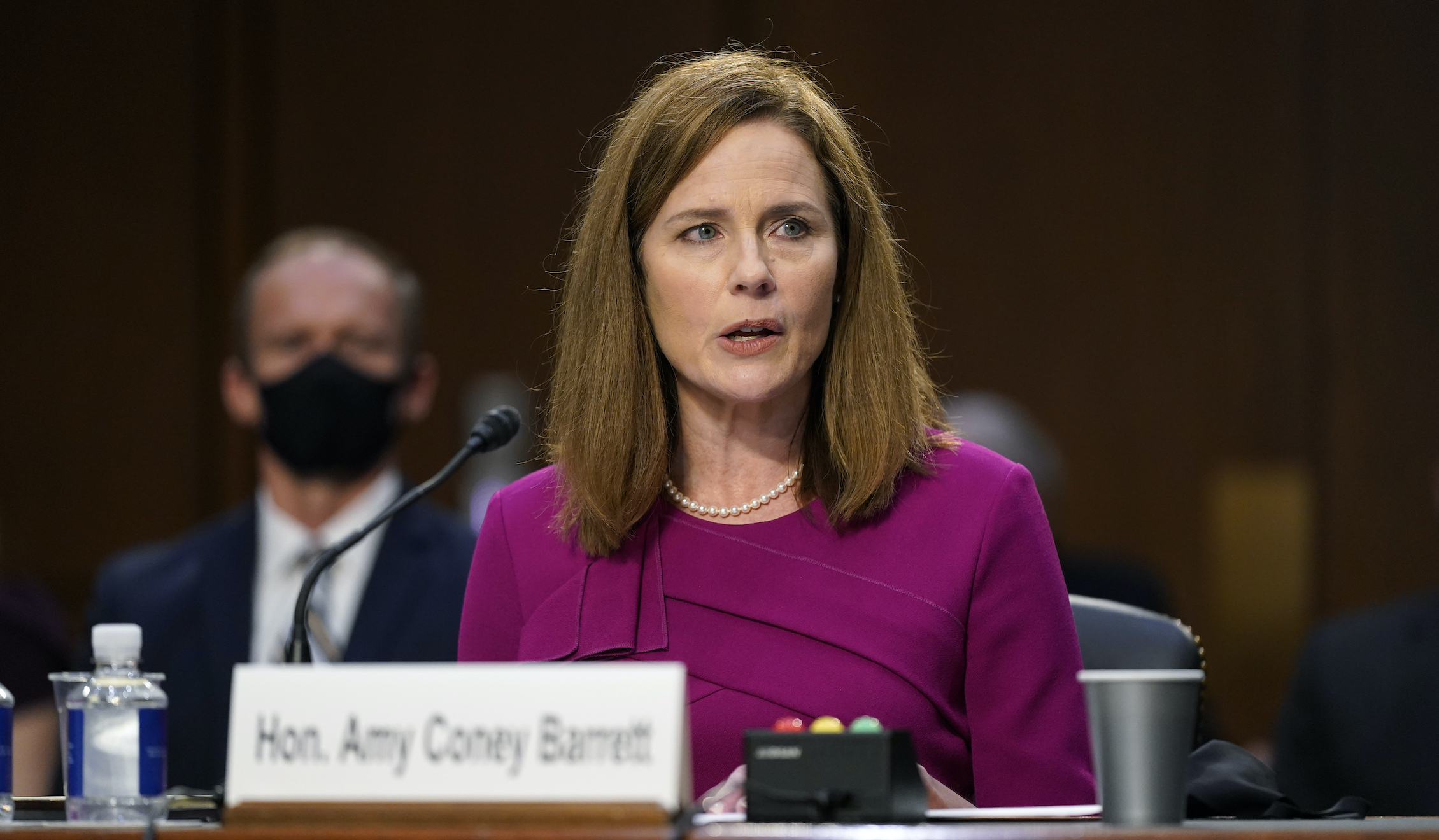
The appointment of John Marshall as chief justice of the Supreme Court in 1801 provides clear precedent for President Trump’s recent nomination of Amy Coney Barrett just weeks before the presidential election.
Sens. Kirsten Gillibrand of New York, Jeff Merkley of Oregon, and Elizabeth Warren of Massachusetts all described the nomination of Barrett as “illegitimate” because it is too close to a presidential election. Sen. Richard Blumenthal of Connecticut called Trump’s nomination of Judge Barrett “a raw act of power.” Blumenthal added that the Barrett nomination is “making history. Never before has a Supreme Court nominee been approved after July in an election [year].”
Recommended Stories



Blumenthal and others seem not to be aware that Chief Justice John Marshall was confirmed not only in an election year but long after the president who nominated him had been defeated. Marshall, the greatest chief justice in American history, was nominated to the Supreme Court on Jan. 20, 1801, by John Adams, just 43 days before his term was to end, and Thomas Jefferson was to be sworn in as president. Chief Justice Oliver Ellsworth had resigned, on short notice, due to poor health. Adams was a lame duck, but he exercised his powers as president up until his very last day in office on Mar. 4, 1801. Indeed, the justice of the peace commission for William Marbury, of Marbury v. Madison fame, was signed by Adams on his very last evening in office — so late, in fact, that the commission was never delivered.
Adams moved boldly and decisively to nominate John Marshall as Ellsworth’s replacement, despite the fact that he had recently lost his bid for reelection as president in the election of November 1800. His party had also lost control of the Senate, but this did not deter the lame duck Senate from quickly confirming Marshall as chief justice on January 27, 1801 — at that time, both presidential terms and new Congresses began in March, not January.
In 1801, as now, the two major political parties were bitterly divided. The Federalist Party of George Washington, Alexander Hamilton, and Adams, was at odds with the newly elected Republican Party of Jefferson, James Madison, and James Monroe over nearly every major issue of the day, including the constitutionality of the National Bank.
Divisions were so deep that Congress, two years earlier, passed the Sedition Act of 1798, which made it a crime to publish “false, scandalous, or malicious writing” against the government of the United States — namely Adams and the Federalist Congress. Newspapers during the late 1790s were organs of the Federalist and Jeffersonian-Republican parties. The opposition newspapers were quite vicious, in some ways even more disparaging of Adams than the modern press is of Trump.
History shows that the bizarre notion of a Trump cabal to stay in office, even if he loses in the Electoral College, is not unique to our time. If the Sedition Act achieved its goal of silencing Republicans, Jefferson predicted: “we shall immediately see attempted another act of Congress declaring that the President shall continue in office during life [and] reserving to another occasion the transfer of succession to his heirs.”
The rancor and vitriol between the Federalists and Jeffersonian-Republicans became even worse after Marshall was appointed chief justice. Jefferson had once viewed the Supreme Court as an indispensable check, but, under Marshall’s leadership, he believed the Court had become a “subtle corps of sappers and miners constantly working under ground to undermine the foundations of our confederated fabric.”
Jefferson’s disdain for the Marshall Court led him to propose, unsuccessfully, a term limit on members of the Supreme Court and a bid to make judges easily removable by a simple majority vote in Congress, rather than through the more arduous process of impeachment. Today’s Democrats have much in common with Jefferson in threatening repercussions if Barrett is confirmed.
Sen. Kamala Harris may have given us a preview of her own solution to dealing with a detested conservative judiciary a year ago when she told a New York Times reporter that she was “absolutely open” to expanding the size of the Supreme Court. Sen. Mazie Hirono of Hawaii has been even more blunt, telling CNN that packing the Supreme Court with more justices is “long overdue” and will be put into action should Democrats take back the Senate in the 2020 elections.
Phillip G. Henderson taught political science for 28 years at the Catholic University of America in Washington, D.C. His books include The Presidency Then and Now and Managing the Presidency: The Eisenhower Legacy.
