

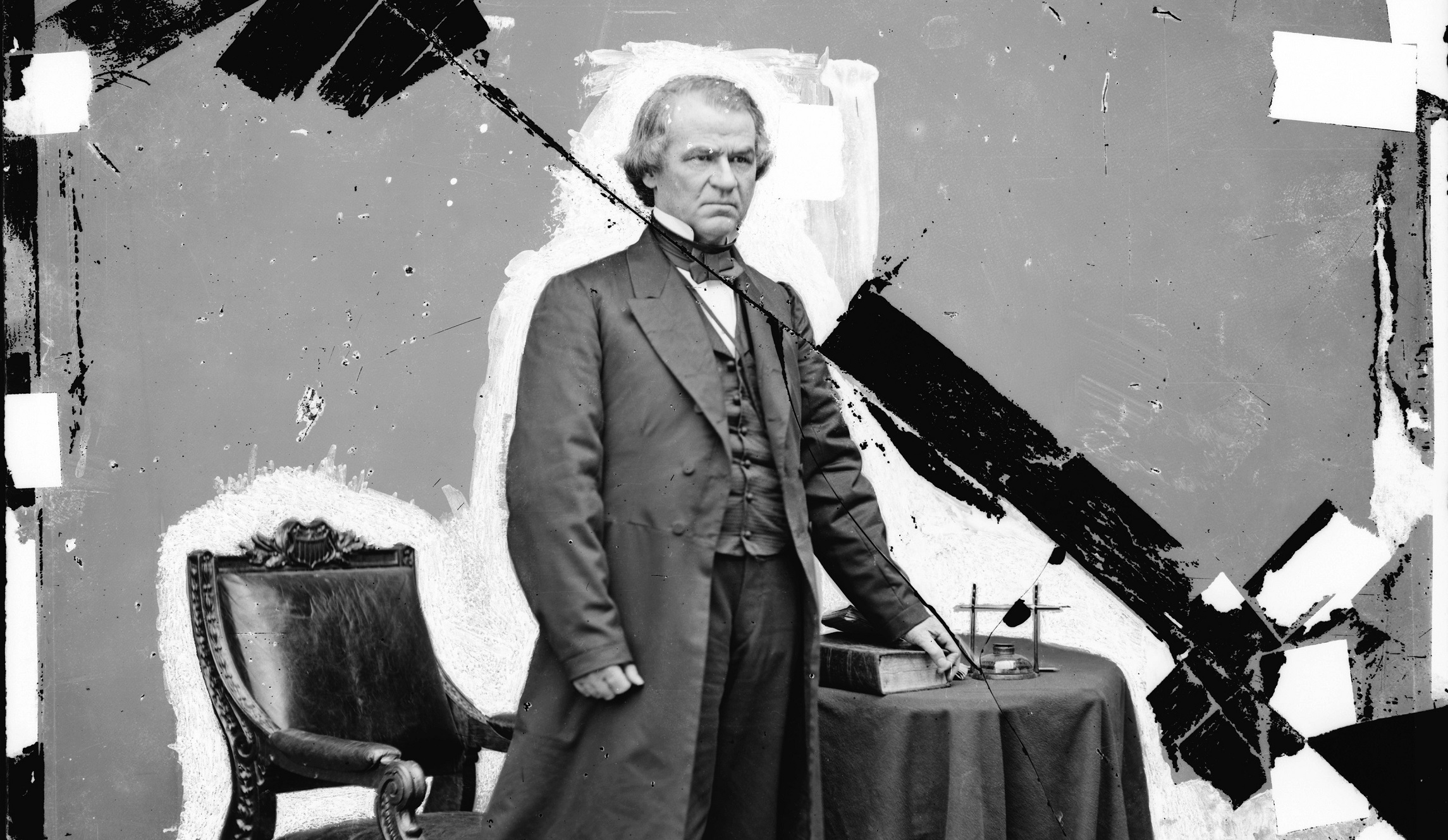
The few people who remember the figure of President Andrew Johnson these days recall two things about him: He was the president who got the job when President Abraham Lincoln was murdered, and he was the first president to be impeached. Neither look particularly good on a presidential resume.
Yet, every time a president faces hearing the dreaded words, “You’re fired,” from Congress, poor Johnson is trotted out of obscurity, and we’re reminded he was the first chief executive to undergo the humiliating experience. It’s the kind of factoid news readers love dropping to show off their knowledge.
Recommended Stories



Johnson remained in the White House because each of the 11 articles of impeachment filed against him fell one vote shy of the 36 needed for approval. Talk about a close call.
In our collective memory, that’s where his story ends. Yet, there’s another chapter, one that deserves to be remembered, because Johnson was one of only two men who served in Congress after the presidency.
Johnson was born in North Carolina. Too poor to attend school, he worked as a tailor’s apprentice as a child. He ran away, eventually settling in Tennessee where he opened his own tailor shop, learned to read, got involved in politics, and rose to become first congressman and then senator. When Tennessee sided with the South, he stuck with the Union. As blue troops overran the Volunteer State, he was appointed its military governor, the job Johnson was holding when Lincoln picked him as his running mate in 1864.
As president, Johnson enraged radical Republicans by pursuing Lincoln’s policy of a kinder and gentler reconciliation with the defeated South. As I noted, Johnson dodged the impeachment bullet by the narrowest of margins.
That’s when Johnson’s story really gets interesting.
He returned to Greenville, Tennessee, when his term ended in 1869 and bought a farm. But, he soon missed the glamour and excitement of life in the capital. It was tough going back home, too. He contracted cholera, his son committed suicide, and most of his money was lost when a bank failed.
Yet Johnson yearned to erase the impeachment stain on his record, and the only way to do that, he realized, was with a political comeback.
He tried to get his old Senate job back, but failed by just one vote. This was the time when state legislatures selected senators. Then he sought a seat in Congress but was defeated by a former Confederate general.
At that point, many people would have thrown in the towel. But not Johnson. Stubborn almost to a fault, he persisted, and, on Jan. 20, 1875, he was finally elected to be a senator, once again by a single vote. His reaction? “Thank God for the vindication.”
Johnson thus became the second former president to serve in Congress and the only one to serve in the Senate. John Quincy Adams was a Massachusetts congressman for nearly 17 years.
His return to the capital was national news. Some Republicans went out of their way to avoid him. He was sworn in on March 5 alongside Hannibal Hamlin, who preceded him as Lincoln’s first vice president, and took the oath from Vice President Henry Wilson, who had voted against him in the impeachment trial.
But Johnson’s final stint in Washington didn’t last long. He spoke only once during a short session, lambasting his presidential successor, President Ulysses Grant, for sending troops to support Louisiana’s Reconstruction-era state government.
He returned to Tennessee after adjournment. Johnson was convinced he was being slurred in the Ohio governor’s race and, never one to walk away from a fight, decided to go there and defend his name. Stopping for a visit at his daughter’s house, he suffered a series of strokes and died on July 31 at age 66. As he had requested, he was buried wrapped in an American flag with a copy of the Constitution on his chest.
He rests today in a national cemetery that bears his name, a president who may have been bloodied but who left the White House with his head unbowed and then returned to Capitol Hill for the last laugh.
J. Mark Powell (@JMarkPowell) is a contributor to the Washington Examiner’s Beltway Confidential blog. He’s vice president of communications at Ivory Tusk Consulting, a South Carolina-based agency. A former broadcast journalist and government communicator, his “Holy Cow! History” column is available at jmarkpowell.com.
