

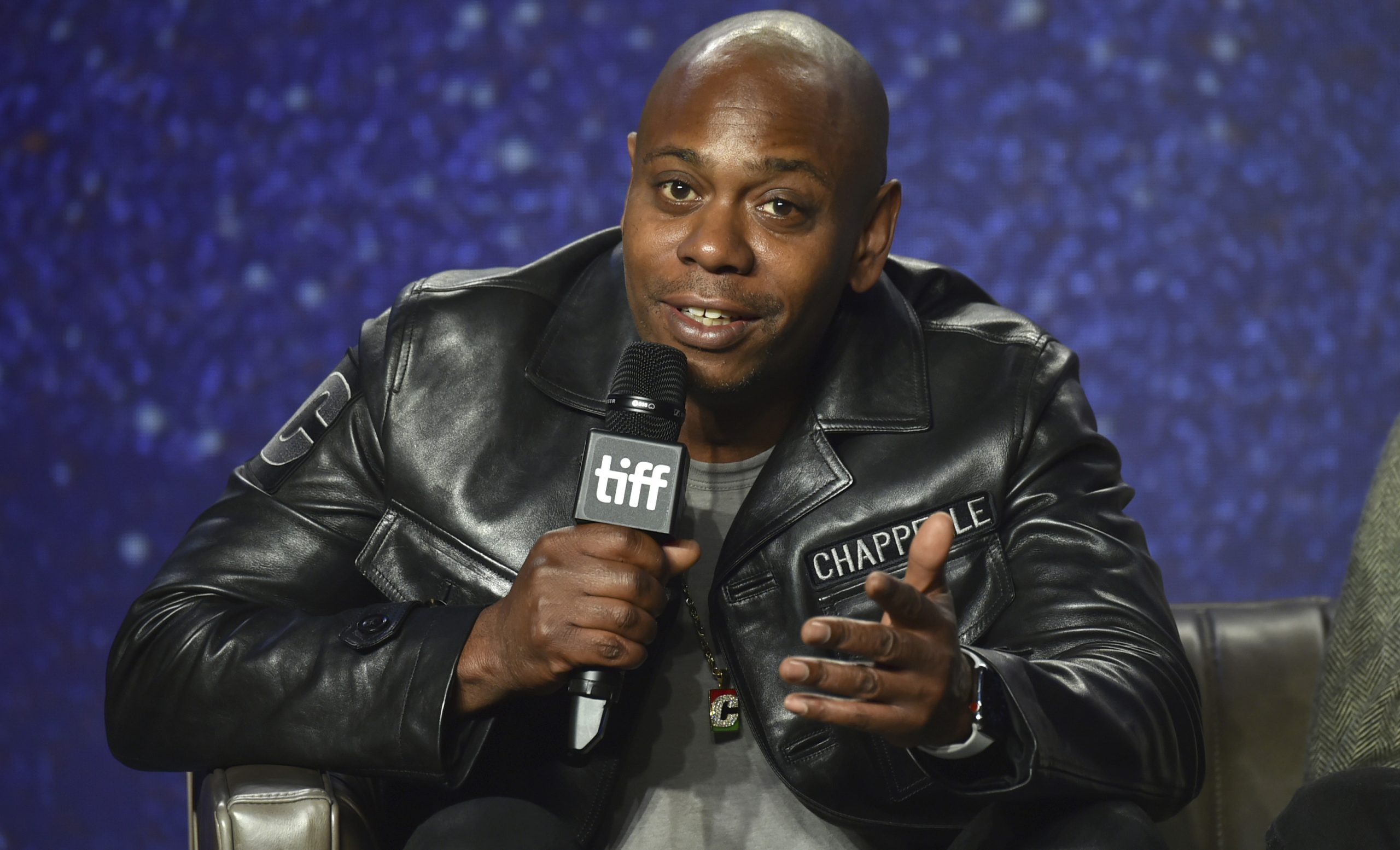
In his new special, The Closer, comedian Dave Chappelle jokes about everyone from Jewish people to Mike Pence to Martin Luther King Jr. to himself. But he also had the audacity to poke fun at the gay and transgender community, and for that, Chappelle has (once again!) earned the ire of intolerant wokescolds.
A transgender activist and showrunner for the Netflix show Dear White People, Jaclyn Moore, slammed Chappelle and said she will boycott Netflix as long as the company continues to “profit from blatantly and dangerously transphobic content.” Meanwhile, the left-wing activist organization GLAAD condemned Chappelle for “ridiculing trans people and other marginalized communities” and called for his deplatforming. In a hit piece sadly typical of the liberal media’s coverage of the special, NPR ran an article accusing Chappelle, who is black, of “using white privilege to excuse his own homophobia and transphobia.” (The NPR piece also misquoted Chappelle and was forced to issue a correction.)
Recommended Stories


I told the story of my transition for @netflix and @most‘s Pride week. It’s a network that’s been my home on @DearWhitePeople. I’ve loved working there.
I will not work with them as long as they continue to put out and profit from blatantly and dangerously transphobic content.
— Jaclyn Moore (@JaclynPMoore) October 7, 2021
Dave Chappelle’s brand has become synonymous with ridiculing trans people and other marginalized communities. Negative reviews and viewers loudly condemning his latest special is a message to the industry that audiences don’t support platforming anti-LGBTQ diatribes. We agree. https://t.co/yOIyT54819
— GLAAD (@glaad) October 6, 2021
In his new Netflix special, Dave Chappelle tries — and often fails — to justify button-pushing jokes about gay people, trans people, and feminists, writes NPR critic Eric Deggans.https://t.co/gG1zFMv2eM
— NPR (@NPR) October 6, 2021
All of these critics need to get a grip. After seeing the insane backlash, I sat down and actually watched the special on Netflix. It’s not hateful; it’s comedy — and good comedy at that. Moreover, the ultimate message is actually one of empathy.
Yes, Chappelle jokes at the gay and transgender community’s expense, both in regard to gay rights and the transgender community. He pokes fun at the newfound status that ostensibly oppressed gay people now hold in the culture, ironically lamenting the story of a black rapper recently “canceled” for anti-gay comments who had, Chappelle says, “once shot a [N-word] and killed him in Walmart,” yet that didn’t hurt his career.
The comedian jokes that the rapper, DaBaby, “punched the LGBTQ community right in the AIDS.” But Chappelle goes on to say that DaBaby made “an egregious mistake.” He simply laments the fact that “in our country, you can shoot and kill a [N-word] … but you better not hurt a gay person’s feelings!”
As a gay person, I don’t find this offensive. It’s funny! Moreover, Chappelle pokes fun at the gay community in the same way that he mocks, well, just about every other group during the special.
“You guys are confusing the emotions,” Chappelle says to his critics. “You think I hate gay people … what you’re really seeing is that I am jealous of gay people. We blacks, we look at the gay community and go, ‘Damn, look at how well that movement is going. We’ve been trapped in this predicament for hundreds of years. … How the hell are you making that kind of progress?’ I can’t help but feel that if slaves had body oil and booty shorts, we might’ve been free 100 years sooner.”
This last line, which made me audibly cackle when I heard it in real time, has particularly rankled left-wing critics online. But, ironically, these woke reactionaries who can’t take a joke are actually proving Chappelle’s point.
“I don’t hate gay people at all. … I respect the s*** out ya — well, not all of you,” he says later on in the special. “I’m not that fond of these newer gays. Too sensitive, too brittle. Those aren’t the gays I grew up with. … I miss them old-school gays, them Stonewall [N-words]. They the ones that I respect. They fought for their freedom.”
On this front, Chappelle is absolutely spot-on. A generation of older gay people lived through real oppression, fought for their rights, endured pseudoscientific anti-gay conversation therapy, and so much more. Too many of today’s gays, at least the ones overrepresented on Twitter and in the media, think they’re victimized if a comedian makes a joke at their expense. Give me a break.
The comedian goes on to tell the story of how a white gay man called the police on him during a verbal confrontation. “Gay people are minorities until they need to be white again,” he ribs.
For this and other commentary in the act, Chappelle has been accused of overlooking the existence of black and minority gay people. But this criticism is obviously from people who didn’t actually watch the special. The comedian almost immediately goes on during the story to note that “a black gay man would never have done that.”
Of course, the most controversial part of The Closer is when Chappelle once again roasts the transgender community. And this part of his routine is admittedly outrageous. He jokingly compares the surgically altered genitalia of transgender women, who are born biologically male, to “Impossible P****,” referencing the synthetic, vegetarian Impossible Burger. He also defends author J.K. Rowling, who has come under fire for her supposedly “transphobic” public questioning of the transgender movement as it pertains to women’s rights issues.
Are these jokes boundary-pushing and shocking? Yes. But that’s the point, and they’re no more so than his jokes about anybody else (including black people and himself!). It seems to me that if gay and transgender people really believe in equality, they should want to be treated just as comedians treat every other group of people, not afforded some special, condescending protection as if we are more mentally fragile than everyone else.
The real saving grace of Chappelle’s routine is that it is not, ultimately, coming from a place of hate or ill-will. He tells a moving story about a transgender comedian he befriended, Daphne, who laughed at all his gay and transgender jokes. He even gave her, an amateur, the opportunity to open for a major event he did in San Francisco. Chappelle fondly recounts the way they connected over their shared love of comedy and how all she ever asked of him was to respect her humanity.
“Just believe I’m a person and I’m going through it,” she said to him.
“I believe you because it takes one to know one,” he said back.
Here’s where the special gets dark. Chappelle recounts how after the release of his controversial special Sticks & Stones in 2019, Daphne stood up for him when he was widely attacked as “transphobic.” But the transgender community turned on her and bullied her viciously online. She killed herself a week later.
Chappelle immediately cracks a joke about her suicide. Yes, seriously. But then, he notes that Daphne would have loved that joke and explains that in the aftermath of her death, he started a trust fund for her daughter.
With this somber note, Chappelle hits home the real message of his special. It’s that we need to give up our sanctimony to talk instead honestly about our differences. More than anything, we need to embrace empathy over outrage, cancel culture, and self-victimization.
“Empathy is not gay,” Chappelle says. “Empathy is not black. Empathy is bisexual — it must go both ways.”
Does all this make Dave Chappelle a “transphobe” or a “bigot”? Only if one defines those words down to the point of meaninglessness, so loosely as to include anyone who questions, disagrees with, or pokes fun at the woke Left’s ever-evolving dogma. Bigotry, properly understood, isn’t about what jokes you crack; it’s about where you’re coming from and if you have hate in your heart. And Chappelle most certainly does not.
Yes, The Closer is rife with exasperation at the stifling hold political correctness has over our culture, and in it, Chappelle mercilessly mocks many groups of people. Yet its ultimate message is not one of bigotry; it’s one of empathy for those who see the world differently, and that’s exactly what Dave Chappelle’s self-righteous critics are lacking.
Brad Polumbo (@Brad_Polumbo) is a libertarian-conservative journalist and a Washington Examiner contributor. Subscribe to his YouTube channel or email him at [email protected].
