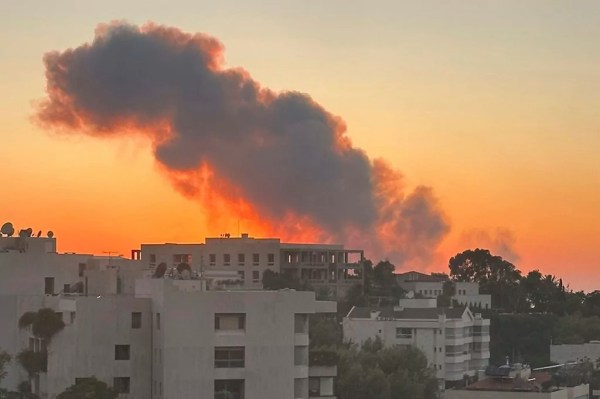
TEL AVIV — The beach volleyball continued on the sand as Iran launched a barrage of missiles against Israel on Sunday. It was Tehran’s first direct strike since the fragile ceasefire began on April 8. The Iranian attack followed an Israeli strike on Hezbollah-linked targets in Beirut’s southern suburbs. Tehran framed its launch as retaliation and warned that additional attacks could follow.
“The Iranians are doing whatever they can to [show] that they are strong,” said Dr. Eyal Hulata, Israel’s former national security adviser and longtime Mossad official.
Recommended Stories

Israel is also strong, of course. But Prime Minister Benjamin Netanyahu faces constraints. Israel has long insisted that Iranian attacks require a military response. Washington is strongly pushing in the opposite direction, with President Donald Trump urging Netanyahu to avoid a retaliatory strike. Trump fears that new escalation could jeopardize U.S.-Iran diplomacy and a broader regional arrangement. Trump also criticized the Israeli strike in Beirut that preceded the Iranian launch. In an interview with the Financial Times, Trump said Netanyahu would have “no choice” but to accept a U.S.-brokered Iran deal, if one was to come about.
“What Israel is more worried about is the precedent that Israeli action in Lebanon leads to an Iranian response into Israel directly,” Avishay Ben Sasson-Gordis, a senior researcher at Tel Aviv University’s Institute for National Security Studies, told me. “Even if it is a symbolic move, it’s a very unpleasant point for Israel, because it establishes that the response to Israeli action in Lebanon will be attacks from Iran.”
Having survived a surprise all-out Israeli-American assault, Tehran treats its endurance as a victory in and of itself. Yet, that posture of strength masks an acute domestic fragility. The attacks on Iran came when the regime was arguably at its weakest point in years, with discontent driven by a deteriorating economy and regime brutality. For Iran, a deal represents the only pathway to domestic relief, restoring legitimacy and providing proof to its own population that the leadership is capable of governing.
“This is why [the regime doesn’t] want to resume the war. They definitely prefer a deal,” Hulata explained. But the broader concern in Israel is that an agreement reached today could lower tensions in the short term while ultimately empowering Iran in the longer term.
IRAN FIRES MISSILES AT ISRAEL AS MIDDLE EAST TIT-FOR-TAT ESCALATES
That leaves Israel in a bind: Absorb a limited Iranian strike without due retaliation to avoid further alienating an ally, or respond militarily and risk being blamed for disrupting Trump’s diplomatic push. Iran’s move appeared calibrated to exploit that gap between Israeli readiness and American restraint.
Tehran does not want a full-scale war and more damage to its standing. But it is testing how far it can go without provoking that war.