
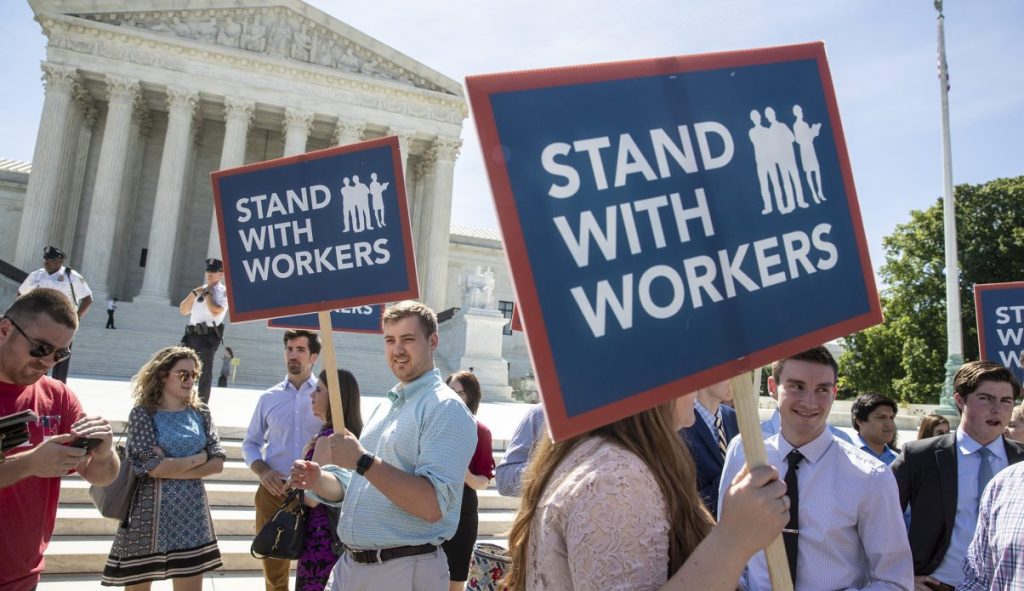
Union fails in effort to circumvent Janus ruling and extract dues from unwilling worker

Published January 14, 2019 9:40pm ET


Chalk up another victory for supporters of the Supreme Court’s 2018 ruling that it is unconstitutional for labor unions to force nonconsenting public employees to pay membership dues.

Union officials have settled a lawsuit brought against them on behalf of a Minnesota public sector employee who claimed they tried to block her from opting out of financially supporting the International Brotherhood of Electrical Workers.

Sandra Anderson, who serves as clerk for the City of Brainerd Police Department, chose to end her union membership following last year’s Janus v. American Federation of State, County and Municipal Employees ruling. Janus established that government-employee unions can’t force nonmembers to pay union dues.

In case you’re wondering why a police department clerk was paying dues to an electrical union, there’s a reason for that: In 2004, IBEW Local 31 and the City of Brainerd agreed to a deal wherein public employees were required to pay dues or fees to the labor group. The government had made employment contingent on these payments.

Anderson was given two choices: Either join the union and pay dues, or decline membership and pay fees. She joined the union, which authorized labor officials to deduct dues directly from her paycheck.

Then Janus happened, and Anderson decided she wanted out.

However, after she requested that the IBEW cancel her membership and cease deducting dues from her paycheck, she was told by union officials that she’d have to comply with their convoluted “window period” policy.

The National Right to Work Legal Defense Foundation describes the “window” policy thusly: Public employees can “only stop dues payments either during a 10-day window prior to the expiration of the monopoly bargaining contract or a 10-day window prior to the anniversary date of her dues deduction authorization.”

Sensing that she was not being afforded her constitutional rights, Anderson recruited NRTWLDF to represent her in her fight against the IBEW, a shrewd move considering the right to work group is responsible for the Janus decision.

Anderson argued in her now-settled lawsuit that the “window policy” is unconstitutional, claiming it both limits her First Amendment rights while also allowing union officials to deduct money from her paycheck without her affirmative consent. Her legal representatives also argued that when she “signed her dues deduction authorization, she was not informed of her First Amendment right to refrain from paying union dues or fees and, therefore, could not give her affirmative consent to waiving her First Amendment right not to subsidize the union.”

Rather than engage in a lengthy (and likely losing) court battle, IBEW opted to settle, agreeing to refund the dues it collected after Anderson requested that it cancel her membership. Union officials also agreed not to attempt to consider her a member or collect dues from her again unless she gives her explicit affirmative consent.

“Ms. Anderson is the first of thousands of government employees to successfully challenge union boss ‘window period’ schemes designed to limit workers from exercising their First Amendment rights under Janus,” National Right to Work Foundation President Mark Mix said after the settlement. “This victory serves as an inspiration for civil servants across the country who are stepping up to challenge union bosses’ coercive tactics to limit public employees’ constitutional rights.”

His group noted this week in a press release that it is pursuing similar lawsuits in other areas of the country, including in New Jersey where two public school teachers claim they are also fighting a union “window period” policy.