

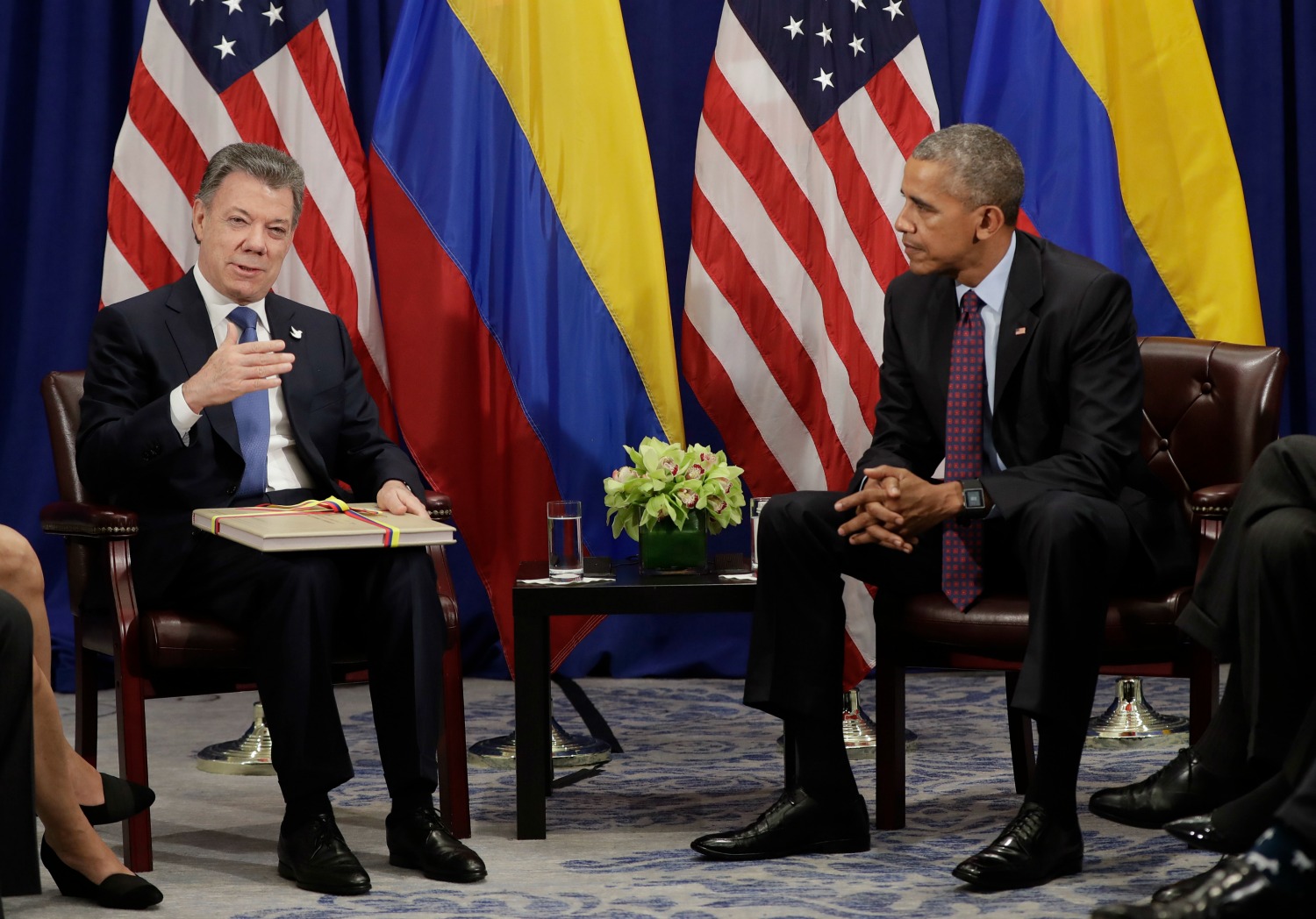
This week Colombian President Juan Manuel Santos will sign a series of agreements with the Revolutionary Armed Forces of Colombia (known by its Spanish initials, FARC) ending a 52-year conflict that has cost 220,000 lives. The pact will be put to a popular vote on Oct. 2. Although Colombians are vigorously debating the details of the plan, they are united in their skepticism about the FARC’s true intentions. On this precise point — holding the FARC to its commitments — the United States can make a unique contribution to peace.
Recommended Stories


Opponents of the accords are led by former president Alvaro Uribe Velez (2002-2010), whose “democratic security” strategy, with substantial U.S. support, is credited with decimating the FARC and saving the country. Uribe and his allies have assailed the peace process from the outset, arguing that Santos should have kept up the military offensive to impose its terms on the FARC commanders. They also contend that Santos made concessions that undermine Colombia’s democratic institutions and let the guerrillas get away with murder.
Among the criticisms leveled by the “no” campaign, opponents say that a proposed “transitional justice” system — consisting of ad hoc tribunals to investigate denunciations against combatants — would carelessly bypass the country’s judicial institutions, allow members of an internationally-designated terrorist group to evade meaningful justice, and treat soldiers as equals to the guerrillas they fought for decades. Critics argue that guerrilla commanders who are guilty of the most heinous crimes against humanity will likely escape incarceration — denying victims and their survivors genuine justice. They condemn granting the FARC three non-voting seats in each chamber of the national congress and guaranteeing them the opportunity to compete for no fewer than five seats in the next two election cycles. Critics also complain that Santos has used his majority in the congress to scuttle constitutional procedures to impose new reforms and to engineer a plebiscite in which people are asked to choose between war and peace rather than pass judgment on elements of the agreement.
During the peace negotiations, the FARC demanded significant resources to compensate victims; to support ex-combatants, their families, and collaborators who are resettling in rural zones that had been recaptured by the armed forces; and to deliver social services and economic opportunity in areas of past conflict. Although these demands are seen as addressing the legitimate grievances of marginalized people who the FARC claimed to represent, they also are an impossibly high benchmark against which the state will be measured. Today, Colombia’s economy has stalled and the projected fiscal deficit is at a six-year high due to plummeting oil revenue. It is not clear where the state will get the $30 billion its says it needs to meet its commitments under the peace plan.
Ultimately, it is for Colombian voters to weigh whether these concerns are great enough to scrap the accords. For every skeptic, there is a victim who thinks the promise of a more peaceful future is worth the sacrifice.
Friends of Colombia — including the United States — must consider how best to shore up weaknesses in the peace plan. For example, although Santos sees the FARC as vanquished militarily, concessions made in the interest of peace may allow the group to continue its “insurrection” against Colombia’s democratic institutions. In an August essay, Douglas Farah, senior visiting fellow at the U.S. National Defense University, described how the FARC is “shifting to economic and political warfare,” following the game plan of other “Leninist” movements in Cuba, Venezuela, El Salvador, and Nicaragua for “taking power and then holding it in perpetuity.” Farah argues that the FARC’s new political movement will use more than $1 billion generated from drug smuggling and other criminal activity to sustain its campaign against Colombia’s democracy.
The United States, which has invested $10 billion in economic and security assistance to Colombia since 1999, can shore up this ally by thwarting the FARC’s dangerous scheme. U.S. and European financial authorities should intensify their efforts to locate and seize billions of FARC assets and channel them to state-run development and security programs. Moreover, U.S. intelligence and security cooperation must continue so Colombia’s military and police can deter, detect, and defeat any involvement of FARC remnants in the lucrative drug trade.
President Obama has pledged $450 million to support the Colombia peace process, and Congress is considering the first tranche of such assistance. But that aid and a 15-year investment will be squandered unless Colombia and its allies ensure that the FARC does not abuse the peace process to wage war by other means.
Roger F. Noriega was U.S. Ambassador to the OAS and Assistant Secretary of State for Western Hemisphere Affairs from 2001-05. He is a visiting fellow at the American Enterprise Institute, and his firm Visión Américas LLC represents U.S. and foreign clients. Thinking of submitting an op-ed to the Washington Examiner? Be sure to read our guidelines on submissions.
