Byron York: As debates near, forum shows potential Trump advantage

Published September 8, 2016 4:19am ET


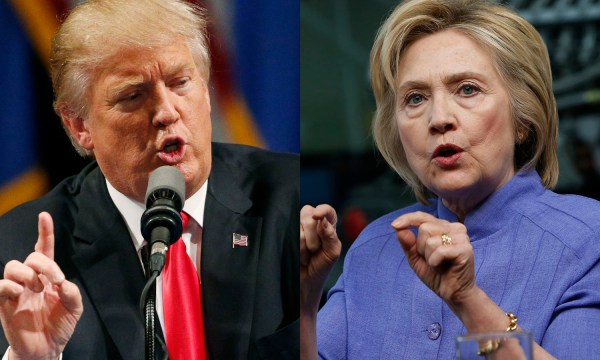
NBC’s “Commander in Chief Forum,” held Wednesday night aboard the USS Intrepid in New York, was the closest thing to a debate between Donald Trump and Hillary Clinton until the real thing on Sept. 26. And it showed an advantage Trump might have when the two meet face-to-face: she has a record in government to defend, while he doesn’t. On that score, Trump, at 70 a newcomer to politics, seems new, while Clinton, at 68 a veteran of decades in public life, seems, well, not new.

The format of the NBC forum, in which the two candidates were separated by only a commercial break, put that contrast into higher relief than ever before.

Clinton cited her experience right out of the blocks, when moderator Matt Lauer asked her, “What is the most important characteristic that a commander in chief can possess?”

“Steadiness,” Clinton answered instantly. “An absolute rock steadiness, and mixed with strength to be able to make the hard decisions. Because I’ve had the unique experience of watching and working with several presidents …”

The problem for Clinton was that talk of her experience leads naturally to talk of what she has done — and that, in today’s campaign environment, means talk of her mishandling of classified information as secretary of state. “Why wasn’t it disqualifying?” was Lauer’s second question of the evening.

Then, when it came time for the military audience to ask questions of their own, the first for Clinton, from a retired naval officer, was brutal. “Secretary Clinton, how can you expect those such as myself who were and are entrusted with America’s most sensitive information to have any confidence in your leadership as president when you clearly corrupted our national security?”

Ouch. Clinton argued that she did not send or receive emails with a header marked “TOP SECRET” or the like. Maybe voters will find that convincing, and maybe they won’t. But it was a rocky start.

The next question, from Lauer, was about Clinton’s vote in 2002 to authorize the Iraq War.

Another audience member stood to ask: “You have had an extensive record with military intervention. How do you respond to progressives like myself who worry and have concerns that your hawkish foreign policy will continue?”

And then Lauer asked about Clinton’s role in the Iran nuclear negotiations.

One common theme of all the questions: They focused on things Clinton did in her years in office, in the Senate and as secretary of state. She started out by citing her experience, so Lauer and the audience answered, in effect, “OK, let’s talk about your experience.”

Trump has no such experience. There’s no Trump record in public office, no government decisions that went awry, no votes to back away from, no nothing. When running for public office, even for the presidency, that can be an advantage.

In a number of presidential elections in recent decades, especially races between two non-incumbents, the candidate with less governmental experience, especially less national government experience, won.

Barack Obama had a lot less experience in government than John McCain when he defeated McCain in 2008.

George W. Bush, midway through his second term as governor of Texas, had less experience in government than Al Gore, who by 2000 had served 16 years in the House and Senate and eight as vice president.

And Bill Clinton, a long-time governor of Arkansas, had nowhere near the experience that President George H.W. Bush had when Clinton defeated Bush in 1992.

That’s not to say Obama, Bush I, and Clinton had no experience at all in government, as is the case with Trump. But in 2008, 2000, and 1992, less was more when it came to national government experience.

And that’s the way it was with Trump on the Intrepid Wednesday night. Lauer brought up experience right away — “What have you experienced in your personal life or your professional life that you believe prepares you to make the decisions that a commander in chief has to make?”

The real answer was nothing, pretty much the same as it was for Obama in 2008. Trump’s stock answer that he “built a great company” which did business “all over the world” is not much of an answer at all. When Lauer pressed, Trump’s answer — “The main thing is, I have great judgment. I have good judgment” — actually got closer to the mark.

Not that Trump actually does or does not have good judgment. The key was that voters will make a judgment of their own on Trump and Clinton, and with Trump they’ll likely judge in great part on what he says, while with Clinton they’ll likely judge on what she’s done. It’s easier to talk a good game than to cite one’s experience. Just ask candidate Barack Obama, 2008.

Democrats who try to pin Trump down on his record have a harder time than Republicans going after Clinton. Look at what Clinton tried to do Wednesday evening with Trump on Iraq. “My opponent was for the war in Iraq,” she said. “He says he wasn’t. You can go back and look at the record. He supported it. He told Howard Stern he supported it.”

On Sept. 11, 2002, Stern asked Trump, “Are you for invading Iraq?” Trump answered, haltingly, “Yeah, I guess so. I wish the first time it was done correctly.”

Compare that brief exchange — on the Howard Stern show! — with Clinton’s extended and carefully reasoned speech on the Senate floor supporting military action against Saddam Hussein, plus her vote to authorize the war, and it’s not clear voters will see the equivalence Clinton is trying to sell.

That’s the challenger’s advantage: The candidate who has done less on the national stage has less to answer for, and his hopeful promises and pronouncements are less weighted by an actual record.

At various times in various elections, political types have debated whether candidates have a “sell-by date,” or whether there is a “14-year rule,” as the journalist Jonathan Rauch has argued. Even if one doesn’t count Clinton’s years as first lady, it’s been 16 years since she first won election to the Senate. If you do count the time in the White House, she’s been a major national figure for 24 years. That’s a very long time for a presidential candidate.

Trump, who has never run for elective office, doesn’t even fit the question. He’s an extreme case: a presidential nominee with almost universal name recognition and absolutely no record in government. Maybe that will be a disaster at the polls. Or it could be a potentially potent combination, especially in what many experts believe is a “change election.”

Of course, Clinton has significant advantages of her own. But for Democrats hoping Clinton will land a knockout blow in the upcoming debate, Wednesday night was a cautionary moment. It showed that Trump has some serious strengths of his own, and that in what could be the most asymmetrical matchup ever, Clinton’s experience might not be the advantage her supporters hope it will be.