

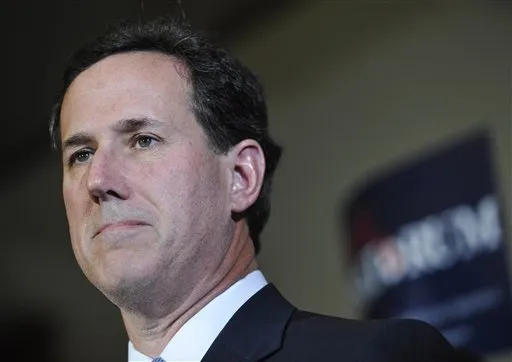
Rick Santorum has surged back into contention for the Republican presidential nomination because of persistent reservations among conservatives about Mitt Romney. But those on the right who embrace Santorum as an alternative should do so with no illusions. To his credit, Santorum did not support the kind of mandate and subsidize approach to health care as Romney, but as Senator, he still voted like a big government Republican on many occasions. Some of this had to do with being a loyal soldier during the Bush era, when he backed the Medicare prescription drug plan and No Child Left Behind. But a lot of it had to do with his parochialism.
As a Senator from Pennsylvania, Santorum took earmarks, pushed a support program for dairy farmers, sided with unions and backed steel tariffs. In these instances, when free market principles clashed with local concerns, he abandoned limited government conservatives.
Recommended Stories



A year ago, I asked Santorum about his support for dairy subsidies.
“(T)he milk program, compared to Social Security and all the entitlement programs was a small program about an industry that was struggling in America — the small farmer in that part of the country,” he told me. “My feeling is, sure, we can have a milk program that has a concentration of milk into big super duper farms in the South and in the West, and we will continue to see the deterioration of rural Pennsylvania, rural New York, and other rural areas. And if people are fine with that, that’s fine. I think there’s something to be said for having viable businesses in that part of the country to compete.”
Whatever can be said about such a position, it is not the free market position.
And during the January 7th New Hampshire ABC/Yahoo debate, when Rep. Ron Paul, R-Tex., has challenged Santorum for being a big spender who sided with against “right to work” laws, he once again cited local concerns.
“Ron, I’m a conservative,” Santorum shot back. “I’m not a libertarian. I believe in some government. I do believe that government has — that as a senator from Pennsylvania that I had a responsibility to go out there and represent the interests of my state. And that’s what I did to make sure that Pennsylvania was able, in formulas and other things, to get its fair share of money back.”
He also defended his vote against “right to work” again in CNN’s Jan. 19 South Carolina debate.
“I’ve already signed a pledge and said I would sign a national right to work bill,” he said. “And when I was a senator from Pennsylvania, which is a state that is not a right to work state, the state made a decision not to be right to work. And I wasn’t going to go to Washington and overturn that from the federal government and do that to the state.”
The problem is that one of the biggest obstacles to shrinking government is politicians protecting their home state interests – such as farm state representatives fighting to maintain agricultural subsidies that analysts from across the political specture acknowledge are terrible policy. Even if Santorum pledges to be a limited government president, if everybody in Congress followed his example, we’d never be able to shrink government.
