

Ann Coulter’s support for Mitt Romney entered a new stage today with a column offering an all out embrace of Romneycare. In the process, she insults the intelligence of conservative critics of the law and doesn’t address their actual arguments against it.
Her first defense of the law is to name other conservatives who supported it at the time. So what? Many of us were opposed to it all along. For instance, in August 2006, before Barack Obama even announced he was seeking the presidency, I fretted that Romney’s support for universal health care made him the natural heir to President Bush’s big government “compassionate conservatism.” In July 2007, I wrote that, “It is hard to imagine anything representing a greater affront to conservative principles than using government to coerce private citizens into purchasing healthcare.” David Hogberg was another early critic, among many others.
Recommended Stories


Coulter goes on to suggest that conservative opposition to Romneycare is based on mere semantics: “But because both Obamacare and Romneycare concern the same general topic area — health care — and can be nicknamed (politician’s name plus “care”), Romney’s health care bill is suddenly perceived as virtually the same thing as the widely detested Obamacare. (How about “Romneycare-gate”?)”
This is a shameful argument, and she must have a very low opinion of conservatives if she thinks this is actually true. In reality, people don’t compare Romneycare and Obamacare because their nicknames share the same basic structure, but because the laws have the same basic structure. Specifically, both laws expand Medicaid, force individuals to purchase government-approved insurance or pay a fine, and provide subsidies for individuals to purchase government-designed “private” insurance policies on government-run exchanges.
Coulter then spends the next chunk of her column making the case that Romneycare is constitutional. That’s true – states have police powers that the federal government does not – but that’s a total straw man. That’s not the argument conservative critics are making. We oppose Romneycare because it’s a massive expansion of government, regardless of the fact that Massachusetts was within its power to enact it. To use another example, it’s perfectly legal for a Republican governor to sign a massive tax increase and a budget that doubles spending, but that doesn’t make it a conservative policy. And if that theoretical Republican governor were to run for president saying he’s against raising taxes and spending at the federal level, conservatives wouldn’t ignore his big government record as governor simply because states have the leeway to set their own fiscal policies. And I doubt Coulter would make such an exception either, at least if the candidate’s name weren’t Mitt Romney.
Coulter goes on to write, “A governor can’t repeal the 1946 federal law essentially requiring hospitals to provide free medical services to all comers, thus dumping a free-rider problem on the states. It was precisely this free-rider problem that Romneycare was designed to address in the only way a governor can.” It’s actually a 1986 law, but more significantly, Romneycare wasn’t about addressing the free rider problem. As I detailed at length earlier this week, the point of the mandate was to force healthier individuals into the insurance pool to ameliorate the distortion in the market caused when the state required insurers to cover people with pre-existing conditions. The numbers show that the cost to government of expanding coverage to lower-income residents far exceeded any marginal savings from lower uncompensated care costs.
Then she eventually gets to her final defense of Romneycare: “What went wrong with Romneycare wasn’t a problem in the bill, but a problem in Massachusetts: Democrats.”
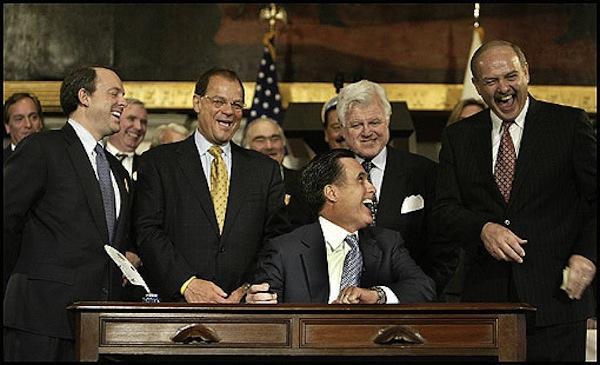
This is more silliness. To start, Romney signed the health care law with a smiling Ted Kennedy at his side knowing that Democrats had the votes to override any symbolic line-item vetoes of certain provisions. Furthermore, when he signed the law, he had already announced he wasn’t seeking reelection as governor and knew that it would almost certainly fall on Democrats to implement the law. Part of being a limited government Republican is realizing that once you put the infrastructure in place, successors can always add to it.
Regardless, what he actually signed was bad enough.
If Coulter has decided that Romney is the best of the Republican options and she can’t stand Newt Gingrich, that’s fine. If she wants to argue that conservatives should trust Romney’s commitment to repealing Obamacare, okay. But she shouldn’t defend big government social welfare policy as conservative and treat conservatives like they’re too dumb to understand the difference.
