

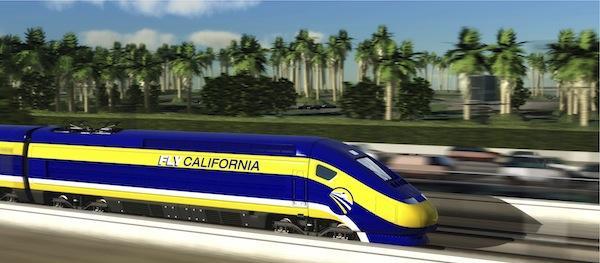
California’s high speed rail project, the crown jewel of President Obama’s vision for the future of public transportation, is announcing today that its proposed bullet train from San Francisco to Anaheim will cost nearly $100 billion, smashing earlier estimates. It’s also now projected to be completed in 2033, or 13 years longer than originally announced, according to the Associated Press.
The rail project has been a boondoggle from the get go, as indepenent analyses have questioned its cost estimates, ridership projections and financial plan. At the same time, environmental groups, farmers and local communities have opposed its proposed routes for carving up land and ripping through neighborhoods. Originally projected to cost $43 billion just two years ago, it’s now projected to cost $65.4 billion in 2010 dollars, or $98.5 billion assuming 3 percent inflation over the 20-year life of the project.
Recommended Stories


The business plan says that it can only expect 20 percent of the cost to be financed with private money, meaning that the cash-strapped state and federal governments will have to pick up the remaining $80 billion. It’s highly unlikely that they’ll ever get that amount of money and the project will be tied up in years by lawsuits and environmental impact assessments. So the only question now is whether the California legislature will kill it before it squanders billions of dollars.
The initial 130-mile stretch of the train is supposed to be built in the less-inhabited Central Valley at a cost of $8.8 billion. For that money, according to the San Jose Mercury News, taxpayers would be paying “to build the tracks, which would be used to provide a 45-minute shortcut for the 3,000 riders on Amtrak’s San Joaquin line.” So nearly $9 billion to save 3,000 riders 45 minutes. It will take years and tens of billions of dollars more until the system could even theoretically extend to a major city and have enough track to run high-speed trains.
If the state were to cancel this initial segment, dubbed the “train to nowhere,” it would have to forgo $3.5 billion in federal stimulus money, which requires the system to break ground by next October. Of course, if they were willing to give back the money, they’d be saving state taxpayers over $5 billion in the near-term, and tens of billions of dollars if they kill the whole project.
UPDATE: The full plan is now available here.
