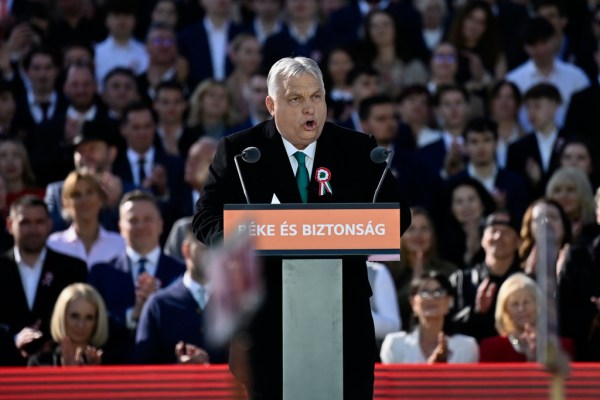
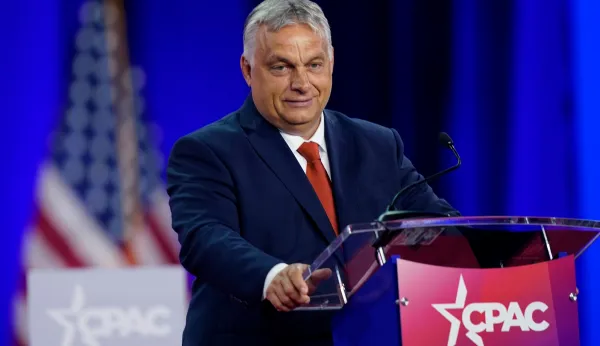
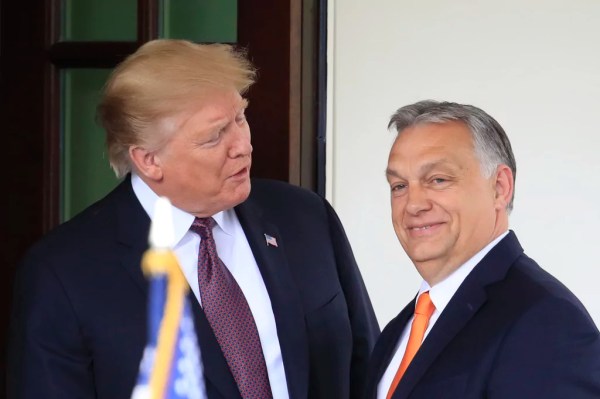
On April 12, Hungarians will vote in the most important European election of 2026. For the first time since Viktor Orban consolidated power in 2010, the prime minister faces a challenger capable of unseating him. Peter Magyar, a former Fidesz insider who broke with the ruling party in 2024, has built the Tisza Party from a protest vehicle into the leading force in Hungarian politics.
A poll by 21 Kutatokozpont, published on April 1, placed Tisza at 56% among decided voters and Fidesz at 37%. The aggregated PolitPro trend puts the gap at roughly 8 points, and even Nezopont Intezet, a pollster with close government ties that has consistently shown Fidesz ahead, concedes the race has tightened.
This is the political backdrop against which a damaging scandal has engulfed Orban’s government.
Leaked audio recordings published this week by a consortium of investigative outlets, including Insider and VSquare, capture Minister of Foreign Affairs and Trade Peter Szijjarto in conversation with his Russian counterpart, Sergey Lavrov, and other senior Russian officials. In one call, dated August 2024, Lavrov asks Szijjarto to help remove the sister of Russian oligarch Alisher Usmanov from the European Union sanctions list; Szijjarto agrees and says he will coordinate with Slovakia to submit a delisting proposal.
In another call, from June 2025, Szijjarto appears to ask Russia’s deputy energy minister for arguments he could use to justify opposing EU sanctions on Russia’s shadow oil fleet. Separately, the Washington Post reported, citing anonymous sources, that Szijjarto had for years called Lavrov during breaks in EU meetings to share details of what was discussed. Szijjarto has dismissed the broader claims as fabrications, called the leaks a foreign intelligence operation designed to sway the election, and insists he says the same things publicly as he does privately. He has acknowledged the authenticity of the recordings. The European Commission has called for clarification, and Germany has described the allegations as extremely serious.
Orban has responded by ordering an investigation into who wiretapped his minister, treating the messenger as the culprit. Magyar, for his part, has accused the government of treason, telling supporters that Szijjarto was operating as an errand boy for the Kremlin. The scandal threatens to become Orban’s greatest electoral liability.
Orban has banked heavily, throughout this campaign and the last, on fear of the war in Ukraine. He tells voters that alignment with Europe’s support for Kyiv would bankrupt Hungary, force Hungarian youth onto the front lines, and cut off Russian energy supplies. In 2022, weeks after Russia’s full-scale invasion, Orban positioned himself as the candidate of peace and won a landslide. The strategy worked back then. Four years on, the economics of his pro-Kremlin stance have soured. Hungary’s GDP contracted by 0.8% in 2023 and has grown at roughly 0.5% annually since, below the EU average.
Orban bet that Russia would emerge from its war in Ukraine in a position of strength, and that his early accommodation of Moscow would yield dividends. Magyar has capitalized on this opposite sentiment, centering his campaign on dismantling what he calls Hungary’s “mafia state” and restoring its European orientation. According to Gallup, a majority of Hungarians (57%) doubt the honesty of their own elections. Among Tisza supporters, 94% view government corruption as widespread. Nonaligned voters, who may well decide the outcome, tilt closer to the opposition on most major issues.
Yet Orban retains formidable structural advantages, and his defeat remains far from assured. Hungary’s mixed electoral system heavily favors Fidesz in rural single-member districts. In 2022, the party won 86 of 88 constituencies outside Budapest. State media remains overwhelmingly loyal.
HERE ARE THE HOLDUPS FOR THE BILL MEANT TO FIX THE HOUSING AFFORDABILITY CRISIS
Orban faces the most serious challenge of his political career.
Whether that challenge translates into a transfer of power depends, in significant part, on whether the election itself is free and fair. All of this demands that the United States pay close attention.