

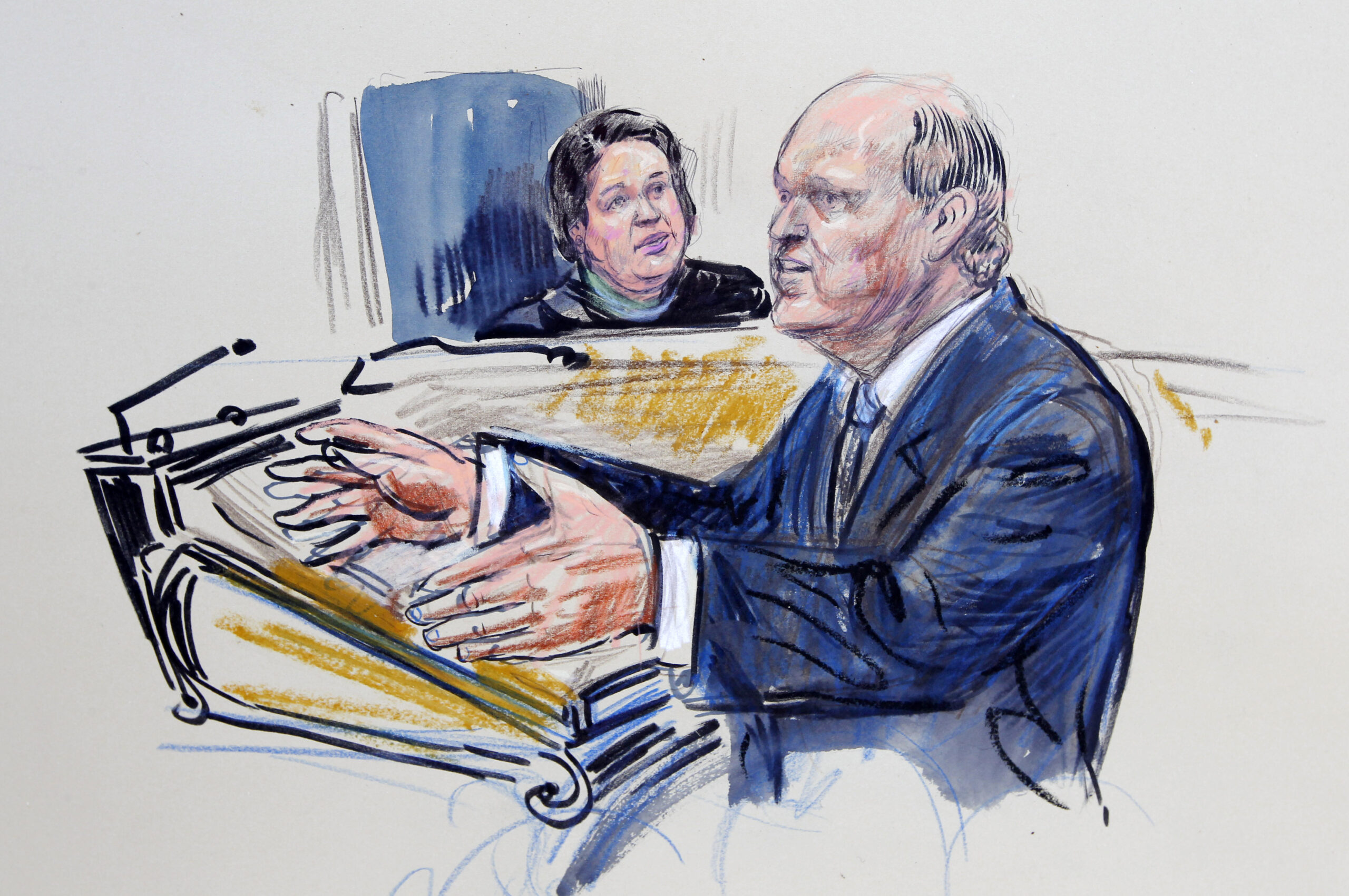
President Obama warned the Supreme Court today not to hold Obamacare unconstitutional, saying he can’t imagine that an “unelected group of people” would “not take what would be an unprecedented, extraordinary step of overturning a law that was passed by a strong majority of a democratically elected Congress.”
In fact, as Harvard Law graduate Obama surely must know, the Supreme Court has often ruled legislation approved by Congress and signed by presidents to be unconstitutional, beginning with the famous Marbury v Madison case in 1803 in which Chief Justice John Marshall wrote the opinion that established the High Court as having the final word on such issues.
Recommended Stories



But there is another aspect of the Supreme Court’s consideration of the Obamacare challenge brought by 26 states and the National Federation of Independent Business (NFIB) that the president likely won’t be discussing any time soon.
Obama has appointed two members of the present court, Justice Sonia Sotomayor in 2009 and Justice Elena Kagan in 2010. As it happens, Kagan was Obama’s Solicitor General when Obamacare was conceived in the White House in part with her legal input and in part with her tactical advice as it was being debated in Congress.
As a result, there have been multiple suggestions that Kagan should recuse herself from participating in the Court’s Obamacare deliberations. Kagan has not done so, however, and was an active participant in last week’s three days of hearings on the issue.
If Kagan did recuse herself from the Obamacare case, the court would be reduced from nine to eight members, which could leave the Court deadlocked 4-4. In that event, Obamacare would remain on the books. (Thanks to reader Kellihodge88 for reminding me that it could also come out 5-3, presumably depending on how Justice Kennedy comes down).
Judicial Watch – the public interest legal advocacy group that filed Freedom of Information Act (FOIA) requests in 2010 which revealed Kagan’s active participation in the administration’s campaign for Obamacare – is not now calling on the newest member of the Court to recuse herself.
But Tom Fitton, the group’s president, did call on Kagan last week to follow a precedent set by Justice Antonin Scalia several years ago in which he provided a detailed public explanation of why he chose not to recuse himself in a case from which some critics said he should have withdrawn.
In a March 22 letter to Kagan, Fitton wrote:
“During your confirmation process, you wrote that you would ‘consider carefully the recusal practices of current and past Justices’ as well as consult with your colleagues if questions about recusal in particular cases arose. Judicial Watch believes that it would be of substantial benefit to the Court’s consideration of the legal challenges to the PPACA if, like Justice Scalia in the NEPDG matter, you were to address the facts surrounding your tenure as Solicitor General and the enactment and subsequent legal defense of the PPACA as they ‘existed,’ not as they are being ‘surmised or reported,’ as well as provide an articulation of your reasoning behind any decision regarding recusal.”
For the complete text of the Judicial Watch letter and a timeline of events surrounding the Kagan recusal issue, go here.
