

I wanted Ben Sasse to be president of the United States. Since he has been diagnosed with stage 4 pancreatic cancer, that is unlikely to happen. A tragedy for him and his family, obviously, but a tragedy, too, for the country he might have led.
I know Ben is a Washington Examiner reader, so I am going to let him read his own obituary now. Lots of people know the former Republican senator from Nebraska better than I do, but I will try to give you (and him) a sense of why he is a big deal beyond the U.S.
Stay informed.Stay ahead.
Join Washington Examiner for unlimited access to the news, analysis, and commentary that matter most.
Already a member? Log in
Sasse is five months younger than I am. My first thought when we met was that he had used his years much more effectively than I had, and that I needed to get moving. Most of us are, I think, disproportionately affected by the deaths of exact contemporaries; and it goes harder in this case because our children are also the same age — we each have two daughters in their early 20s and then, after long gaps, one son.
Sasse is giving the rest of us a masterclass in meeting our end with grace, courage, and dignity. As with every chapter of his life, he is buzzing with original observations, combining gallows humor with religious faith. As he keeps telling us, we are all on the clock; he just has a clearer idea of the timing.
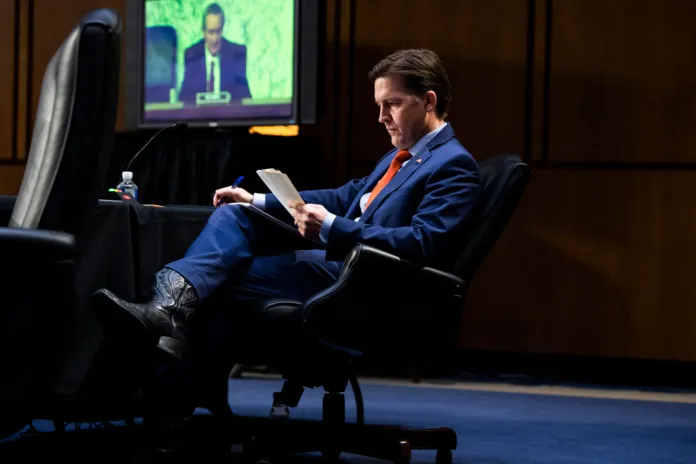
Rather than his death, I want to write about his life as a public figure and (if such a thing can be said of a fifth-generation Nebraskan) a public intellectual. Sasse embodies one of the things I love about Americans, namely, the way they can be at once ordinary and completely extraordinary.
If I were setting a novel in a small heartland town, I might give it a name like “Plainview, Nebraska”. Sasse grew up there, the son of a football coach — a profession he says he wishes he had pursued himself. He was top of his class and went on to get degrees from Harvard, St John’s, and Yale. We were briefly at Oxford at the same time. Although he is always the smartest man in the room, Sasse never lets you know it.
He is the most unpompous man I know. Lots of politicians can turn on the charm, but he has that amiability that comes from unfeigned interest in others. While in the Senate, he worked as an Uber driver, partly to understand how the economy was changing, but mainly because he liked chatting to people.
Sasse has a uniquely practical streak for an academic historian. His last job before the Senate, while still in his 30s, was turning around an almost bankrupt college in Nebraska, more than doubling its student body.
For Sasse, politics is didactic. Most candidates are wary of disagreeing with their voters, but he relished the chance to change minds. I once watched him explain to an audience of skeptical Nebraskan cattlemen why free trade was in their interest. By the time he sat down, they were eating out of his hand.
Sasse’s principled conservatism infuriated the Make America Great Again base. During the 2016 primaries, in one of the first signs of how the Republican Party was about to change, he asked Donald Trump on Twitter: “Will you commit to rolling back Exec power & undoing Obama unilateral habit? These r sincere questions & I sincerely hope u answer rather than insult.” The reply? “@BenSasse looks more like a gym rat than a U.S. Senator. How the hell did he ever get elected?”
Trump’s presidency played out as Sasse had feared. He voted against the first impeachment attempt, but drew the line at backing the Jan. 6, 2021, criminality. He took the view that personality cults are unconservative, a position which (proving his point) enraged the Nebraska GOP leadership. “Politics isn’t about the weird worship of one dude,” Sasse told them.
In 2023, he quit the Senate to become a successful president of the University of Florida. Relieved at being away from the front line, he focused on how people should adapt to the artificial intelligence revolution.
DAN HANNAN: THE CURIOUS BIRTH OF ENGLISH AMERICA
We are naturally drawn to an eloquent man discussing his impending death. More immediate, though, is Sasse’s message that, instead of fretting about politics, we should sort out our own families and communities.
Asked what his last wish for America was, he replied, “I’d like a lot more dinner tables to turn off the devices, put them out of the room, pour a big glass of wine, break bread together, and wrestle with some really grand questions about what you’re building for your family.” Amen, Ben. Amen.
