President Donald Trump‘s campaign promise to boost domestic oil and gas production and “drill, baby, drill” has run into significant obstacles in the form of higher supply chain costs and volatile oil markets, seeding doubt that the industry could meet that call.
True, crude oil production hit records in 2025, and it is agreed that Trump is a greater friend to the oil and gas industry than his predecessor, former President Joe Biden. And Trump has kept his promise to lift burdensome environmental regulations imposed by the Biden administration by pulling back regulations and policies limiting liquefied natural gas exports, blocking drilling on federal land, and more.
Recommended Stories
But production has not quite responded as hoped, at least not yet. The administration’s energy analysis arm is now predicting that production will fall in 2026. And nor has the industry prospered: Several oil majors saw their profits decline in the last year.

Some of the problem is attributable to market swings, though federal policy does play a key role in how quickly oil and gas firms are able to expand their operations and increase production over a longer period of time.
But Trump administration policies have also played a negative role. That includes Trump’s efforts to increase oil supply elsewhere in the world to bring down prices. His tariff policies, too, have limited smaller producers from investing in new projects.
Pro-industry: Reversing Biden rules
Trump began initiating his pro-fossil fuel agenda on his first day in office by declaring a national energy emergency and issuing executive orders focused on increasing domestic oil and gas production.
This included rescinding several environmental regulations issued under the Biden administration, which were meant to limit oil and gas development on federal lands and waters and accelerate the deployment of cleaner alternatives, especially renewable energy.
“I would say that this administration is much friendlier to our industry,” Kim McHugh, vice president of Chevron’s shale and tight base business, told the Washington Examiner.
“It’s allowed us to be able to do some things that maybe we could not have done in the past,” she said. “We’re going to work under any administration we have. But I would say, yeah, there’s been some things that make this a bit friendlier for our industry. … That’s obviously nice to work in.”
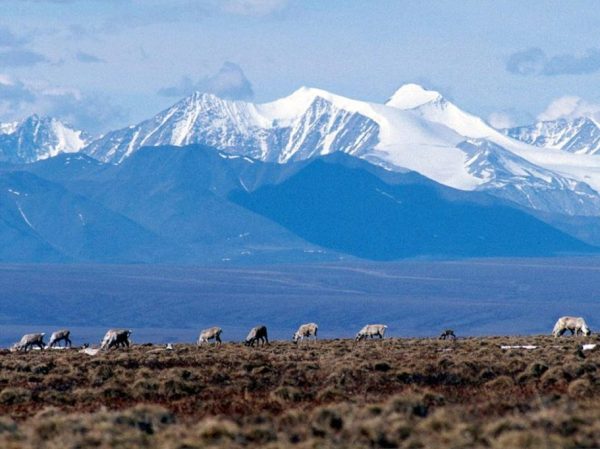
In Alaska, for example, the Biden administration cut the amount of acreage available for leasing in the Coastal Plain of the Arctic National Wildlife Refuge over risks to the environment and surrounding wildlife. In 2024, oil and gas development was barred on roughly 1.2 million acres of the 1.6 million-acre region.
Trump and his Cabinet have since moved to fully open the state to fossil fuel production, making the entire Coastal Plain available to leasing. The Bureau of Land Management will hold its first lease sale for the region in June. The administration has also lifted environmental protections in the National Petroleum Reserve of Alaska and has moved to facilitate fossil fuel projects, such as a liquefied natural gas pipeline stretching across the state.
During his presidency, Biden also restricted LNG exports. He paused approvals on new export terminals, a move justified as allowing the administration to study the environmental and economic effects of increased exports.
Trump rescinded this pause on his first day in office, instructing Energy Secretary Chris Wright to restart reviews of applications as quickly as possible.
“The Biden administration not allowing these facilities to get built is just a horrendous handicap for all of the world, because it’s going to take billions of dollars and years to be able to get those facilities up and pipelines built to get them the gas,” said Kirk Edwards, former chairman of the Permian Basin Petroleum Association.
The One Big Beautiful Bill Act, signed into law in July 2025, also lowered oil and gas drilling royalty rates back to 12.5%. Royalty rates are a percentage of profits made from the production of oil and gas extracted on federal lands that is paid to the U.S. government. Those funds are traditionally given back to local communities and states, supporting infrastructure growth.
The rates had been increased to around 16.67% by the 2022 Inflation Reduction Act, the signature Democratic domestic policy bill signed by Biden. Returning the rates to pre-IRA levels essentially makes it cheaper for oil and gas firms to drill on public lands.

“The previous administration did so much destruction so fast when they came into office that was almost unrecoverable as an industry,” said Jack Shepherd, vice president of Mountain States Oilfield Services.
While embraced by the industry, these policy changes only appear to have a marginal influence on operators’ plans to increase crude and natural gas production on federal lands in the next five years.
In September 2025, a quarterly survey released by the Federal Reserve Bank of Dallas found that roughly 58% of oil and gas executives surveyed said the changes would slightly increase their oil production. Around 55% said it would slightly increase their gas production on federal lands. Meanwhile, 36% and 38% said it would result in no change to their oil and gas production, respectively.
“In production, [presidents] influence it over the long term well after they’re in office,” an industry source told the Washington Examiner. “It’s those leases, it’s the access, it’s the regulatory changes, and those kind of reforms that pay dividends years later, not next month or next quarter.”
Removing the threat of environmental regulations and higher fees does lift a burden off large and small producers looking to expand their operations. But as drilling new wells is a monthslong endeavor worth millions of dollars, very few are likely to make new investments immediately, particularly as other policies and external factors, such as global markets, have a greater influence on their willingness to take on new projects.
Plummeting prices
During his campaign, Trump made two key promises related to the fossil fuel industry: that he would promote “drill, baby, drill” and slash gasoline prices. The second promise can only occur, however, if oil prices drop, which is not in drillers’ interest.
Oil prices fell significantly throughout 2025, with the monthly average price of international benchmark Brent crude hitting a low of $63 per barrel in December — the lowest monthly average price since 2021.
The Energy Department’s Energy Information Administration has said this decline was primarily due to global supplies outpacing demand — driven by slow economic activity and OPEC+’s decision to ramp up production throughout the year.
With prices that low, drilling was not profitable for many producers. Because of the low prices, 2025 was “not a good year for the independent oil community” across the country, Edwards told the Washington Examiner.
Prices dipping as low as the high $50s “kept everybody on the sidelines from doing any additional drilling whatsoever,” Edwards said.
“The term ‘drill, baby, drill’ went away very quickly after the administration came in, and it turned into more ‘wait, baby, wait,’ because the economics of drilling $60 oil are just not very good,” he said.
While the industry is able to maintain production levels around the $60-per-barrel mark, many executives have warned that companies will be unable to expand operations with those prices. Vicki Hollub, CEO of U.S. independent oil producer Occidental, told Reuters in February that crude needs to sit near at least $70 per barrel to grow.
Oil prices are a fungible global commodity and are primarily set on a global market. But geopolitical tensions and federal policy can influence investor sentiment and trader fears. Even direct pressure from leaders such as Trump can have a significant influence on global prices.
In January 2025, Trump said he would be directly asking Saudi Arabia and OPEC to “bring down the cost of oil” by increasing production. At the time, both domestic and international crude oil prices fell by around 1%.
Last year, key Cabinet officials, including Wright, encouraged similar policy, saying that domestic producers would be able to increase production at $50 per barrel.
“New supply is going to drive prices down,” Wright told the Financial Times. “Companies are going to innovate, drive their prices down, and consumers and suppliers will bounce back and forth.”
The administration has advocated that the industry boost supply with lower prices by utilizing more efficient drilling tactics and embracing artificial intelligence.

Several oil majors, such as Chevron, have already begun using AI and other tools, allowing them to increase and stabilize their production levels with fewer drilling rigs and wells. As a result, the U.S. hit record annual production of around 13.6 million barrels of crude a day in 2025.
It is unclear how sustainable it will be to expand production with volatile prices, particularly as smaller producers may not have as much access to these tools. The EIA is now predicting U.S. production will fall in 2026 to 13.5 million barrels per day.
Trump’s tariffs
Early last year, oil prices were also heavily influenced by uncertainty around U.S. trade policy and fears that Trump’s sweeping tariffs would trigger a global trade war.
In April 2025, Trump issued “reciprocal tariffs” for most countries, with a 10% baseline rate and higher rates for select nations. He also later issued tariffs on products such as steel and semiconductor chips to encourage domestic manufacturing of the materials.
While the Supreme Court has since struck down the sweeping “Liberation Day” tariffs, the administration has moved to replace them with other means, and the levies on aluminum and steel remain in place, as they were implemented under a different law.
For several independent operators, however, these tariffs have significantly increased their supply chain costs. In May 2025, Karr Ingham, president of the Texas Alliance of Energy Producers, told the Washington Examiner that one member in the Permian Basin saw their steel-piping costs from the same supplier jump by more than 100% after the tariff announcements.
This combination of lower barrel prices and higher operating expenses has made it difficult for some smaller companies to expand their operations.
“Since Trump got in office, we’ve gotten crushed,” said Dan Doyle, president and owner of fracking firm Reliance Well Services and Wyoming-based operator Arena Resources.
“The rig market is tightening,” he said.
Between January and May 2025, Doyle’s fracking company received just six jobs. Over the same period in 2024, his company received 40.
“We lost money,” Doyle said. “Two years in a row we lost money, and we are fully anticipating we’d be losing money again.”
Meanwhile, many large oil companies, such as Chevron, appear to be relatively insulated from the tariffs.
“We actually had pre-purchased a lot,” McHugh told the Washington Examiner. “So we were not as impacted as those were happening, as a lot of others who were maybe purchasing at the time of the tariffs.”
Funding pauses
Federal policy does not just affect oil and gas producers’ ability to increase drilling. It can also limit or expand other aspects of their operations, such as plugging abandoned wells.
Plugging orphaned wells is a crucial step at the end of a well’s life, typically when it is no longer economically viable for a company to continue producing oil and gas from the well.
Once abandoned, the wells can pose significant environmental risks to surrounding areas, with the potential to contaminate water supplies or emit methane and other pollutants. If fully abandoned by an operator, plugging the well often becomes a financial burden for local and federal governments and taxpayers.

Shepherd, whose company works with the federal government to plug orphan wells, told the Washington Examiner that when the Trump administration paused funding and grants approved under Biden early last year, his plugging operations were all put on hold.
“When DOGE came in, everything stopped,” he said, referring to the Department of Government Efficiency’s efforts to cut wasteful government spending, which coincided with many grant pauses.
“It’s been completely idle for just over a year,” he said.
In early April 2025, officials from states including Oklahoma, New Mexico, and Texas said the $4.7 billion orphaned well program was paused at the start of the administration, leaving thousands of abandoned oil and gas wells in limbo.
While the funds were ultimately unfrozen and the Trump administration has since emphasized the program’s importance, the uncertainty around the funding appeared to delay deals expected by oilfield service companies.
“As DOGE came in, departments stopped doing processing, because they were focused on everything else,” Shepherd said, adding that his company just finalized its first project with the Trump administration in March.
“We’re just getting started again, but we’re hoping that everything’s going to ramp up this year,” he said.
What’s still desired
Despite these challenges, there is still a general consensus among large oil and gas firms and smaller producers that current conditions are far better than they were under the Biden administration.
A White House official confirmed to the Washington Examiner that administration officials held a call with a dozen oil and gas executives on Thursday, who represented majors and independent producers such as Chevron and Diamondback Energy, all of whom thanked the president and his team for their action thus far.
The official revealed that executives said it has been a “night and day” difference from the Biden administration.
“Joe Biden spent the past four years trying to kill the oil and gas industry and shut out oil producers,” White House spokeswoman Taylor Rogers said. “When President Trump returned to office, he immediately rolled back burdensome Biden regulations to unleash American energy. President Trump and his entire energy team are always working with the industry to ensure they have the resources necessary to ‘DRILL, BABY, DRILL.’”
For some smaller producers, however, there is still more the administration can do to support the industry, including ending its urging to bring oil down to $50 a barrel and advocating crude to rest around $60 and $70 a barrel.
PHOTOS: OIL AND GAS DRILLING IN THE AGE OF RECORD PRODUCTION
Others have said there should be increased policy focused on expanding pipeline infrastructure in regions such as the Permian Basin to support increased LNG exports, particularly amid global supply disruptions due to the Iran war.
“The Permian can help the entire world out there, but you just have to have good, sound policy ahead to get that done,” Edwards said. “And that’s what the administration can come back and start working with the domestic producers, as opposed to asking OPEC to do this like they have done in the last year.”